
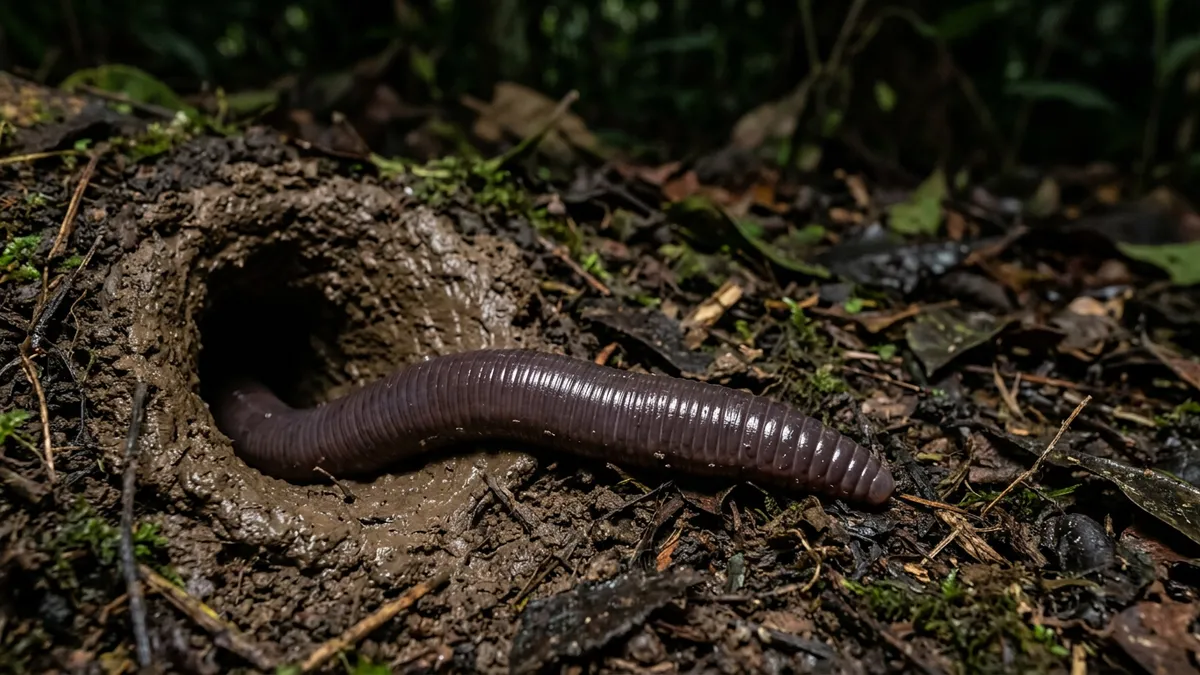
In a patch of Amazonian soil, the transformation can start almost unnoticed. The giant Amazonian earthworm opens vertical and horizontal galleries that reach nearly 10 feet (3 meters) deep, forming a network of passages inside the ground. The animal can grow to 6.6 feet (2 meters) in length, a size that helps explain the scale of these underground structures.
Rather than simply passing through the soil, it creates pathways that stay open for longer and change how essential elements circulate for the roots and for the organisms living below the surface.
A burrow that reaches nearly 10 feet down
The galleries do not all serve the same purpose. Some extend vertically, linking the surface to the deeper layers, while others run horizontally, spreading the effects of the digging. When these passages are permanent, they receive a lining of hardened mucus that helps them keep their shape.
The resulting structure works as an internal route for the movement of water and air. The presence of the earthworm is therefore not limited to the body that shows up in the soil. The main environmental effect lies in the set of channels it builds and maintains over time.
An animal that links soil, water and air
Rainwater finds different paths through the ground when deep galleries exist. Instead of staying concentrated at the surface, it can seep down through the channels opened by the giant Amazonian earthworm. The entry of air is equally relevant, because the underground layers gain better communication with the surface. This mechanism creates more favorable physical conditions for a soil that needs to absorb water and keep open, porous spaces.
The effect does not depend on one isolated passage. Vertical and horizontal galleries form a network, and the structures lined with hardened mucus can stay open. The combination of depth, permanence and distribution of the channels explains why the animal is associated with better soil conditions.
For plants and soil organisms, the benefit is indirect but concrete: roots and underground life depend on water and air moving through the ground. When channels connect the surface to the deeper layers, those two elements are no longer limited to the top of the soil. An animal that can reach 6.6 feet (2 meters) builds on a scale that matters to the soil around it, which is why its galleries are described as a network and not as isolated holes.
The earthworm acts as a biological digger, but its contribution goes beyond turning over the earth. It reorganizes the internal spaces, makes it easier for water and air to enter, and carries organic matter and nutrients to different points of the underground profile.
A nocturnal routine with a fertilizing effect
Although it spends much of its time in the underground environment, the giant Amazonian earthworm also comes out at night to forage on the surface. This nocturnal emergence lets the animal look for food outside the galleries without staying exposed during the brightest hours. The outing is part of its feeding routine, connecting the material found on the soil with the deep space where the earthworm lives. Moving between these two zones makes the animal an agent of transfer within its own environment.
Seen as a whole, the work comes in three steps: the earthworm digs, feeds on the surface at night and returns nutrients to the ground. Each step leaves a trace in the soil, and together they tie the surface to the depths.
After processing its food, the earthworm releases excreta known as coprolites. This material is rich in nutrients and helps fertilize the soil. The link between surface foraging, passage through the animal’s body and the deposit of coprolites creates a circuit that moves matter and nutrients through the environment.
It is not just a one-off fertilizing event, but a contribution tied to the animal’s everyday activity. While it digs, the earthworm adds the waste from its feeding to the soil, strengthening the connection between the surface and the underground layers.
A sign of soil quality and recovery
The population of the giant Amazonian earthworm is pointed to as an indicator of soil quality and of the recovery of degraded areas in the Amazon. This reading treats the presence and number of individuals as signs tied to the condition of the underground environment. Where the soil keeps enough structure and resources to sustain the species, the occurrence of the earthworms can offer useful information about the recovery process.
The indicator does not replace other assessments, but it adds a biological component to the analysis of areas that have lost quality.
The reasoning behind the indicator is straightforward. An animal this large needs soil with enough structure to dig its galleries and enough resources to keep feeding. Its presence therefore says something about the ground that a look at the vegetation alone may miss. Counting individuals adds a living measure to the assessment of recovery, one that reflects what is happening underground.
In the Amazon, understanding this kind of activity helps frame soil recovery as a process involving organisms, water, air and nutrients. The giant earthworm is not just a large animal but part of an underground architecture that makes the ground more permeable and better aerated.
Its work takes place out of sight, while the nighttime emergence and the coprolites reveal only part of what happens below. In degraded areas, following these signs can bring observation closer to what really sustains regeneration: life that reorganizes the soil even before the landscape starts to look recovered.
Reporting: Natália Santos / Amazonia Mag

Editor · Amazonia Mag
Anne Silva is the editor of Amazonia Mag, the English-language edition of Revista Amazônia. She curates, translates and adapts the outlet's science and environment coverage for an international audience, reporting on Amazon wildlife, flora, rivers, climate and research. Every story she edits is grounded in peer-reviewed studies, official data and on-the-ground reporting from the Revista Amazônia newsroom in Belém, Pará, Brazil. More by Anne Silva →