
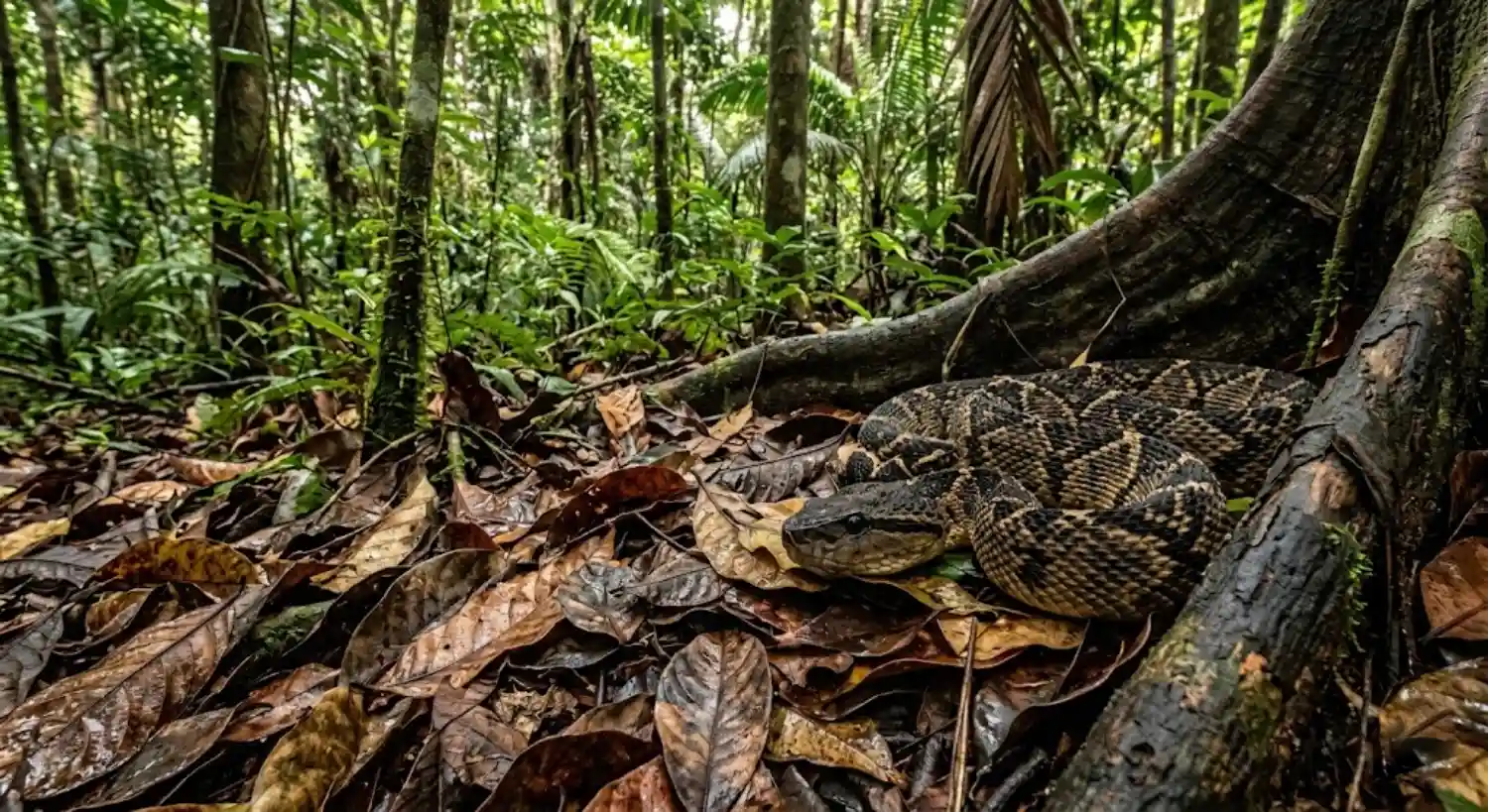
Lachesis muta, commonly known as the bushmaster or surucucu-pico-de-jaca, occupies an exceptional place among the reptiles of the Americas. It is the largest venomous snake in the region and can reach an impressive total length of 3.5 meters, or about 11.5 feet (3.5 meters). Its size alone would make it remarkable, but the species also has the largest venom glands of any viper in the world.
A single animal can store hundreds of milligrams of toxins. Unlike other snakes that limit their biological production, the bushmaster uses a high-pressure delivery system that, combined with its body mass, makes it one of the most efficient predators in Brazil’s Neotropical fauna. Its intimidating appearance is therefore the outcome of a long and complex evolutionary history.
Fangs built for a powerful strike
To understand the snake’s impact on its ecosystem, it is essential to examine its highly specialized solenoglyphous dentition. This system represents one of nature’s most advanced forms of biological weaponry. The bushmaster’s fangs are hollow, retractable teeth positioned at the front of the upper jaw, where they work much like hypodermic needles.
When the mouth is closed, the fangs fold back against the roof of the mouth. During a strike, the jaw projects at an angle exceeding 90 degrees, causing the teeth to rise and penetrate deeply into the prey’s tissues. Venom can then be delivered with remarkable efficiency through a combination of anatomical precision and physical force.
A comparison with other familiar snakes helps put this capacity into perspective. A common lancehead injects an average of 40 to 60 milligrams of venom in a defensive bite. Lachesis muta, by contrast, can release more than 300 milligrams in a single strike.
This abundance is not simply an exaggeration of nature. It is an adaptation that allows the snake to subdue medium-sized mammals, such as pacas and agoutis, quickly in dense vegetation. In the forest, tracking prey after a strike can be difficult because of uneven ground and leaf litter. Efficient venom delivery therefore supports successful predation.
The scales behind its common name
The name surucucu-pico-de-jaca refers to the unusual texture of the snake’s dorsal scales. Unlike most snakes, whose scales are smooth or only slightly keeled, the bushmaster has rigid, cone-shaped projections that resemble the rough skin of a jackfruit.
This morphological feature contributes to disruptive camouflage. The animal can blend into shadows, dead leaves and irregularities on the floor of primary forest. Its texture combines with brown and yellow coloration to create an optical illusion that is highly effective against both prey and inattentive observers.
The result is a classic example of mimicry in which the relief of the skin and the color pattern break up the animal’s outline. The bushmaster’s camouflage does not depend on color alone. It also depends on how the textured surface changes the way the snake appears among roots, branches and accumulated plant material.
In such an environment, an observer may see only another irregular shape on the forest floor. The same concealment helps the snake remain close to potential prey while reducing the chance of being detected. Its skin is therefore not merely a protective covering, but part of a broader predatory strategy.
An unusual reproductive strategy
In reproductive biology, the bushmaster stands out among the vipers of the Americas. Most members of the family Viperidae found in Brazil are viviparous, meaning that they give birth to fully formed young. Lachesis muta, however, is oviparous.
The female lays her eggs in protected locations, often inside abandoned armadillo burrows. She then remains coiled over the clutch for weeks. Her presence protects the eggs from predators and helps maintain the moisture required until hatching.
This type of parental care is extremely rare among snakes. It also reveals a behavioral complexity that continues to challenge researchers who study animal behavior. In a species often feared for its venom and size, guarding the clutch exposes a lesser-known dimension of its natural history.
The reproductive behavior adds another layer to the evolutionary story of the bushmaster. Its specialized fangs and venom are only part of the picture. Nest protection, camouflage and the use of sheltered sites show how anatomy and behavior work together in the life of a forest predator.
Venom, medicine and mature forests
The importance of this snake to public health and modern pharmacology is immeasurable. Lachesis envenomation can be severe because of the combined action of proteolytic, coagulant and neurotoxic substances. At the same time, studying these compounds has supported the development of new medicines.
According to established biological knowledge, complex venoms are living chemical libraries. Their components can provide valuable information for medical research. Protecting the bushmaster and the dense forest habitat where it lives preserves the possibility that future research may isolate compounds capable of treating cardiovascular and blood-related diseases.
In this way, a potential danger can become a solution that benefits human life. Conservation is not only about preventing the disappearance of a feared species. It also protects a biological heritage whose value may extend to medicine and to the study of evolution.
The conservation of Lachesis muta is inseparable from the conservation of mature forests. As a specialist species, it requires large areas of intact forest and stable temperatures. For that reason, it serves as an indicator of environmental quality. Where the bushmaster thrives, the forest retains its original structure and its complete food web.
A sign of balance in the rainforest
Coexistence between people and this remarkable reptile depends fundamentally on respecting its territory and understanding its role. The bushmaster is not a gratuitous threat. It is a vital component of the ecosystem that helps regulate rodent populations and supports the health of tropical forests.
Thinking about the bushmaster also means reconsidering our relationship with the unknown. Fear of powerful creatures can prevent us from seeing the beauty of their biological engineering and the vulnerability of their survival in the face of deforestation.
When we examine the precision of its fangs and the texture of its skin, we can recognize that every part of Amazonian biodiversity has a purpose that extends far beyond immediate human usefulness. The bushmaster is part of a living mosaic that deserves protection for generations.
Its presence indicates a forest in balance. As a top predator among terrestrial reptiles, it controls populations of small mammals that, in excessive numbers, could interfere with tree regeneration by consuming too many seeds. Protecting this snake is therefore an indirect strategy for securing the continued renewal of Amazonian flora and maintaining ecosystem services that quietly benefit the entire planet.
Reporting: Anne Silva / Amazonia Mag

Editor, English Edition — Amazonia Mag
Anne Silva is the editor of Amazonia Mag, the English-language edition of Revista Amazônia. She curates, translates and adapts the outlet's science and environment coverage for an international audience, reporting on Amazon wildlife, flora, rivers, climate and research. Every story she edits is grounded in peer-reviewed studies, official data and on-the-ground reporting from the Revista Amazônia newsroom in Belém, Pará, Brazil. More by Anne Silva →