
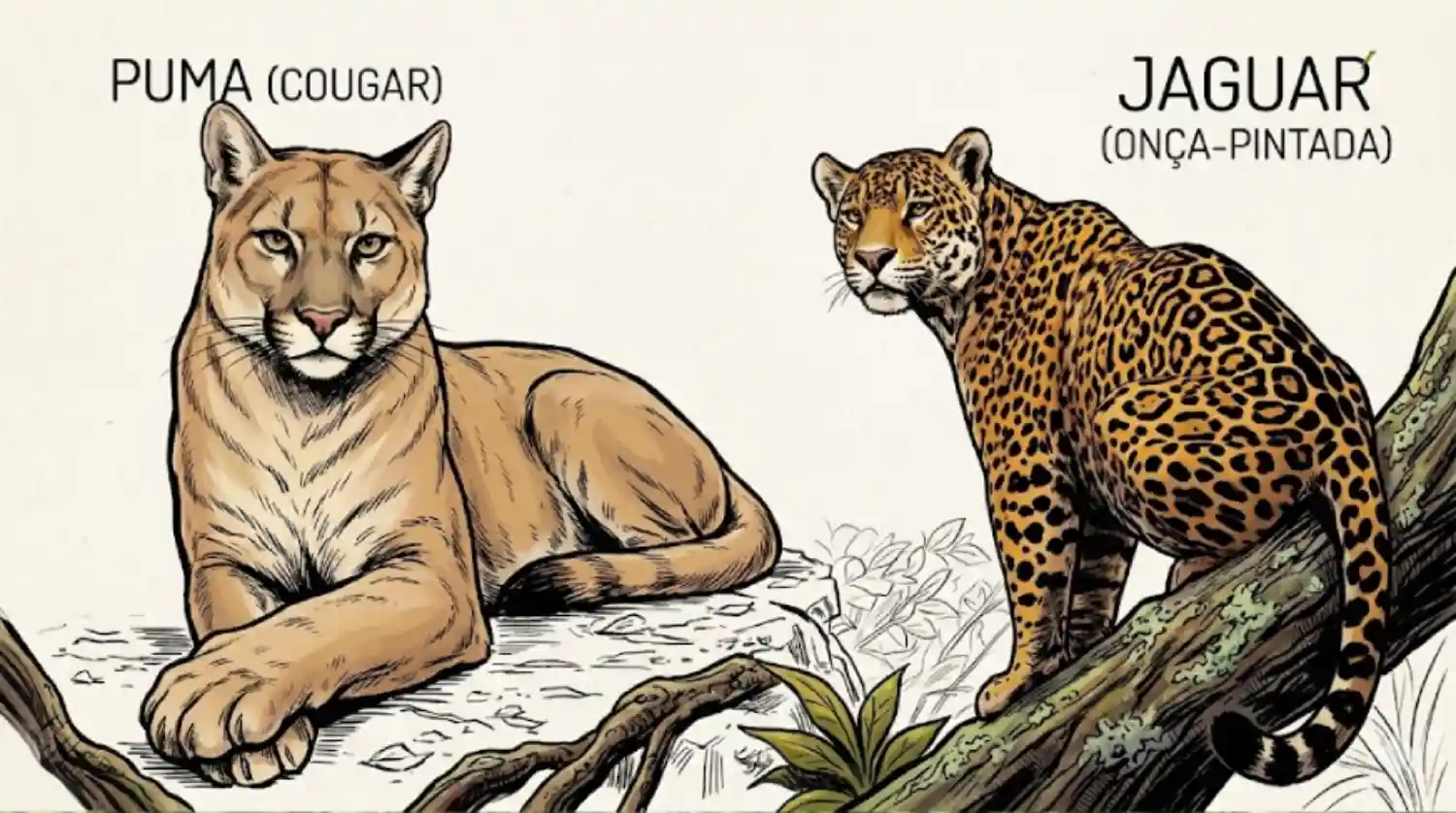
The jaguar (Panthera onca) and the puma (Puma concolor), also known as the cougar, are the two largest cats in the Americas. Although their territories overlap across parts of their geographic ranges, these top predators do not usually turn that proximity into a constant struggle.
Their coexistence is particularly striking because both species occupy similar positions within their ecosystems. Both hunt, require broad areas and depend on resources available across the landscape. Even so, they rarely interact directly unless a localized dispute over prey occurs.
Coexistence through niche separation
Sharing a region does not mean that jaguars and pumas use every resource in exactly the same way. Evolution has shaped behaviors that reduce direct contact, allowing both cats to use the same landscape without one eliminating the other.
Niche separation appears in several forms. The species can differ in the hours when they move, the size of the prey they pursue and the specific places they favor within a shared territory. Taken together, these differences reduce direct competition.
According to studies of their activity patterns, jaguars tend to be more active at night, especially during the darkest hours. Pumas show greater flexibility and can be active during both daylight and nighttime, with activity peaks frequently observed around dusk and dawn.
This difference in timing creates a kind of division across the day. Even when both animals use the same region, they do not necessarily occupy the same places at the same moments. As a result, the chances of direct encounters decline, along with the risk of confrontations that could harm either predator.
Different prey, less competition for food
The jaguar’s powerful bite and sturdy build allow it to take larger prey. That group includes capybaras, caimans, white-lipped peccaries and tapirs. Its physical strength is associated with the ability to bring down animals that are larger than the prey more commonly pursued by the puma.
The puma, in contrast, is more agile and slender. It tends to focus on small and medium-sized prey, including deer, collared peccaries, armadillos and smaller rodents. The diets are not completely separate, but this preference for different prey sizes reduces direct competition for the same animals.
This distinction should not be understood as an absolute division. Some overlap can occur in the prey used by both cats, particularly when resources are shared within the same landscape. Still, each species’ tendency toward certain prey sizes helps distribute feeding opportunities.
The specialization also shows that coexistence does not depend only on avoiding physical encounters. Different use of food resources allows two top predators to remain in the same ecosystem and find ways to survive without competing constantly for everything available.
Two ways of using one landscape
Jaguars have a strong association with aquatic environments and dense forests. They tend to favor areas near rivers and lakes, where their main prey are abundant. This relationship with water and thick vegetation shapes an important part of how they use space.
Pumas are known for greater adaptability in their habitat preferences. They can occupy a wider range of environments, including more open areas, rocky formations and secondary forests. In this way, they do not depend on exactly the same microhabitats as jaguars, even when both species occur in the same region.
The difference is subtle but ecologically important. A shared territory can include river edges, dense vegetation, open areas, rocks and sections of secondary forest. Each cat can concentrate its activity in a different combination of these settings and use resources that are not identical.
This spatial division adds to the division in time and to the difference in prey size. The result is a quiet coexistence in which geographic proximity does not require constant interaction. The cats share the landscape, but not necessarily every hour, every prey animal or every part of the territory.
Protecting habitat to preserve coexistence
The coexistence of jaguars and pumas is a sign of the complexity and resilience of natural ecosystems. It is not simply a matter of avoiding fights. It is an evolutionary strategy that makes the use of available resources more efficient.
Biodiversity can thrive when species specialize and adapt. In this case, niche differentiation allows two top predators to occupy the same ecosystem without eliminating each other. Their coexistence shows that competition does not always lead to exclusion. It can also be reduced through different ways of using time, space and food.
For this balance to continue, protecting large areas of continuous habitat is essential. Forest fragmentation can force the cats into more frequent interactions, increasing competition and the risk of conflict between them.
For that reason, conservation efforts must focus on protecting ecological corridors and maintaining ecosystem integrity. These actions are essential not only for the individual survival of jaguars and pumas, but also for preserving the complex ecological interactions that support healthy forests.
Understanding how these two large cats share resources offers valuable lessons for biodiversity conservation. Recognizing the importance of niche differentiation can support more effective strategies to protect the species and all the elements that make up the ecosystems where they live.
The survival of jaguars and pumas is an indicator of forest health and a reminder of society’s responsibility to preserve the natural balance. Their quiet coexistence shows that nature can find ways for diversity to flourish. It also raises an essential question: if enough space is needed for these complex relationships to continue, will society be willing to protect it?
In summary, jaguars and pumas share territories through niche separation. Jaguars are more nocturnal, prefer larger prey and are associated with areas near water. Pumas have more flexible schedules, focus on smaller prey and adapt to a broader variety of habitats. These behavioral differences reduce direct conflict and competition for resources, allowing both top predators to survive in the same ecosystem.
Reporting: Anne Silva / Amazonia Mag

Editor, English Edition — Amazonia Mag
Anne Silva is the editor of Amazonia Mag, the English-language edition of Revista Amazônia. She curates, translates and adapts the outlet's science and environment coverage for an international audience, reporting on Amazon wildlife, flora, rivers, climate and research. Every story she edits is grounded in peer-reviewed studies, official data and on-the-ground reporting from the Revista Amazônia newsroom in Belém, Pará, Brazil. More by Anne Silva →