
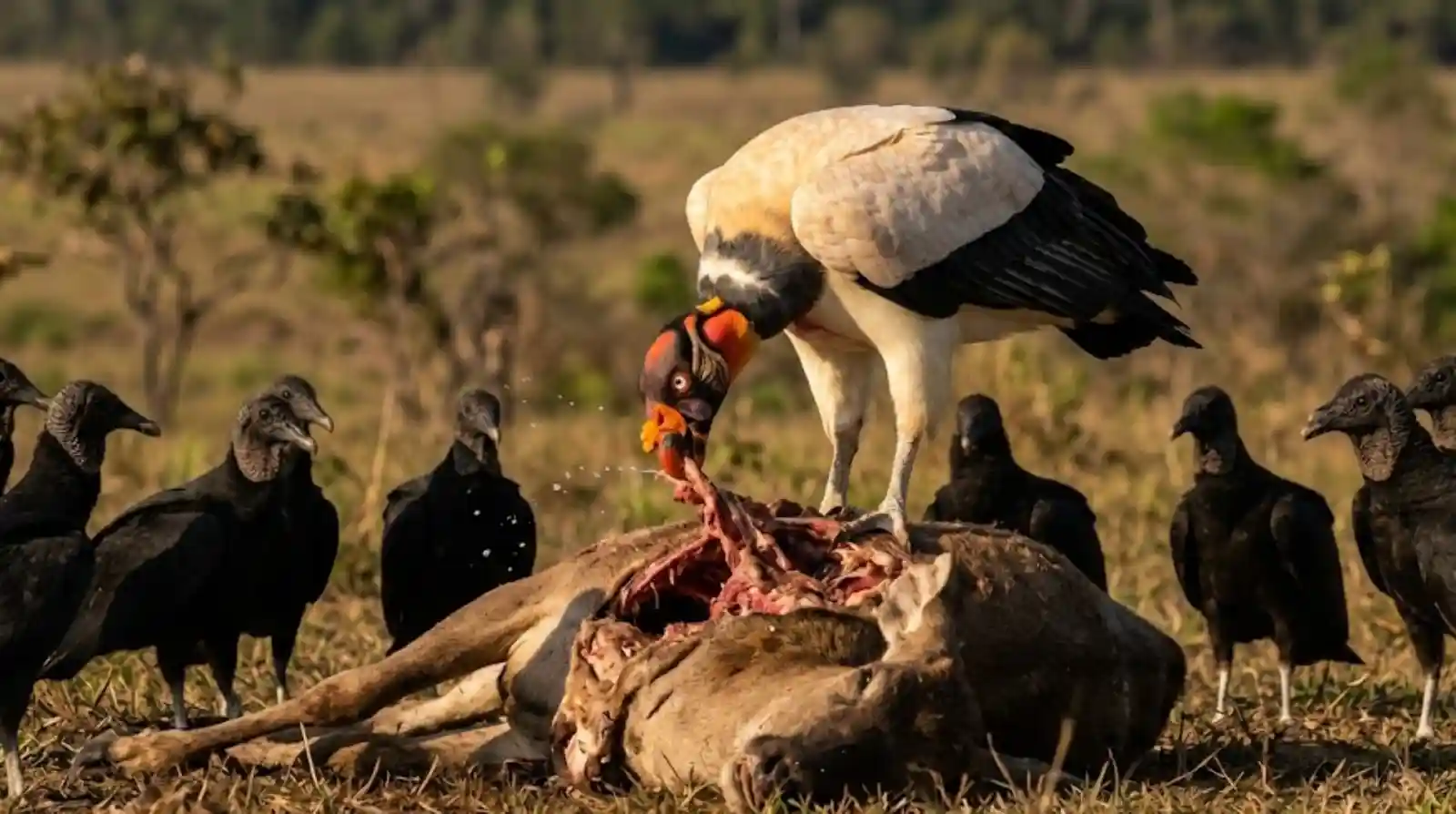
The king vulture, scientifically known as Sarcoramphus papa, is one of the most striking and morphologically distinctive birds of prey in the Americas. Its arrival at a carcass changes the entire dynamic of the site, but its importance extends far beyond appearance or competition for food. The species performs a fundamental and irreplaceable role in maintaining ecosystem health.
Unlike most other vultures, which have dark plumage and relatively subdued heads, the king vulture has a featherless head and neck. Those exposed areas display a vivid palette ranging from intense red to orange, yellow and blue-gray. According to studies of the species, the intensity and brightness of this coloration act as an immediate visual signal of status and dominance within the social hierarchy of these birds.
A color signal around the carcass
In an environment where several vulture species compete for limited food resources, a clear visual signal can reduce the need for costly physical conflict. The king vulture’s coloring is therefore more than a striking feature. It also communicates a position within the social order that forms around a carcass.
The scene shows how competition and cooperation can exist at the same time in nature. The king vulture is the dominant species, although it is rarely the first to find a dead animal. Smaller vultures often locate the carcass before it does, yet the king vulture’s later arrival immediately changes how space and food are distributed.
This pattern reduces expensive confrontations. Rather than relying only on physical fights, the birds respond to visible signals and to differences in body size and structure. The king vulture’s colorful head and larger build reinforce a message of dominance that the smaller vultures recognize when the resource becomes available.
The first arrivals and the bird that opens the hide
The black vulture, Coragyps atratus, and the turkey vulture, Cathartes aura, often find carcasses first because they have extremely well-developed senses of smell. However, these smaller species frequently lack the strength or bill structure needed to break through the thick skin and tough hide of large dead mammals.
That is when the king vulture’s hierarchy becomes especially visible. Its vivid coloration, larger body and exceptionally strong, hooked bill cause the smaller vultures to retreat and make room. The link between visual signaling and physical ability allows the scene to become organized quickly.
The king vulture’s bill is one of the most powerful tools among scavenging birds in the Americas. Its robust structure and extremely sharp, hooked tip are adapted to deliver great force and precision. With them, the bird can tear through tough hide and break cartilage and tendons, reaching parts that the weaker bills of other vultures cannot access.
When the king vulture opens the carcass, it is not merely securing its own meal. It also gives smaller vultures access to the food, allowing them to consume the softer internal parts. In this way, the dominant species performs the most difficult task and helps the resource be used more completely and efficiently by the members of the scavenger guild.
Cooperation that strengthens ecosystem cleanup
This process is described as a form of commensalism. The king vulture receives the direct benefit of opening the carcass, while the other species benefit indirectly from the opening that lets them reach the food. The scene combines competition over priority access with an ecological cooperation that prevents the resource from being wasted.
The work performed by these birds is often underestimated, even though it is vital. By consuming decomposing organic matter, vultures act as nature’s sanitation agents. This ecosystem cleanup service removes carcasses that could become centers for the spread of infectious diseases, including anthrax and botulism.
Their activity also helps control populations of vector insects. Science recognizes that the efficiency of this cleanup service is amplified by the coordinated action of different vulture species. Each occupies a specific niche in the use of the carcass, while the king vulture plays the role of a key that unlocks a resource inaccessible to the others.
Without these birds, nutrient cycles would move more slowly and health risks for other animals, and even for humans, would be significantly greater. The removal of decomposing matter connects the behavior of one species with the broader balance of the Amazonian ecosystem.
Protecting an indicator of forest health
Protecting the king vulture and its habitat is essential to ensuring the continuity of these vital ecosystem services. The species requires large areas of intact forest for nesting and foraging, which is why it is considered an indicator of environmental health.
The degradation and fragmentation of tropical forests directly affect the availability of carcasses and safe places for reproduction. Conserving this bird therefore means more than protecting a magnificent species. It also means safeguarding the integrity of an entire ecosystem that depends on its work to remain clean and balanced.
The complexity of these natural interactions shows why biodiversity is more than a collection of isolated species. The king vulture’s social hierarchy is part of a network in which each animal has a role, and in which a color signal can organize access to a resource that is essential to the community.
A Sarcoramphus papa carcass is not simply a feeding site. It is a stage where ancient social rules and evolutionary adaptations meet to make the recycling of life more efficient. The bird’s colorful head acts as a communication tool that regulates access to food and minimizes conflict, allowing ecosystem cleanup to proceed in a more harmonious and effective way.
Watching a king vulture in its natural environment invites a closer look at the interconnection of living forms. It also shows that cooperation, even when disguised as hierarchical competition, is one of the principles that sustains the health and vitality of the planet.
The existence of such a refined system of signals and social roles around decomposition raises a broader question: how many other invisible rules silently govern life in the forest? The king vulture reminds us that even behavior associated with death participates in the continuation of natural cycles.
Reporting: Anne Silva / Amazonia Mag

Editor, English Edition — Amazonia Mag
Anne Silva is the editor of Amazonia Mag, the English-language edition of Revista Amazônia. She curates, translates and adapts the outlet's science and environment coverage for an international audience, reporting on Amazon wildlife, flora, rivers, climate and research. Every story she edits is grounded in peer-reviewed studies, official data and on-the-ground reporting from the Revista Amazônia newsroom in Belém, Pará, Brazil. More by Anne Silva →