
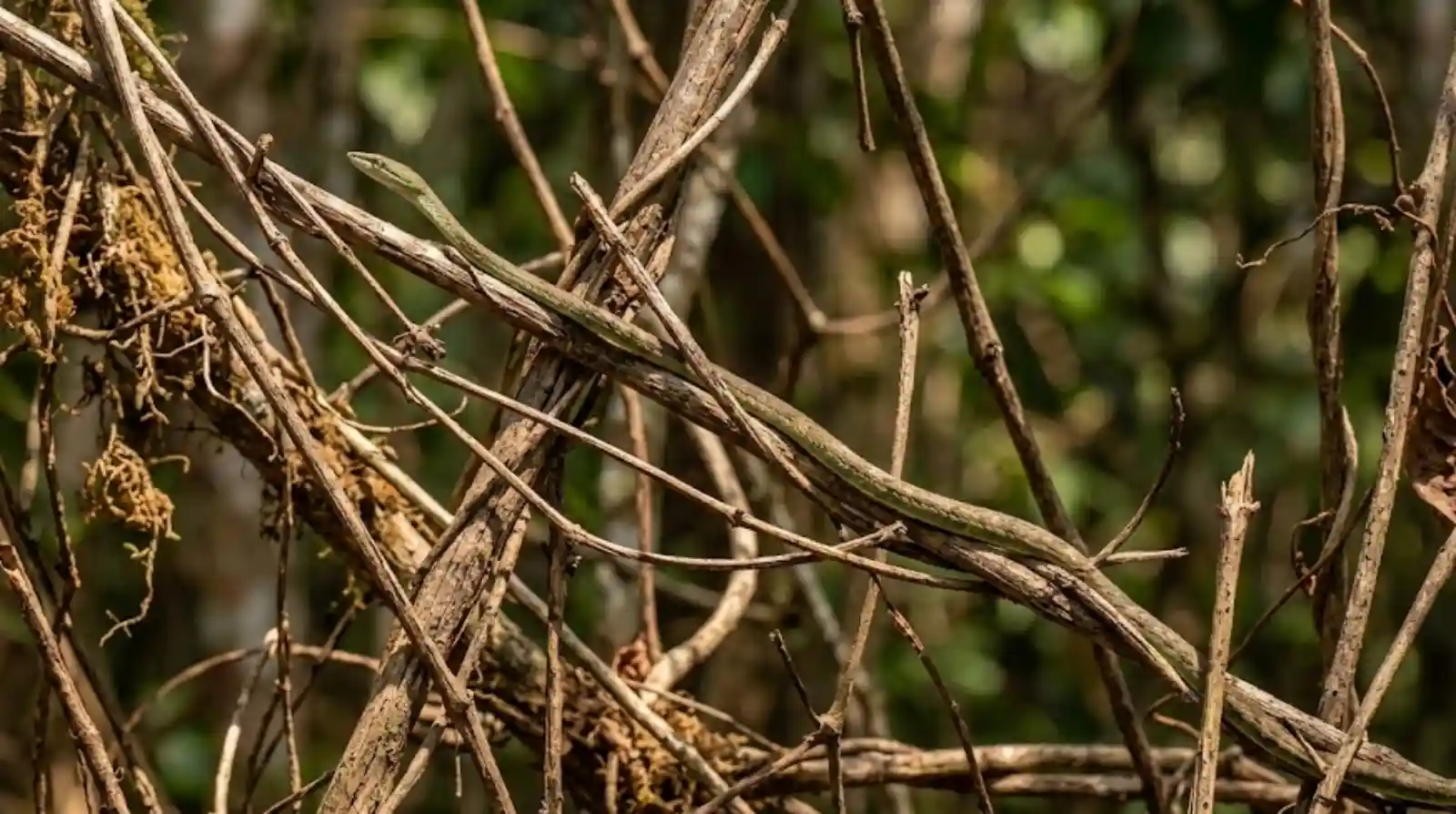
Among all vertebrates, the Amazonian vine snake displays one of the most perfect examples of static mimicry. Its extremely slender, elongated body, combined with coloring that closely reproduces the patterns of vines and dry branches, allows it to remain completely motionless for hours at a time.
The species Oxybelis fulgidus does not rely on color alone to disappear into the forest. Its posture also imitates the curves, irregularities and direction of the surrounding stems, making the snake nearly impossible to detect even for experienced observers moving through the rainforest.
According to studies of the species, this adaptation goes beyond simple visual defense. The snake uses the same disguise to wait for prey without attracting attention, becoming a natural extension of the Amazonian vegetation.
A body shaped to blend with the forest
The vine snake’s anatomy supports a form of concealment built on absolute stillness. Its narrow outline can be mistaken for a stem, vine or dead branch, especially when the animal remains supported among leaves, trunks and new growth.
Coloration is essential, but the camouflage does not end with the overall appearance of the body. Scientific descriptions of this behavior include variations in skin texture that imitate tree bark or lichen, making it even harder to separate the animal from the surface supporting it.
The snake may take a vertical or horizontal position within the vegetation. In either case, its body follows the lines of the surroundings and reduces its contrast with the elements that form the forest structure. To an observer, what looks like an inert part of a plant may actually be a predator waiting for the right moment.
The precision of this mimicry also depends on posture. Instead of holding an obviously straight shape apart from the landscape, the snake reproduces the curves and minor irregularities of nearby branches. That combination of shape, color, texture and stillness explains why even people accustomed to patrolling the rainforest may fail to notice it.
Patience as a hunting strategy
Unlike predators that actively chase their prey, Oxybelis fulgidus relies on patience and invisibility. It settles into a position among the vegetation and waits for a lizard, small bird or amphibian to come close enough.
As it waits, the snake becomes visually part of the scene. Its lack of movement reduces the chance that it will be recognized before the strike and allows it to remain beside a potential route of its prey without moving unnecessarily through the canopy or understory.
When the moment arrives, the attack is fast and precise. The strategy combines passive waiting with a directed response, allowing the animal to conserve energy while retaining the ability to capture prey that approaches its motionless hiding place.
The same behavior offers another advantage. By reducing its movements, the snake also lowers the chance of exposing itself to larger predators. The feature that hides it during hunting therefore contributes to its security in an environment where vegetation provides shelter but also demands that animals remain out of sight.
Studies indicate that this extreme specialization is the result of millions of years of selective pressure. Every aspect of the snake’s biology has been refined toward a strategy based on concealment, waiting and a precise strike.
The stillness that completes the disguise
The biology behind the vine snake’s mimicry involves both morphology and highly specialized behavior. When it senses a threat or potential prey, the snake adopts impressive muscular rigidity and keeps its body perfectly still.
Often, the head remains slightly raised. This position can make the animal resemble a shoot or the broken tip of a branch, two shapes that fit naturally into the visual complexity of dry vegetation and vines running through the rainforest.
This so-called tonic immobility is maintained by a skeletal and muscular structure adapted to support the body in unconventional positions without visible trembling. Stillness is therefore not a casual pause, but a central part of the survival strategy.
Field accounts mention researchers who spent years working in areas densely populated by these snakes without noticing them. Those accounts emphasize, according to observations gathered about the species, that the mimicry of Oxybelis fulgidus is a robust survival tool tested over time.
The disguise protects the animal visually, but it also reduces its movement signature in the surrounding environment. By avoiding unnecessary movement, the snake remains integrated into the scene and does not reveal that a shape resembling a branch is alive.
An arboreal ambush predator in the Amazon
In the vast and complex Amazon ecosystem, every niche is occupied by species with distinctive adaptations. The vine snake occupies the niche of an arboreal ambush predator, relying on an exceptional combination of camouflage, patience and stillness.
Its presence demonstrates how the rainforest’s biological interactions can depend on details that are difficult to see. The shape of a curve, the texture of a surface, the position of the head and the absence of movement may determine whether an animal is detected or remains hidden.
Vision is also part of this strategy. Despite relying heavily on static camouflage for defense and hunting, vine snakes have excellent binocular vision, which is rare among snakes.
Their large, forward-facing eyes provide accurate depth perception. This ability is crucial for calculating the exact distance to prey approaching the motionless hiding place, linking passive invisibility with a visually guided attack.
This combination makes the snake a formidable predator in its arboreal habitat. It does not need to reveal its position in order to act, but it does need to judge the correct moment and distance for its response.
Protecting the structure that makes camouflage possible
The vine snake’s camouflage offers a lesson in patience and adaptation. Looking at the layers of Amazonian biodiversity shows that not everything resembling a harmless branch is harmless, and that life can appear in subtle forms that are difficult to recognize at first glance.
Protecting these habitats is crucial not only for charismatic species, but for every organism that, like Oxybelis fulgidus, depends on the integrity of the environment to carry out its vital strategies.
The loss of structural complexity in the rainforest directly affects animals that depend on this natural architecture for hiding and hunting. When branches, vines, textures and spaces within the canopy and understory disappear, the setting that allows the snake to vanish into the landscape is reduced as well.
Understanding these sophisticated camouflage mechanisms enriches knowledge of the region’s natural history. It also reinforces the importance of looking beyond the obvious when studying wildlife and recognizing that some of the most remarkable adaptations may remain hidden in plain sight.
The vine snake is more than a serpent that resembles a branch. It is a symbol of the subtlety and evolutionary efficiency that thrive within the density of the rainforest. Every motionless individual in a shrub represents a lineage that survived by perfecting the art of being overlooked.
This example of positive-impact journalism highlights how nature finds ingenious solutions to the challenges of existence. It also inspires admiration for intricate biological processes that depend on a structurally complex forest and vegetation able to provide shelter and hunting opportunities.
Oxybelis fulgidus reminds us that power does not always lie in strength or speed. Sometimes it lies in the ability to adapt and disappear silently into the environment called home.
Considering a creature that spends its life perfecting its disguise raises a broader question about how many other invisible wonders and evolutionary stories remain concealed in the depths of the planet’s largest tropical rainforest, patiently waiting for attention and protection.
Reporting: Anne Silva / Amazonia Mag

Editor, English Edition — Amazonia Mag
Anne Silva is the editor of Amazonia Mag, the English-language edition of Revista Amazônia. She curates, translates and adapts the outlet's science and environment coverage for an international audience, reporting on Amazon wildlife, flora, rivers, climate and research. Every story she edits is grounded in peer-reviewed studies, official data and on-the-ground reporting from the Revista Amazônia newsroom in Belém, Pará, Brazil. More by Anne Silva →