
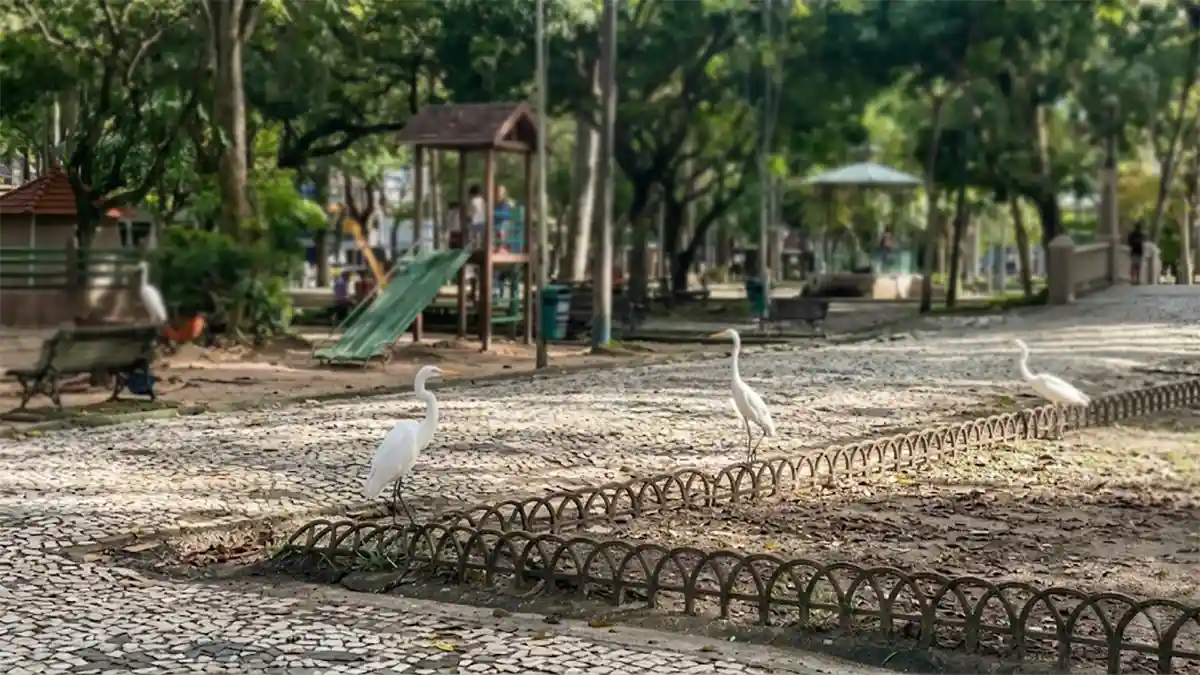
In central Belém, a traditional public square has become the permanent home of hundreds of white egrets. Batista Campos Plaza, one of the best-known public spaces in the capital of Pará, now holds a colony of birds that once depended more directly on mangroves and flooded areas.
The choice is not random. Abundant food, nighttime lighting and the absence of predators have turned an urban square into a stable colony for these birds. What may look like an unusual change of habitat follows an ecological logic tied to energy, safety and the availability of places to rest and nest.
Understanding why the egrets prefer the plaza to the mangrove is also the first step toward dealing with the public health problem caused by the concentration of birds in the area. The same conditions that attract the egrets help explain why the colony continues to grow in a busy part of Belém.
A square with food close at hand
Tree-lined squares in tropical cities can provide a generous menu for birds such as egrets. At Batista Campos, public lighting at night attracts large numbers of insects, which become an easy food source for birds staying in the area.
Insects are not the only source of food. Leftovers discarded by people who use the plaza and poorly contained garbage add to the supply. The urban site therefore brings together several feeding opportunities without requiring the egrets to travel to a mangrove or another flooded area.
In mangroves, the birds must fish and compete with other species for food. In the plaza, feeding requires little effort by comparison. That difference in the energy cost of finding food is one of the factors that explains the birds’ preference for an urban setting.
The square is not merely a resting place. It is also a location where food can be found easily, especially when lighting draws insects and visitors’ leftovers remain accessible. For a colony, that reliable supply can make the plaza more useful than natural areas where feeding demands greater effort.
Safety for roosting and nesting
The second decisive factor is the lack of predators. In their natural habitat, egrets face threats such as hawks, ocelots and snakes that attack nests. In central Belém, those risks are simply not present in the same way.
The plaza’s mango trees provide high, stable branches for roosting and nesting. Their branches and dense crowns keep nests away from traffic and from disturbances on the ground. For the birds, the elevated position combines shelter, stability and distance from activity at street level.
The absence of predators allows the colony to grow without natural control. Each breeding season adds dozens of new individuals to the group, and there is no ecological pressure to reduce the population at the same rate. The result is an increasing concentration of egrets in a place designed as an urban square, not as a bird colony.
The mango trees are therefore central to the colony’s permanence. Their broad branches and dense crowns provide the physical structure the birds need to remain for long periods. When that structure is combined with accessible food and protection from predators, the square stops being an occasional stop and becomes a permanent residence.
Urban growth and a shrinking habitat
The transformation of Batista Campos must also be understood in relation to what happened beyond the plaza. The destruction and occupation of mangroves in the metropolitan region of Belém progressively reduced the natural areas available to the egrets.
As the original habitat becomes smaller, the birds move toward the nearest urban environment that still provides minimum conditions for survival. Their presence at Batista Campos, then, is not only an isolated preference for a particular square. It also reflects the loss and reduction of natural spaces that could previously accommodate the birds.
Squares with large trees can partially imitate the structure of a mangrove. Dense crowns, broad branches and proximity to water sources create a combination that resembles some elements of the original environment. For the egrets, the centuries-old mango trees at Batista Campos function as a viable substitute for the lost mangrove.
This substitution does not mean that a plaza and a mangrove are the same ecosystem. The square supplies some useful conditions for the birds, but it also concentrates people, waste and a large colony in an urban setting. The egrets’ adaptation solves part of their survival needs while creating a situation that requires a response for public health and for the management of urban biodiversity.
Mangal das Garças as an alternative
Mangal das Garças provides an example of how suitable habitat can be offered to these birds within the city. The environmental site is maintained by the Government of Pará on the banks of the Guamá River and includes mangrove vegetation, ponds and a controlled feeding area.
The site shows that egrets’ presence in the city does not have to remain concentrated in a central plaza. An environment with mangrove vegetation and water bodies can better meet the birds’ needs, while controlled feeding can help organize the concentration of individuals.
According to specialists, gradually transferring the egrets from Batista Campos to areas such as Mangal das Garças would be the most balanced solution. The proposal would preserve the birds, reduce the health risk in the plaza and keep urban biodiversity under control.
A gradual transfer also recognizes that the colony emerged from several conditions acting together. The egrets found easy food, suitable trees and safety from predators, while mangroves in the metropolitan region were losing space. A lasting response must address all of those factors, rather than simply removing the birds from the square.
Batista Campos became a colony because it brings together conditions egrets need to survive and reproduce. Night lighting attracts insects, food scraps increase the supply, trees provide nesting sites and the absence of predators removes a natural pressure on the population.
Mangal das Garças offers a way to reorganize the relationship between wildlife and the city. By providing mangrove vegetation, ponds and controlled feeding, the site may help conserve the birds without maintaining a permanent concentration in a central Belém plaza. For specialists, that balance protects both the egrets and the people who use Batista Campos.
Reporting: Anne Silva / Amazonia Mag

Editor, English Edition — Amazonia Mag
Anne Silva is the editor of Amazonia Mag, the English-language edition of Revista Amazônia. She curates, translates and adapts the outlet's science and environment coverage for an international audience, reporting on Amazon wildlife, flora, rivers, climate and research. Every story she edits is grounded in peer-reviewed studies, official data and on-the-ground reporting from the Revista Amazônia newsroom in Belém, Pará, Brazil. More by Anne Silva →