
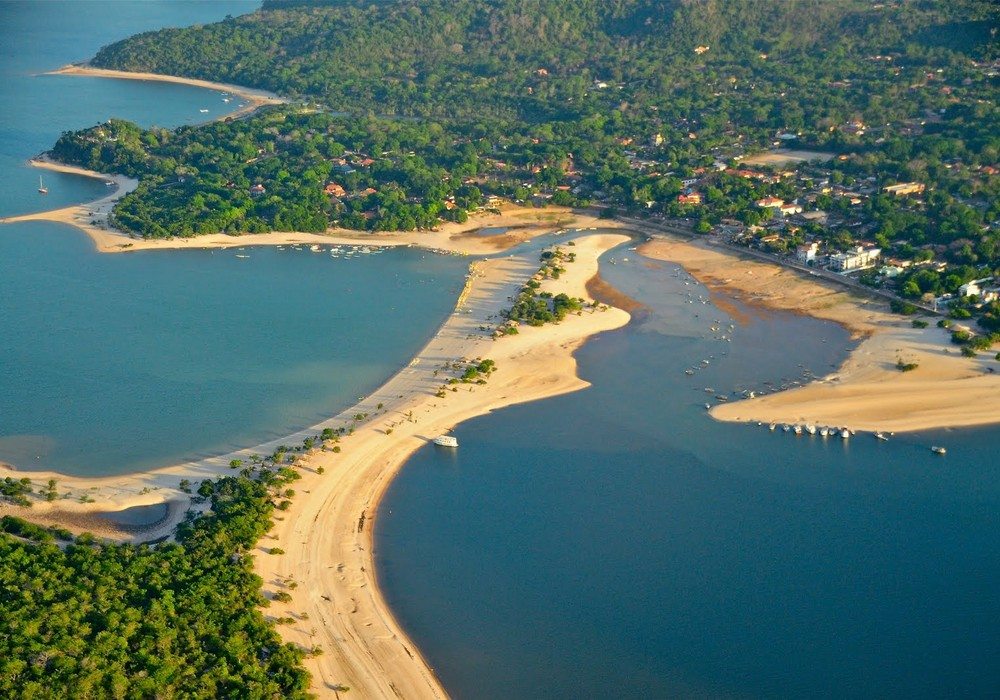
Deep in Pará, where the Tapajós River shapes breathtaking landscapes, a protected area challenges the usual image of a tropical rainforest. Brazil’s Amazon National Park, in Itaituba, contains freshwater beaches with water so clear that they can rival Caribbean destinations, while remaining surrounded by some of the planet’s densest biodiversity.
Researchers and frequent visitors confirm this surprising feature, which remains unknown to many Brazilians. During the dry season, large white-sand banks rise from the river and create beaches framed by dense forest. Along with trails open to visitors, these landscapes make the park one of Brazil’s most powerful and least-known ecotourism destinations.
A historic protected area along the Tapajós
Created in 1974, Brazil’s Amazon National Park is one of the oldest and most important conservation units in the country’s northern region. It covers more than one million hectares of primary forest, an area whose scale helps explain the vastness of the landscapes surrounding the Tapajós.
Its strategic location in Itaituba, in western Pará, places the park at the center of an exceptionally rich biological transition zone. Upland forest, river environments and seasonal changes in the Tapajós form a connected natural mosaic. Protecting this territory allows wildlife, vegetation and ecological processes to continue across a broad landscape.
The park’s most spectacular character appears during the dry season, locally known as the “Amazon summer.” As the Tapajós falls, immense white-sand banks emerge and become freshwater beaches. In some areas, underwater visibility can exceed 10 meters, or about 33 feet, turning the river into a clear window onto aquatic life.
Freshwater beaches shaped by ancient geology
A visit to a Tapajós beach involves far more than sunbathing. The water’s transparency is linked to a drainage basin that runs over ancient geological shields with low sediment levels. Because of this, visitors can see fish and aquatic life with striking clarity, even without diving equipment.
Sumaúma Beach and Cururu Point are among the places where this experience unfolds. They can be reached by boat from Itaituba or from the village of São Luiz do Tapajós. At these sites, the water’s blue-green color creates a dramatic contrast with the deep green forest stretching toward the horizon.
The landscape is a living laboratory in which geology and hydrology create unusual conditions for sustainable recreation. The river’s seasonal movement shapes the beaches, while the clear water reveals a dimension of the Tapajós that is hidden in many other Amazonian settings. Swimming, observing the river and understanding the landscape become part of the same experience.
During the low-water season, Tapajós ecotourism in Itaituba gains momentum. Travelers looking for quiet, striking scenery and an authentic connection with wild nature find a destination that does not depend on large facilities or artificial attractions. The forest, the river and the sandbars provide the central experience.
Trails, giant trees and threatened wildlife
Visitors who prefer the forest floor can explore a network of well-maintained interpretive trails that enter the upland forest. Walking through them is a complete sensory immersion, with bird calls, plant scents, towering trees and the possibility of finding signs of the animals that live within the protected area.
Accredited guides are required for hiking the trails and accessing protected areas. In addition to supporting safety, local guides bring knowledge about the park’s environments, trees and wildlife. Their presence can turn a walk into a deeper interpretation of the forest and its relationships.
The trees include Brazil nut trees and kapok trees, ancient and imposing species that are part of the identity of the upland forest. The park is also a refuge for threatened wildlife, including the uiaçu, or harpy eagle, the golden conure and several species of primates.
Birdwatching is a growing activity in the region because of the high diversity of species endemic to the Tapajós-Madeira interfluve. Each trail can offer a different view of the forest, although sightings always depend on natural conditions and animal behavior.
Planning a low-impact visit
Itaituba is the main base for exploring the park. The city can be reached by air or by land via the Trans-Amazonian Highway. From there, visitors can travel by boat to Sumaúma Beach and Cururu Point, with departures from Itaituba or the village of São Luiz do Tapajós.
Inside the park, facilities are rustic and designed for minimal impact. There are areas for camping and picnics, but no luxury hotels or restaurants. That limited infrastructure reinforces the destination’s wild character and makes careful planning essential.
Advance scheduling and the hiring of local guides are fundamental. These steps support visitor safety, but they also help tourism generate income and recognize the knowledge of surrounding communities. In this way, a trip to the park can strengthen the local economy of conservation.
The best time to visit the beaches of Brazil’s Amazon National Park is from August through December, during the Tapajós River’s dry season. The trails can be visited year-round, but wildlife observation is better during the transition from the rainy season to the dry season.
Visitors should prepare with insect repellent, biodegradable sunscreen, lightweight clothing and plenty of water. They should also leave no trace of their passage through the forest. The beaches, trails and protected habitats depend on travel practices that preserve their natural conditions.
Keeping the forest standing
Tapajós ecotourism in Itaituba represents a model of economic development that values standing forest. By turning scenic beauty and biodiversity into tourism assets, the national park creates alternative sources of income for local populations. This can discourage destructive activities such as illegal mining and deforestation.
Every visitor who walks the trails or enters the waters of the Tapajós contributes to the sustainability of the protected area. Responsible tourism does not replace institutional protection, but it can reinforce the social and economic value of keeping the forest protected and the river clean.
Revista Amazônia, with 25 years of experience, sees Brazil’s Amazon National Park as a strong example of how positive-impact journalism can highlight solutions that connect environmental conservation, cultural recognition and economic prosperity. Itaituba’s clear beaches and immersive trails are more than a vacation destination.
They are also an invitation to reflect on humanity’s relationship with Brazil’s greatest natural heritage. Experiencing the Amazon at close range, feeling its pulse and understanding its complexity can be a first step toward becoming one of its true defenders.
Brazil’s Amazon National Park shows that a living forest has immeasurable value. True wealth is not found in what people extract from it, but in the privilege of being able to exist alongside it, with respect and responsibility.
Reporting: Anne Silva / Amazonia Mag

Editor, English Edition — Amazonia Mag
Anne Silva is the editor of Amazonia Mag, the English-language edition of Revista Amazônia. She curates, translates and adapts the outlet's science and environment coverage for an international audience, reporting on Amazon wildlife, flora, rivers, climate and research. Every story she edits is grounded in peer-reviewed studies, official data and on-the-ground reporting from the Revista Amazônia newsroom in Belém, Pará, Brazil. More by Anne Silva →