
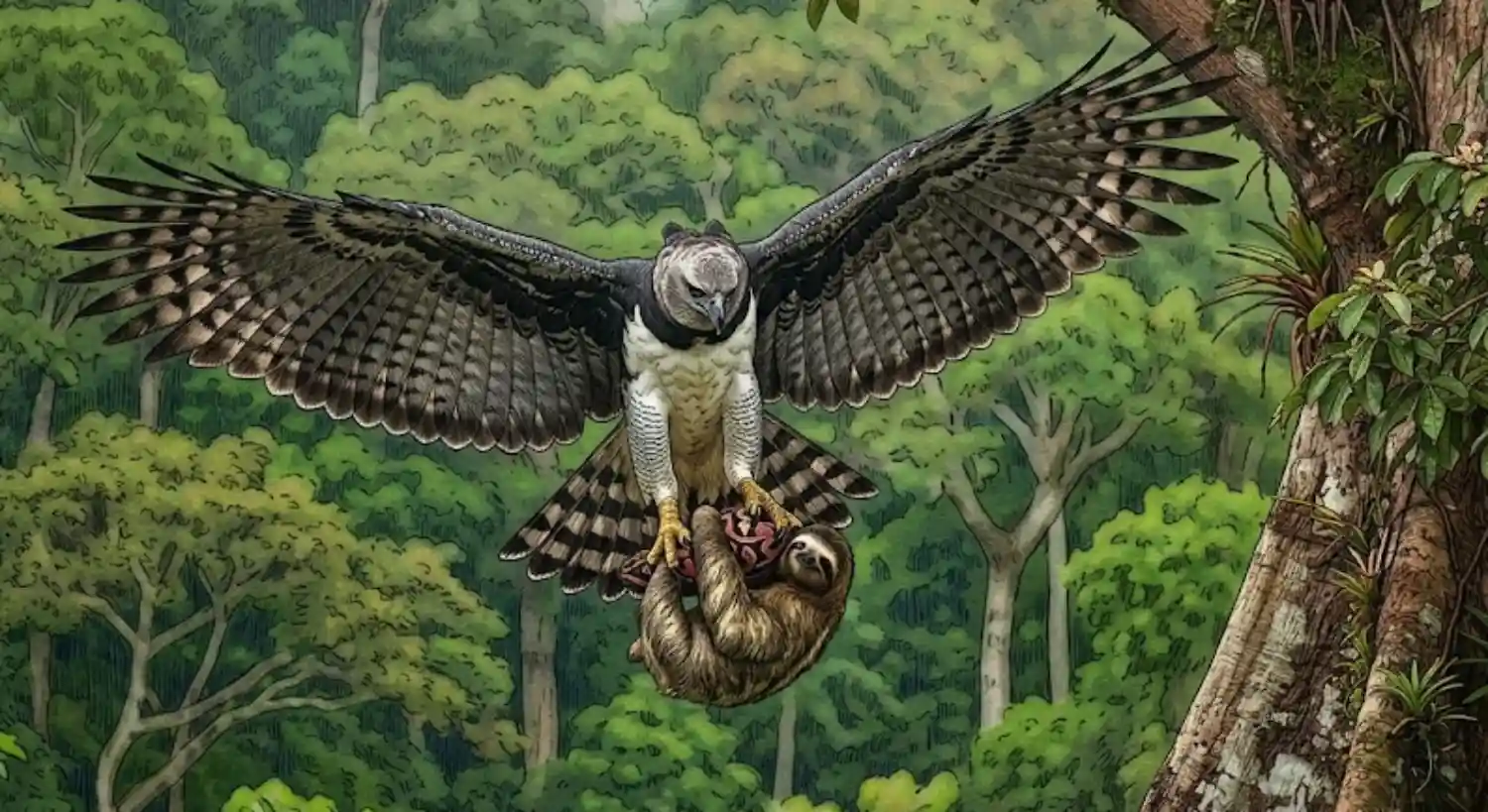
The harpy eagle, known scientifically as Harpia harpyja, has the verifiable biological ability to lift and carry prey heavier than its own body weight up to nests placed in the highest layer of the Amazon rainforest. This raptor, regarded as the most powerful in the Western Hemisphere, performs a hunting logistics operation that defies the limits facing most flying birds. Consolidated biological evidence shows that adult females, which can weigh up to nine kilos, are able to carry medium sized mammals such as sloths and monkeys, weighing between six and ten kilos, over considerable distances to the base of their nesting platforms. This is not an isolated stunt. It is a feeding routine repeated for months on end in every territory held by a breeding pair.
A body built for vertical effort
The feat does not come from any suspension of aerodynamics. It comes from a very specific combination of muscular power, wing design and skeletal adaptation. The force needed to generate lift while carrying extra load comes from massive pectoral muscles that anchor a wingspan reaching two metres. Unlike birds built for fast flight across open country, the harpy eagle has broad, rounded wings, optimised for precise manoeuvring through dense vegetation and for delivering the immediate vertical thrust required to take off with heavy prey from the ground or from low branches. It is a body engineered for power and control rather than for sustained speed.
That design has a cost. Broad wings and heavy flight muscles make the harpy eagle a poor long distance traveller compared with soaring raptors of open landscapes. The species is bound to the forest interior, where short, explosive flights between perches matter far more than endurance. Everything about the bird, from the shape of its wings to the way it moves through the canopy, points to the same conclusion: this is a predator of closed forest, and it is only competitive inside one.
Talons as precision tools
The core mechanism behind successful transport lies in the anatomy of the feet and talons. The harpy eagle has extremely robust tarsi and rear talons that can measure up to seven centimetres, exceeding the size of a grizzly bear’s claws. These structures work like high pressure hydraulic clamps. When the bird seizes prey, the talons penetrate vital organs, ensuring a rapid kill and, at the same time, locking mechanically around the animal’s body. That passive locking allows the eagle to keep its load secure during the climbing flight without continuously spending muscular energy in the feet, concentrating the whole effort on the wingbeat. The rear talons exert a pressure of hundreds of pounds per square inch, which delivers both the kill and the mechanical lock needed to move the prey safely in flight.
Prey selection is intrinsically tied to that carrying capacity and to the ecological niche the species occupies. Trophic ecology studies based on analysis of food remains found in nests show that three toed sloths and several monkey species make up most of the diet. Those mammals, though heavy, are arboreal and slow, which makes them accessible targets for a predator that uses a sit and wait tactic in the canopy. The harpy eagle monitors the forest from high perches and launches short, precise attacks, using gravity to increase impact speed before beginning the return flight with its catch. The economy of the method is obvious: little travel, a great deal of watching, and a single decisive strike.
Housing engineering in the canopy
The final destination of all that transport energy is the nest, the largest nesting structure built by any bird of prey in South America. The harpy eagle picks the tallest trees in the forest, the emergents, such as Brazil nut trees and kapok trees, to build its platforms. Nests are made of thick branches and lined with green leaves, and can reach a metre and a half across and more than sixty centimetres deep. Choosing sites so high above the ground, often forty or fifty metres up, offers protection from ground predators, but it imposes the logistical challenge of raising every single meal to that height.
The species’ reproductive biology justifies that monumental effort. The breeding cycle is long, running for around two and a half years. The female usually lays two eggs, but only one chick survives after hatching. The young bird stays dependent on its parents for food for a period that can exceed a year. In the first months, the male is responsible for hunting and bringing smaller prey to the female and the chick. As the chick grows, food demand rises sharply, requiring the female, with her greater carrying capacity, to take on the hunting of larger prey to meet the energy needs of rapid growth. Every loaded flight to the nest is, in practice, an investment in the single offspring of an extraordinarily long cycle.
Impact on forest dynamics
The presence and hunting activity of the harpy eagle exert a fundamental regulating effect on populations of arboreal herbivores and omnivores. By preying on species such as sloths and monkeys, the bird influences the behaviour and density of those animals, which in turn affects the rate of herbivory on certain tree species and the dispersal of seeds. This top down control helps maintain the diversity of Amazonian flora, preventing a single arboreal mammal species from dominating resource consumption and reshaping the structure of the forest. A top predator, in that sense, is less a zoological curiosity than a working part of the forest itself.
Conservation of the species is directly tied to keeping large stretches of continuous, healthy Amazon rainforest intact. Because of its low reproductive rate and its need for vast hunting territories, which can exceed one hundred square kilometres per pair, habitat fragmentation is the greatest threat to its survival. The loss of emergent trees suitable for nest building and the decline in the density of its main prey make reproduction unviable. Protecting the harpy eagle therefore means protecting the entire complex ecosystem that allows a predator with such singularly adapted biological capabilities to exist at all.
Reflecting on the harpy eagle’s ability to carry such heavy loads to the top of the forest invites admiration for the precision of biological evolution. Every aspect of its anatomy and behaviour has been shaped over millennia to work in perfect harmony with the vertical structure of the Amazon rainforest. The survival of this powerful bird depends not only on its intrinsic strength, but on the continued integrity of the environment it inhabits. Making sure those flights keep happening above the canopy means preserving one of the most authentic symbols of biodiversity and of the functional complexity of South American tropical forests.
Reporting: Anne Silva / Amazonia Mag. Source: Revista Amazônia.

Editor · Amazonia Mag
Anne Silva is the editor of Amazonia Mag, the English-language edition of Revista Amazônia. She curates, translates and adapts the outlet's science and environment coverage for an international audience, reporting on Amazon wildlife, flora, rivers, climate and research. Every story she edits is grounded in peer-reviewed studies, official data and on-the-ground reporting from the Revista Amazônia newsroom in Belém, Pará, Brazil. More by Anne Silva →