
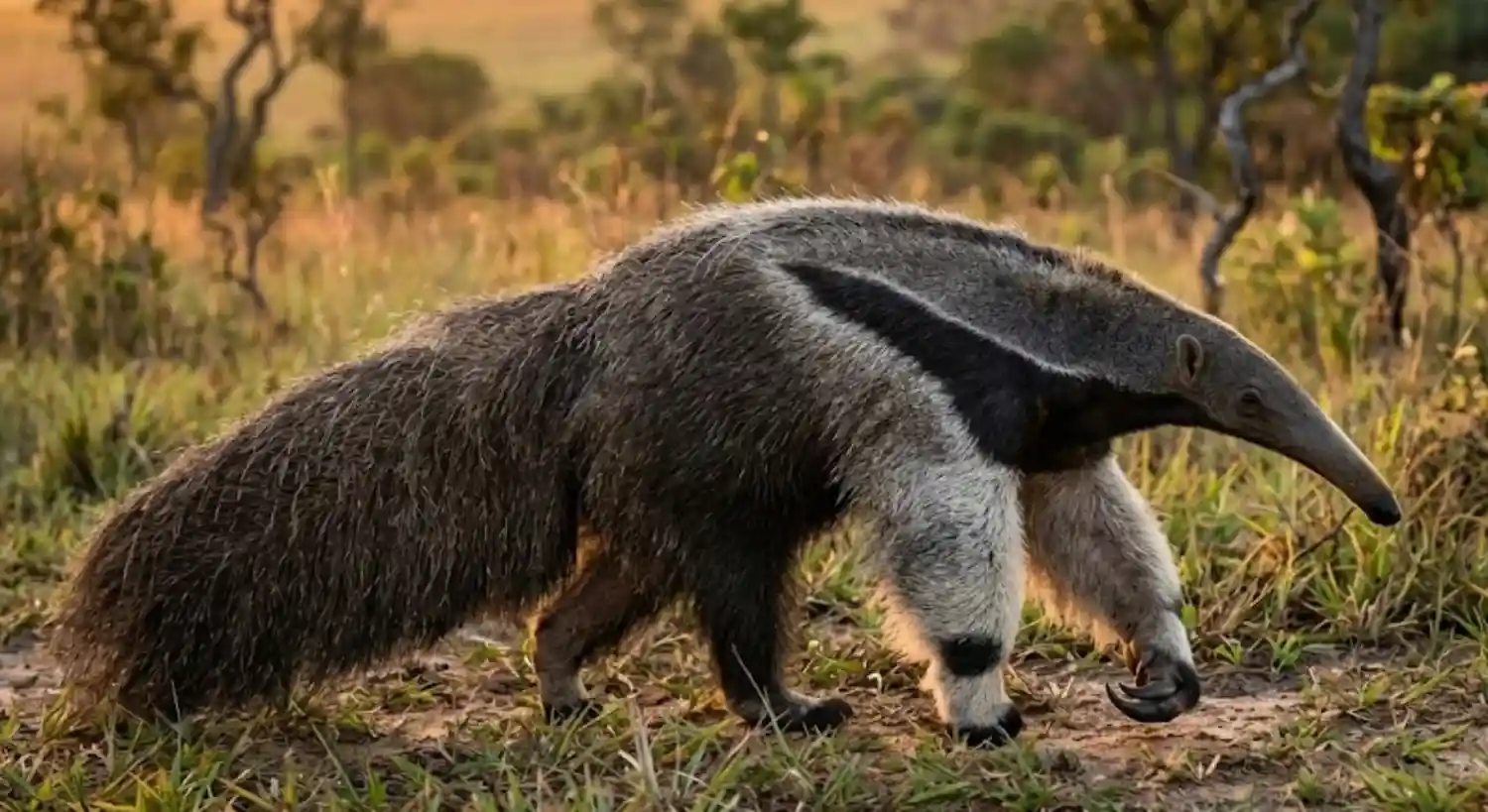
The giant anteater, known in Brazil as tamanduá bandeira and described by science as Myrmecophaga tridactyla, displays one of the most extreme anatomical adaptations found anywhere in the fauna of the Americas. It is the largest land mammal on the continent to have given up teeth entirely, an evolutionary decision that in almost any other lineage would amount to a sentence of starvation. In its case the opposite happened: the complete absence of chewing structures does not limit its ability to obtain nutrients on a large scale, because the animal developed complementary mechanical tools on its front feet and a highly specialised tongue that replaces the dental apparatus with advantage.
Consolidated biological knowledge shows that this giant is able to break through compacted soil barriers as hard as concrete in order to feed on thousands of insects every day, using a collection system of remarkable biological efficiency. Its survival depends directly on the three central claws of the front feet, which work as natural picks of great power. Those claws grow continuously to compensate for the wear caused by constant friction against the ground and against the rigid walls of social insect nests, in a cycle of replacement that never stops throughout the animal’s life.
While moving across Brazilian grasslands and savannas, the animal walks on its wrist joints, turning the tips of the claws inward so that the cutting edge of these structural tools is protected and its own limbs are spared from injury. That peculiar gait, which looks clumsy at first sight, is in fact an engineering solution: it keeps intact the very instrument on which both feeding and defence depend.
The engineering of feeding and an unusual mouth
Opening termite mounds and ant nests requires concentrated mechanical force that few species can apply. The giant anteater locates underground or above-ground nests through a very sharp sense of smell, which compensates for its limited vision and hearing in open environments. Once it identifies the point of least resistance in the earthen structure, the mammal uses its robust forelimbs to dig precise galleries, destabilising the nest without destroying it completely. That restraint guarantees the renewal of the insect colony for future visits and amounts, in practice, to sustainable management of a food resource carried out by instinct alone.
With the access open, the cylindrical tongue comes into action. It can reach sixty centimetres in length and is attached directly to the sternum rather than to the throat, as happens in most mammals. This long muscular structure is coated by enlarged salivary glands that secrete an extremely viscous substance, turning the tongue into a biological adhesive tape. The animal pushes the appendage into the galleries of the mound up to one hundred and sixty times per minute, withdrawing hundreds of workers and soldiers stuck to its surface with every movement.
The insects are swallowed whole and travel straight to a muscular stomach that grinds the food mechanically with the help of sand grains deliberately taken in. That organ therefore performs the task assigned to molars in other mammals: the work of grinding did not disappear, it simply moved to a different place inside the body. The extreme speed of the tongue also has a defensive explanation, since workers and soldiers respond with bites and irritating chemical compounds, and a lightning visit reduces the time of exposure to that collective counterattack.
Standing tall: the defensive posture
The same claws used in the search for food play a central role in protecting the animal against top predators such as the jaguar and the puma. Being a slow-moving creature, unable to flee at speed over long distances, the giant anteater adopts a static and imposing combat posture when cornered. The mammal raises its body onto its hind legs and uses the dense, flag-shaped tail as a third point of support to stabilise the vertical balance of the whole organism.
That bipedal defensive stance frees the forelimbs to deliver fast and deep blows against any aggressor that attempts to come closer. The so-called anteater embrace consists of mechanically holding the opponent against the chest while curved claws of up to ten centimetres pierce soft tissue. This behaviour intimidates even the most experienced carnivores of the forest and of the Cerrado, which avoid direct confrontation with the species because of the high risk of suffering severe or disabling wounds during a territorial dispute.
Seasonal threats and environmental dynamics
Despite its defensive efficiency against traditional biological threats, the natural armour of the species proves useless against the modern impacts generated by the expansion of human infrastructure. The giant anteater appears consistently among the mammal species with the highest rates of roadkill mortality on the highways that cut across the central regions of Brazil. A slow metabolism and a low reaction speed to approaching motor vehicles make it difficult for the animal to cross paved roads safely, and those roads fragment its original foraging areas.
Another critical factor of vulnerability is the seasonal fires that reach the vegetation formations of the Cerrado and the Pantanal during prolonged dry periods. The animal’s coat is made of long, dry bristles covering a thick layer of subcutaneous fat, and it works as fast-spreading fuel when exposed to sparks. Dense smoke disorients the mammal, whose sensory channels are focused on smell and suffer immediate saturation, which prevents it from finding safe escape routes towards wetlands or gallery forests.
Ecological function and the spread of nutrients
The daily digging activity carried out by this large mammal works as a regulating environmental service of great relevance to the health of tropical soils. By drilling through compacted layers of earth to reach insects, the animal creates vertical channels that ease the infiltration of rainwater and the aeration of deep soil layers. That mechanical process speeds up the decomposition of organic matter accumulated on the surface and makes essential mineral nutrients available to the roots of neighbouring plants, promoting the plant productivity of the savanna as a whole.
In addition, the openings left in abandoned termite mounds are taken over as temporary or permanent microhabitats by a variety of small vertebrates and invertebrates that have no digging ability of their own. Lizards, amphibians, rodents and other insect species colonise these cavities to shelter from thermal extremes and from aerial predators. The giant anteater therefore functions as an engineer organism, whose presence positively alters the physical structure of the ecosystem and sustains the diversity of associated species across the landscape.
Maintaining viable populations of this mammal requires land-use planning strategies that include the creation of wildlife crossings and the installation of acoustic and visual barriers along the busiest highways. Preserving continuous legal reserves and corridors of native vegetation connects isolated family groups and guarantees the genetic variability that is indispensable for the survival of future generations. Protecting the living conditions of this species means safeguarding the functional integrity of the savannas and grasslands that make up the biological heart of Brazilian territory.
Understanding the evolutionary solutions contained in the anatomy of the giant anteater reveals the complexity of the ecological interactions that stabilise Brazilian biomes. The absence of teeth and the development of powerful claws are a precise answer to the challenges of an environment that demands specialisation to exploit resources that are abundant but well protected. The central claws are curved and have high bone density, which allows direct mechanical leverage on the hardened soil of open country: that morphological arrangement guarantees both the breaking of barriers for feeding and the stabilisation of powerful defensive blows. Ensuring that these animals keep walking across the fields and shaping the soils means securing the continuity of ancient evolutionary processes that sustain the balance and natural richness of that biological heritage.
Reporting: Anne Silva / Amazonia Mag. Source: Revista Amazônia.

Editor · Amazonia Mag
Anne Silva is the editor of Amazonia Mag, the English-language edition of Revista Amazônia. She curates, translates and adapts the outlet's science and environment coverage for an international audience, reporting on Amazon wildlife, flora, rivers, climate and research. Every story she edits is grounded in peer-reviewed studies, official data and on-the-ground reporting from the Revista Amazônia newsroom in Belém, Pará, Brazil. More by Anne Silva →