
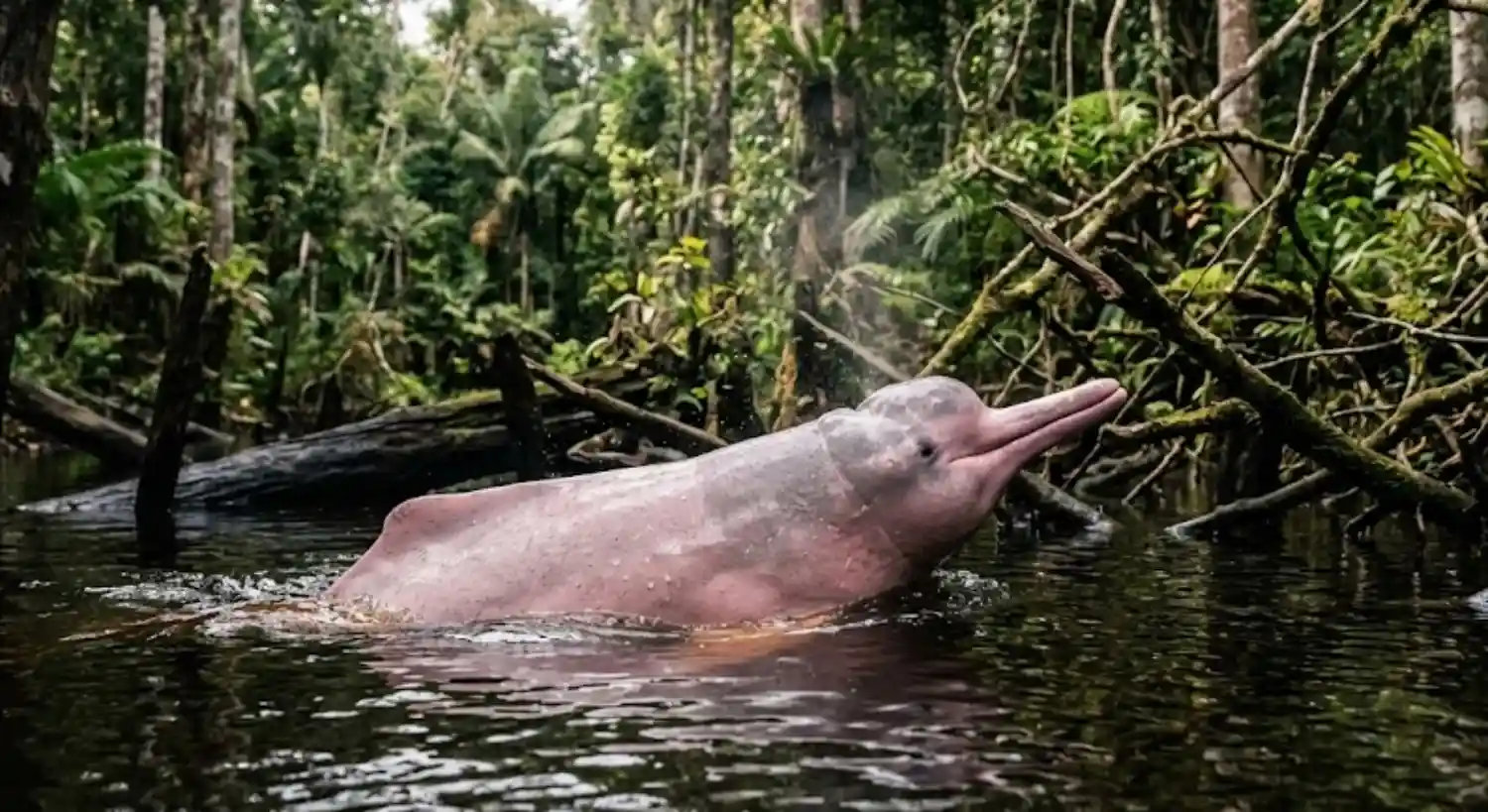
The Amazon river dolphin holds the title of largest freshwater dolphin on the planet, and it carries a set of biological adaptations that make it fully integrated into the dynamics of Amazonian rivers. Unlike marine dolphins, which rely on clear water for visual navigation, this cetacean lives in river environments loaded with suspended sediment, where horizontal visibility drops to just a few centimetres. Consolidated zoological evidence shows that the animal compensates for that opacity through a biological system of emitting and receiving high frequency sound waves, allowing it to build a complete three dimensional map of its surroundings without using sight at all.
A biological sonar for muddy water
This system of spatial orientation works through sound pulses produced in the nasal passages and projected outward through the melon, a fatty structure located in the animal’s forehead. The emitted waves travel through the water column, strike physical obstacles or potential prey, and return to the predator in the form of an echo. The returning signal is received through the lower jaw, which channels the acoustic vibrations to the cetacean’s inner ear and delivers precise information about the distance, density and size of the elements detected in that liquid darkness.
The practical result is a form of perception that does not depend on light. Where a human observer submerged in the same water would see nothing beyond the reach of their own fingertips, Inia geoffrensis continuously reconstructs the shape of the riverbed, the position of submerged trunks and the movement of passing fish. Every echo picked up by the jaw is converted into a detailed spatial map of the river, which lets the animal pinpoint prey hidden under the mud and steer around complex obstacles in the flooded forest even under conditions of zero visibility.
Bone flexibility in the flooded forest
The skeletal morphology of this mammal shows an anatomical feature that is uncommon among modern cetaceans and that makes movement through confined spaces possible. The cervical vertebrae of the Amazon river dolphin are not fused to one another, giving the neck a mechanical flexibility that allows the head to turn sideways at angles of up to ninety degrees. That freedom of movement contrasts with the structural rigidity of ocean dolphins, whose fused vertebrae prioritise hydrodynamic stability for high speed travel across open sea.
This flexible joint works in coordination with the pectoral fins, which are broad and highly mobile, functioning as independent oars that enable precise reverse manoeuvres and rotations around the animal’s own axis. That toolkit of motor abilities allows the dolphin to explore the understory of igapó and várzea forests during the seasonal flood, when rivers overflow and inundate vast stretches of dry land. The mammal moves among fallen trunks, thorny branches and exposed roots without injuring itself or becoming trapped in the submerged maze.
Foraging strategy and a varied diet
Periodic occupation of the flooded forest expands access to a varied food base that includes dozens of fish species, along with crabs and small turtles. The Amazon river dolphin uses its long pointed snout, covered in tactile sensory hairs known as vibrissae, to dig into the mud of the riverbed and dislodge prey hidden in the submerged leaf litter. The species has a mixed dental configuration, with sharp front teeth for seizing smooth bodied fish and robust rear teeth designed to crush the hard shells of crustaceans.
That capacity for mechanical chewing sets the animal apart from other cetaceans, which swallow their prey whole, and lets it extract the full nutritional value of bottom dwelling organisms living on the river floor. Hunting takes place alone or in small family groups, which reduces competition for biological resources inside narrow channels. Individuals patrol river confluences and the mouths of lakes, where waters of different densities and temperatures meet and concentrate migrating shoals in transit.
Reproductive cycle and the shift in colour
The life cycle of the mammal is closely governed by the flood pulse of the Amazon basin, which determines the availability of shelter and food across the seasons. Gestation lasts around eleven months and ends with the birth of a single calf at the peak of the flood season, when the inundated forests offer ideal protection from predators and strong currents. The calf nurses for more than a year and stays attached to the matrilineal group through several seasonal cycles, until it reaches social maturity and masters the echolocation techniques needed to survive on its own.
The colouring that gives the species its popular name changes gradually over the course of an individual’s biological development. Newborns and juveniles show a uniform dark grey tone that lightens as the animal reaches sexual maturity and undergoes the natural wear of the skin caused by social interaction and abrasion against elements of the environment. Adult males tend to display the most intense pink tones, a biological factor that reflects increased vascularisation of the skin and the healing of surface scrapes acquired during territorial breeding disputes.
A regulating role in the river food web
As a top predator in continental aquatic ecosystems, the Amazon river dolphin plays a central ecological role in natural selection and in maintaining the health of fish populations. By preferentially consuming old, sick or weakened individuals, the cetacean prevents the spread of pathogens through river basins and preserves the genetic vigour of commercially important species. This top down control stabilises the community structure of fresh water, ensuring that no single detritivorous or medium sized carnivorous fish species monopolises the available food resources.
The persistence of healthy populations of these mammals works as a precise bioindicator of the environmental quality of Amazonian rivers. Because they are long lived animals sitting at the apex of the food web, the dolphins accumulate in their tissues the imprint of systemic ecological disturbance, such as the silting of lakes and the excessive noise produced by heavy motorised boat traffic. Keeping navigation routes clear for these animals ensures that flows of biological energy continue to knit together the aquatic and terrestrial portions of the tropical forest in a functional way.
Reading the river through sound also reframes what conservation has to protect. The dolphin’s world is acoustic before it is visual, which means that a stretch of river can look intact from the surface while being unusable for an animal that navigates by echo. Sediment loads, engine noise and the physical fragmentation of channels all act on the same sensory pathway that the species depends on for feeding, breeding and orientation, and none of those pressures leaves an obvious mark on a photograph of the water.
Understanding the adaptive mechanisms that let the Amazon river dolphin thrive in the hydrological complexity of the Amazon reinforces the value of seeing aquatic networks as inseparable components of forest integrity. This cetacean shows how life expands and specialises by developing precise sensors that turn environmental limitation into an opportunity for survival. Guaranteeing free flowing rivers and preserving flooded forests means safeguarding the invisible channels of sound and movement that keep the biological wealth at the heart of Brazil alive and active.
Reporting: Anne Silva / Amazonia Mag. Source: Revista Amazônia.

Editor · Amazonia Mag
Anne Silva is the editor of Amazonia Mag, the English-language edition of Revista Amazônia. She curates, translates and adapts the outlet's science and environment coverage for an international audience, reporting on Amazon wildlife, flora, rivers, climate and research. Every story she edits is grounded in peer-reviewed studies, official data and on-the-ground reporting from the Revista Amazônia newsroom in Belém, Pará, Brazil. More by Anne Silva →