
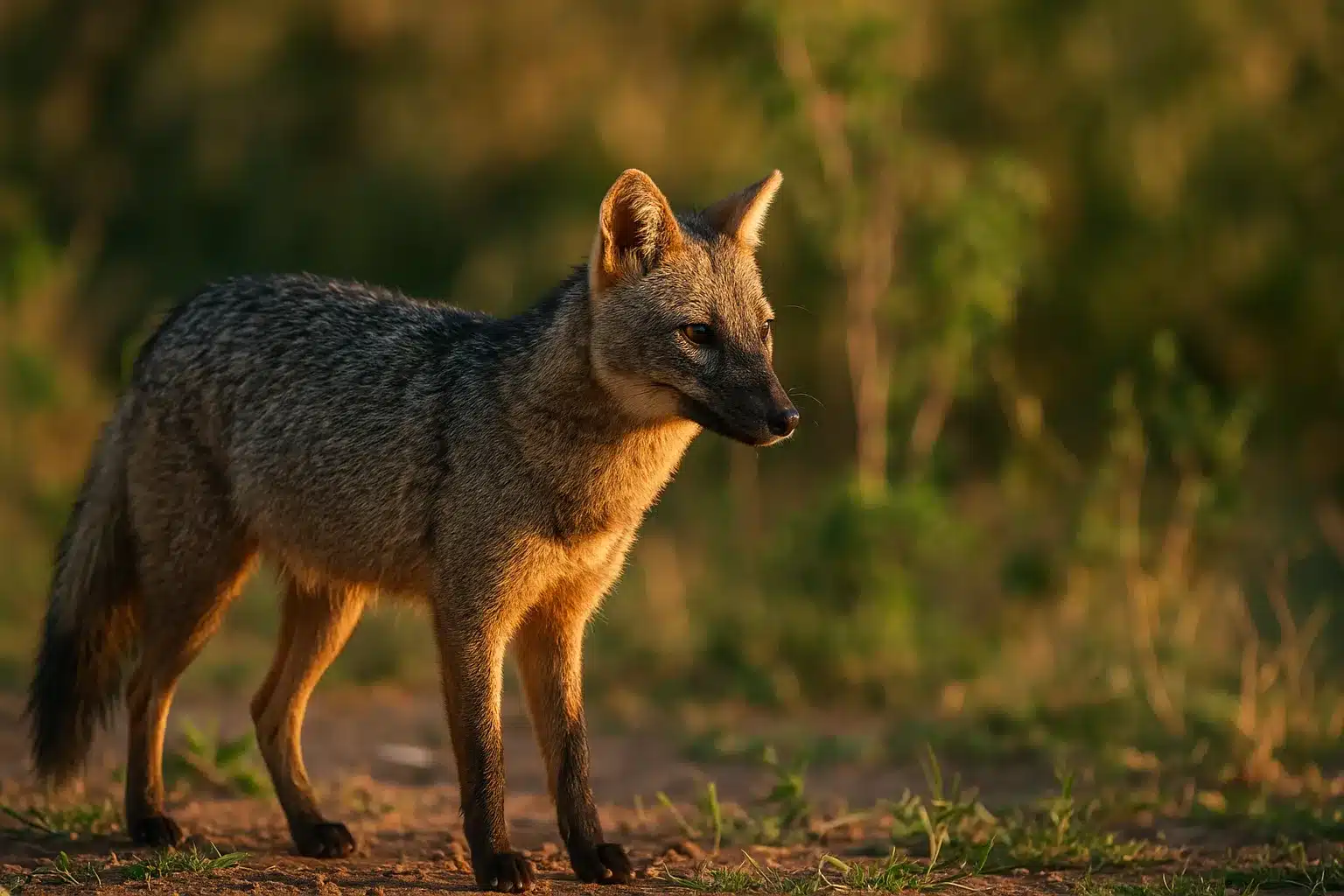
Rarely seen, yet increasingly present on the margins of cities, the crab-eating fox (Cerdocyon thous) shows how a wild animal can adapt to urban growth. Discreet, nocturnal and equipped with the keen sense of smell expected of a canid, it has found an unlikely place on the outskirts of inhabited areas, where it looks for food, avoids threats and stays out of human sight. In Brazil it is known as the cachorro-do-mato.
Understanding how this animal lives helps explain why it turns up where least expected, and what to do, and not to do, when someone crosses its path.
A silent survivor
The crab-eating fox, also called the graxaim-do-mato or simply the wild canid, is native to South America. It is found mainly in Brazil, Argentina, Uruguay and Paraguay. Although it is related to domestic dogs, its behavior is very different: it is cautious, discreet and active mostly at night.
That nocturnal life explains much of its reputation as an elusive animal. While the city sleeps, it works the edges of woodlots and open ground in search of food. By dawn it has already taken cover. That is why many people live for years with crab-eating foxes near their homes without ever having seen one.
The species has stood out for its ability to live in transition areas such as fragmented woodland, pasture edges and even vacant lots. In those places it takes advantage of the food people leave behind, such as scraps, and of the small prey that garbage attracts.
A canid’s nose and a nocturnal life
Like all canids, the crab-eating fox relies on its sense of smell to find food. That tool lets it locate small prey, such as rodents and birds, even when they are hidden or sitting under dense vegetation. It also helps the fox detect possible predators or people ahead of time, which is essential for avoiding dangerous encounters.
In urban settings that sense becomes even more valuable. An animal able to pick up organic waste or discarded food from a distance can cut down the time it spends away from shelter. The less it is exposed, the lower the odds of being hit by a car or meeting domestic dogs, two of the most common threats at the edge of cities.
Adapting to urban surroundings
Although it is a wild animal, the crab-eating fox has shown a remarkable ability to adapt. In several regions of Brazil it has been spotted in outlying neighborhoods, abandoned lots and even in housing complexes next to green areas.
That approach is no accident. As cities expand and its natural habitat is destroyed, the animal looks for other ways to feed. But the adaptation is not a sign of domestication. On the contrary, the fox stays shy, avoids contact with people and is hard to catch in full daylight.
It helps to distinguish between tolerating the proximity of houses and depending on them. The crab-eating fox treats human spaces as one more source of resources, yet it keeps its wild habits. It does not seek company or grow used to people, and encounters tend to be brief and at a distance.
What it eats when it lives near people
The crab-eating fox’s diet is highly flexible. It is considered omnivorous, with a carnivorous leaning. In natural settings it eats small mammals, birds, insects, reptiles and fruit. Near urban areas it widens the menu to whatever is available: food scraps in the trash, carcasses, fallen fruit and even pet food left out in yards.
That variety helps it survive, but it also puts the animal at risk, mainly from food poisoning, contact with diseases and being hit by vehicles on streets and highways. A flexible diet is an asset in a changing landscape, but in the city the food on offer is not always safe.
Even if at first glance it resembles a thin dog or a wary stray, the crab-eating fox has features of its own. Its muzzle is more pointed, its legs are slimmer and its coat tends to be coarser, in grayish or reddish tones. Its behavior is also more reserved, and it avoids any kind of approach.
Mistaking it for a domestic dog can lead to capture or even an attempt at forced adoption, which causes great stress and harms its health and well-being. A wild animal does not adapt to life in a house, and trying to domesticate it almost always ends badly for the animal.
Despite its remarkable ability to adapt, the crab-eating fox suffers from urbanization. Habitat loss, heavier traffic, pollution and contact with domestic animals expose it to constant dangers.
There are also cases of poisoning by residents who confuse it with dangerous animals, such as foxes or aggressive dogs. Environmental education campaigns have been key to changing that perception and encouraging more respectful coexistence.
How to help conserve it
The first step is simple: do not disturb it. Avoiding feeding the animal directly, storing organic trash securely and keeping pets under supervision all help maintain a healthy balance. Preserving green areas and supporting parks and reforestation efforts also benefit the habitat of this and other wild species.
If a crab-eating fox is spotted in an urban area, the best course is to contact local environmental authorities, such as the Environmental Police or zoonosis control centers, which are prepared to handle these situations without putting the animal or people at risk.
The crab-eating fox is an example of how nature finds ways to persist even through the most aggressive changes to its surroundings. Its sense of smell, its reserved character and its versatile diet make it a true master of discretion. By understanding and respecting it, we can build a more harmonious model of coexistence with wildlife, even inside cities.
Reporting: Revista Amazônia newsroom / Amazonia Mag

Editor · Amazonia Mag
Anne Silva is the editor of Amazonia Mag, the English-language edition of Revista Amazônia. She curates, translates and adapts the outlet's science and environment coverage for an international audience, reporting on Amazon wildlife, flora, rivers, climate and research. Every story she edits is grounded in peer-reviewed studies, official data and on-the-ground reporting from the Revista Amazônia newsroom in Belém, Pará, Brazil. More by Anne Silva →