Weight spread across a moving carpet
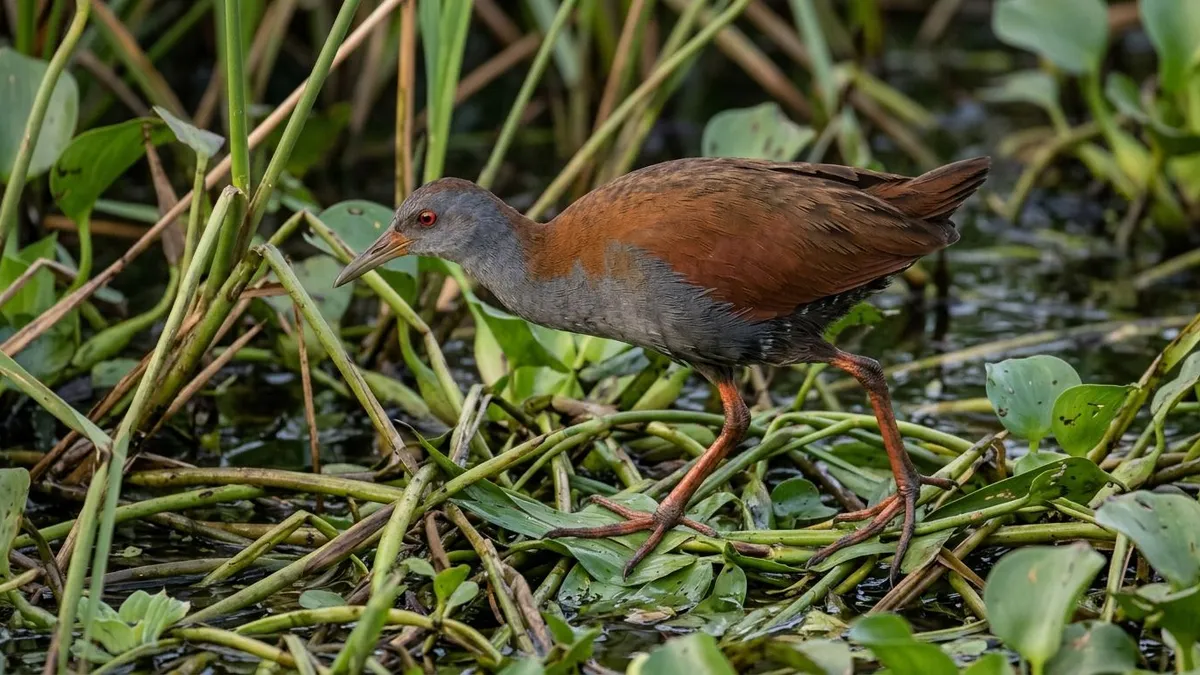
The saracura, a Brazilian rail, can move across patches of floating vegetation because its long toes distribute the weight of its body over a larger area. Instead of concentrating pressure on one point, the bird places its feet on leaves, stems and tangles of plants that sink under its steps but can hold it when the weight is shared out.
When it senses a threat, the saracura tends to use the same path and escape on foot among the plants, rather than taking off at once. Its laterally compressed body helps it squeeze through narrow gaps between stems, while a loud call, common at dusk, announces its presence in the flooded places where this behavior takes place.
How the toes hold up the walk
The saracura’s support on floating vegetation depends on the relationship between the length of its toes and the way weight is distributed. Longer toes reach different points of the surface at the same time and reduce the pressure applied to each leaf or stalk. The plant may still sink partly, but the support is not concentrated in a single small area.
This mechanism does not turn the bird into an animal light enough to ignore the resistance of the vegetation. The movement demands careful steps and constant contact with the tangle of plants. By advancing with a balanced body and spread feet, the saracura takes advantage of the uneven structure of the marsh, instead of depending only on firm ground to walk.
A narrow body for tight passages
Besides the feet, the shape of the body takes part in the movement. The lateral compression reduces the bird’s width when it crosses corridors formed by stems that grow close together. This lets the saracura move through an environment where broad leaves, roots and stalks create obstacles at several heights.
A narrow body also favors quick changes of direction. When it meets a barrier, the bird can go around it without having to clear a path with its wings or interrupt its route to gain height. Walking through the vegetation is therefore a combination of foot support, body balance and the choice of paths with the least resistance.
Why the saracura runs before it flies
Escaping on foot is a quick response in flooded areas with plant cover. By running, the saracura stays protected by leaves and stalks, which reduces how much of its body is exposed. Flight, on the other hand, requires room to move the wings and can be less convenient when the vegetation is dense or when the threat is very close.
The bird is not unable to fly. Like other members of the rail family, it can use its wings when the distance, the obstacle or the risk makes moving along the ground unsuitable. The preference for running depends on the context. In a marsh with dense plants, staying at the level of the vegetation can be a more direct and discreet option.
The moment of danger changes the strategy
The saracura may stop walking, stay among the stems and only then accelerate when it identifies danger. This sequence uses the cover of the environment and makes it harder to locate the bird by sight. The run may also follow an irregular line, tracking the spaces available between leaves and stalks, instead of crossing an open area.
The behavior is especially useful in a habitat where water limits the passage of land animals but the vegetation creates continuous surfaces. For the saracura, this mosaic works as a network of paths. The bird can move over plants, reach the edge of a firmer patch or vanish into a dense strip without having to leave the environment by flying.
A voice that connects birds in the marsh
The saracura’s loud voice stands out at dusk, when visibility drops and the vegetation can hide individuals. The sound allows birds to keep in contact without relying on a clear line of sight. In flooded areas, where leaves and stalks break up the view, this communication is useful for signaling presence and relative position.
The call does not replace escape and it is not a physical defense. It is part of the species’ communication and can occur at different times of the daily routine, although people notice it more at the end of the day. The combination of a strong voice, movement on foot and plant cover shows that the saracura makes use of both acoustic signals and the structure of the marsh.
What the saracura’s path says about the marsh
When it walks over floating vegetation, the saracura uses the growth of the plants themselves as support and shelter. Stalks, leaves and tangled roots form a patchy surface that is still enough to let a bird adapted to this kind of environment pass. The presence of these paths depends on keeping flooded areas with a diversity of plants.
This behavior also helps us see that a marsh is not just a stretch of open water. Its vegetation creates different levels of movement, shelter and feeding for many species. The saracura occupies this space without making flight the only way to cross the landscape. When a bird runs over leaves that look fragile, what appears is a precise relationship between anatomy and environment.
The saracura does not need to master the surface of the marsh in order to move across it. It is enough to combine toes that spread the support, a body able to slip through gaps and an escape adjusted to the maze of stems. This set turns floating vegetation into a passage, a cover and a boundary at the same time. Watching the bird run instead of fly moves attention from the most visible gesture to the quiet engineering behind each step. In flooded environments, survival can also mean staying close to the water, inside the vegetation and away from the most obvious path.
Reporting: Natália Santos / Amazonia Mag

Editor · Amazonia Mag
Anne Silva is the editor of Amazonia Mag, the English-language edition of Revista Amazônia. She curates, translates and adapts the outlet's science and environment coverage for an international audience, reporting on Amazon wildlife, flora, rivers, climate and research. Every story she edits is grounded in peer-reviewed studies, official data and on-the-ground reporting from the Revista Amazônia newsroom in Belém, Pará, Brazil. More by Anne Silva →