Soil on the menu
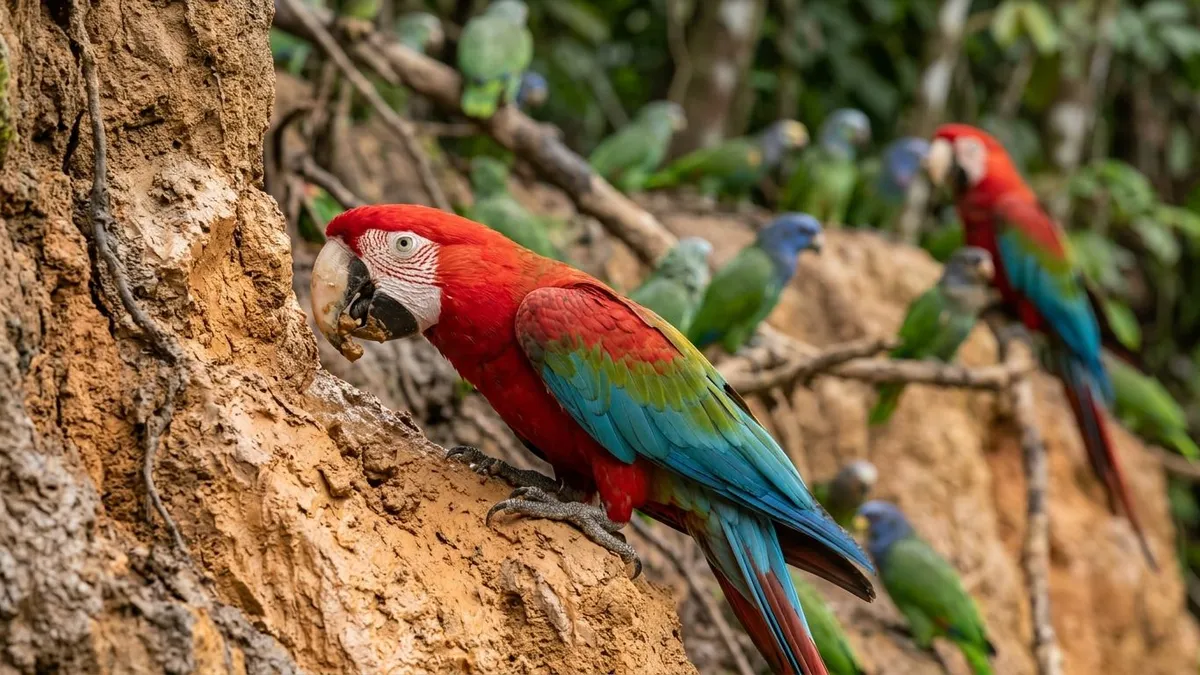
A parrot swallows small portions of clay, and the habit raises a simple question: why would a bird that feeds on seeds also eat soil? The behavior is called geophagy. It happens at clay licks, patches of exposed ground where dozens of birds can gather, take in the soil and return to the forest soon afterward. One long-standing explanation is that the clay helps the bird cope with defensive compounds found in the seeds that are part of its diet.
The clay does not replace digestion and it is not a main food. Its minerals and its structure can interact with certain molecules in the digestive tract, which may reduce the absorption of irritating or toxic substances. Meanwhile, the curved and robust beak lets the parrot break open hard seeds, widening its access to resources that other animals cannot use.
What clay can do inside the gut
Soil swallowed by a parrot travels through the digestive system together with fragments of seeds, pulp and other parts of the diet. Fine clay particles can stick to some molecules, especially when their chemical properties are compatible. This interaction can lower the amount of certain compounds that cross the intestinal wall and reach the bloodstream.
That does not mean any kind of soil neutralizes any substance. The composition of clay varies from one lick to another, just as the seeds that are eaten and the defensive compounds they produce also vary. For this reason, geophagy is better understood as a strategy that may reduce dietary risk, not as a universal cure for poisoning. The parrot selects the material available and swallows small portions as part of its natural behavior.
A second explanation: salt
The toxin idea is not the only one, and the evidence is still being weighed. Research on clay licks in southeastern Peru by Hobson and Brightsmith, published in 2017, found that the soils eaten by parrots were rich in sodium, at concentrations far above those in the plant foods the birds favor. The same work reported that the habit tracks the breeding season, which suggests that nutritional demand may be a major driver. In that part of the Amazon, the licks are far from the ocean, and the local plants contain very little sodium.
Other researchers have asked for more direct tests, such as offering clay that differs only in sodium content. For now, the most careful reading is that clay licks may serve more than one purpose. A mineral supplement and a buffer against plant defenses are not mutually exclusive, and the weight of each may change from one place and one season to another.
A beak built for hard seeds
The parrot’s beak combines a curved upper mandible, strong muscles and precise movements. The upper part rests or closes against the lower one, applying pressure to points on the shell until it breaks. Then the tongue and the beak remove the contents, so the bird reaches the seed without necessarily eating all of its outer protection.
This anatomy widens the group of plants that can enter the diet. Hard seeds protect embryos and nutritious reserves against chewing, digestion and predators, but the parrot has a tool that can overcome that barrier. The cost of such a diet is exposure to compounds produced by the plants themselves. The ingestion of clay appears, in this context, as one possible way of handling a nutritious resource that demands extra protection.
Dozens of birds at the same spot
Clay licks are areas of exposed soil, usually on riverbanks or along streams, where birds find moist material rich in mineral particles. The concentration of dozens of parrots in one place makes the behavior visible and creates a collective scene. Individuals land, observe their surroundings, drop down to take small portions and return to nearby branches.
This gathering also changes the dynamics of risk. An isolated parrot has to detect an approaching predator alone, while a group keeps many eyes on the forest and the sky. The presence of a crowd does not remove danger, but it can improve vigilance during an activity in which the birds stay concentrated near the ground. The lick therefore works at the same time as a source of mineral material and as a social meeting point.
Long-lasting pairs that share decisions
Parrots form long-term bonds and usually carry out activities in partnership with their mates. The search for food, the movements between forest areas and the visits to the lick can involve constant communication between the two birds. Calls help them stay in touch when one is on the ground and the other stays on an observation perch.
The pair bond also appears in the coordination of behavior. While one bird explores the clay, the other may remain alert to the surroundings, and they can alternate positions as the group moves. This division does not have to be rigid to offer an advantage. Pair life, combined with the gathering of many individuals, creates different levels of social protection around an important activity. The same place brings together the physiological need behind geophagy and the relationships that organize the life of the flock.
A link between soil, plants and birds
The parrots’ visits to the lick reveal a connection between the chemistry of plants and the composition of soil. Seeds provide energy, the beak gives access to them and the clay may reduce part of the defensive compounds that are absorbed. None of these elements works alone. The behavior results from the interaction among anatomy, diet, local geology and the presence of water that keeps the soil available.
When a lick is preserved, the birds keep a resource that does not appear in the treetops but influences their feeding and their movement across the landscape. Watching parrots on the ground instead of only in the trees broadens our view of the forest as a network in which even mineral particles take part in survival. Protecting the forest, in this case, means keeping both the trees that feed the pair and the places where the flock finds the conditions to process what it eats.
Reporting: Natália Santos / Amazonia Mag

Editor · Amazonia Mag
Anne Silva is the editor of Amazonia Mag, the English-language edition of Revista Amazônia. She curates, translates and adapts the outlet's science and environment coverage for an international audience, reporting on Amazon wildlife, flora, rivers, climate and research. Every story she edits is grounded in peer-reviewed studies, official data and on-the-ground reporting from the Revista Amazônia newsroom in Belém, Pará, Brazil. More by Anne Silva →