
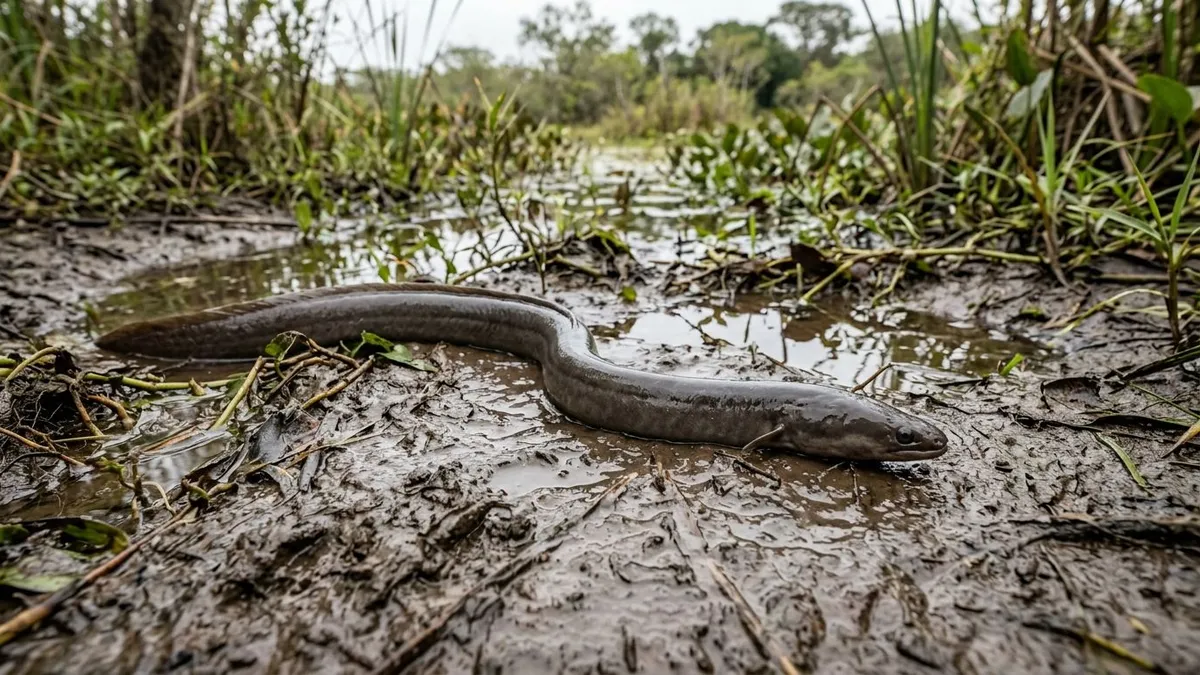
The marbled swamp eel, known in Brazil as múçum (Synbranchus marmoratus), can stay out of the water because it breathes air through the lining of its mouth and pharynx. This mechanism lets the fish cross damp earth and mud when the pool where it lives starts to dry, reaching another spot where water remains.
Its cylindrical body, without pectoral fins, helps explain its elongated look and the way it moves through swamps and waterlogged ground. Besides breathing out of the water, the fish changes sex over its lifetime, a trait that widens its reproductive options in environments where conditions can shift quickly.
How the swamp eel breathes out of the water
In most fish, water must pass over the gills for oxygen to be used. The marbled swamp eel, however, also uses the mucous lining of the mouth and pharynx to exchange gases with the air. This damp inner surface comes into contact with atmospheric oxygen when the animal stays out of the water, keeping it breathing while it moves across wet terrain.
Air breathing does not mean the fish stops depending on moisture. The lining has to stay damp to work, which is why the crossing happens over mud, waterlogged soil or damp earth, not over a completely dry surface. The mechanism gives the fish a margin of survival when the water recedes, but it relies on conditions that prevent the body and the respiratory surfaces from drying out.
An elongated body favors travel through mud
The body of the marbled swamp eel is cylindrical and elongated, with no pectoral fins. This build sets the animal apart from many fish with taller bodies and side fins used to stabilize swimming. In a swamp, the narrow shape lets the fish advance through tight spaces among mud, low vegetation and the damp material that builds up on the ground.
During a crossing, the body does the main work of propulsion and steering. The fish does not have to stay confined to an open channel to move between flooded areas, because its anatomy allows movements close to those of an elongated animal looking for a way through the substrate. The lack of pectoral fins is an important detail for understanding why the fish’s locomotion looks different from that of species that swim in more open water.
When the water dries, the fish looks for another wet area
The passage over damp ground happens when the water in a pool or swamp begins to disappear. Instead of staying stuck in the spot that is drying, the marbled swamp eel can use its ability to breathe air and advance across wet soil until it finds another place with water. The crossing turns the continuous moisture of the terrain into a route between temporary aquatic habitats.
This behavior is tied to the natural variation of swamps and muddy areas. The amount of water can shrink, crowd animals into small spaces and separate one pool from another. For the marbled swamp eel, breathing through the mouth and pharynx offers an alternative when staying submerged is no longer possible. At that moment the moisture of the soil serves both as a condition for travel and as protection against excessive loss of water.
Sex change is part of its life history
The marbled swamp eel also stands out for changing sex during its life. This transformation is not an isolated detail of its anatomy, but a trait linked to how the species organizes reproduction. The animal goes through different conditions as it grows, and its reproductive role can change over time.
In a species that lives in environments subject to changes in the amount of water, reproductive flexibility matters biologically. A change of sex lets individuals take part in reproduction at different stages of life, without every animal having to be treated as equivalent in age and function. The mechanism should not be confused with an instant change triggered by a single dried-up pool. It is a feature of the life cycle of the marbled swamp eel.
Pools, swamps and mud, joined together
When it crosses a damp stretch, the marbled swamp eel widens the space it can occupy within the swamp. The species is not limited to a single water-filled hollow, because it can move between nearby points while the water level falls. This movement connects small areas that, for fish without air breathing, might become isolated as soon as the water film disappeared.
The presence of the eel in different parts of the environment also puts the fish in contact with varied conditions of shelter and food. The swamp, in this case, is not only a set of flooded areas. Mud and wet soil are also part of the space the fish uses.
The damp environment sets the limits of the mechanism. Swamps and muddy areas give the fish the conditions it needs to combine air breathing with movement outside the water. The lining of the mouth and pharynx must keep its moisture, while the cylindrical body needs a substrate that allows it to make progress. For that reason, the ability to cross land does not turn the fish into a permanently terrestrial animal.
The behavior reveals a double dependence. The marbled swamp eel needs water to live as a fish, but it can turn to air and damp soil when water becomes scarce at one point in the swamp. This combination helps explain why conserving wetlands should also take into account the strips of mud and waterlogged ground that connect them. For the species, preserving only the pool without keeping the damp surroundings may reduce its chances of moving between habitats.
The marbled swamp eel shows that the boundary between water and land can be less rigid than it looks. Its breathing through the mouth and pharynx allows it to cross the moisture of the ground, while sex change adds another layer of flexibility to its life cycle. Looking at this fish means recognizing that survival in swamps depends on combined mechanisms, not on a single adaptation. When a pool dries up, the mud may still hold a passage, as long as the environment keeps the conditions that support the crossing.
Reporting: Natália Santos / Amazonia Mag

Editor · Amazonia Mag
Anne Silva is the editor of Amazonia Mag, the English-language edition of Revista Amazônia. She curates, translates and adapts the outlet's science and environment coverage for an international audience, reporting on Amazon wildlife, flora, rivers, climate and research. Every story she edits is grounded in peer-reviewed studies, official data and on-the-ground reporting from the Revista Amazônia newsroom in Belém, Pará, Brazil. More by Anne Silva →