
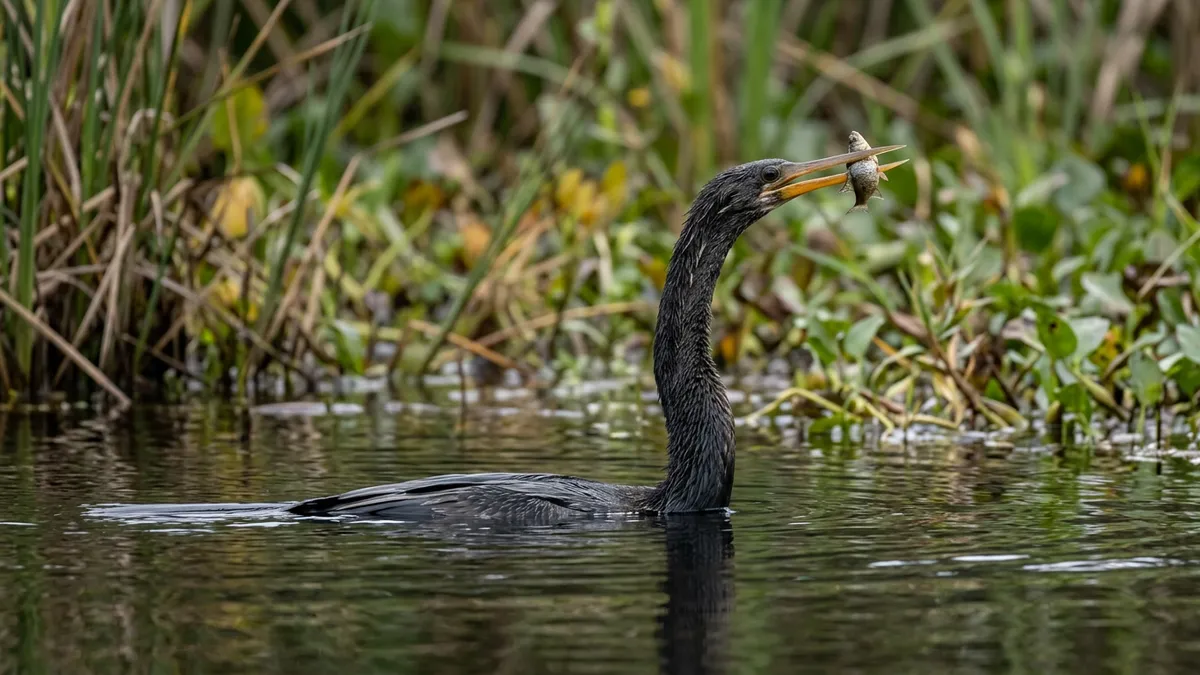
The anhinga (Anhinga anhinga), called carará in Brazil, swims with most of its body underwater and keeps only its neck above the surface to locate prey. When a fish comes within range, the bird shoots its head forward and uses its straight bill like a spear, piercing the animal instead of gripping it like a pair of tongs.
This behavior combines two physical traits. The anhinga’s feathers soak up water, which reduces buoyancy and helps the bird stay below the surface. At the same time, the joint structure of the neck concentrates force into a fast strike, letting the bird catch fish without exposing its whole body during the approach.
A waterlogged body helps the anhinga vanish into the water
The anhinga, also known in Brazil as biguatinga, has a swimming strategy unlike that of many water birds. Its feathers do not form a fully waterproof layer. Water seeps between them, reducing the air trapped against the body and lowering buoyancy. With less tendency to float back up, the bird can keep its trunk submerged as it moves forward.
The posture makes the anhinga look like a snake gliding through the water, which is why it is often called the snakebird. The neck stays in view, but the rest of the body is hidden, which limits the cues a fish can pick up. The same property of the feathers comes at a price, though. After a dive, the anhinga has to open its wings and expose its body to the air to dry them. Hunting is therefore a trade-off between underwater stealth and the need to dry out.
A straight bill works as a spear
The anhinga’s bill is long, straight and sharply pointed. That shape was not made to crush or hold prey between two surfaces, as a pincer would. The main movement is a thrust. The bird lines its head up with the fish, drives the bill forward and runs the tip through the prey’s body.
After the strike, the anhinga pulls back its head and repositions the fish to swallow it. Capture demands precision, because the bill does not hold a slippery prey as well as a hooked or strongly compressed bill would. Distance and angle of attack therefore matter. The more direct the strike, the lower the chance that the fish escapes before it is pierced.
The neck stores force and fires the head
The anhinga’s neck does more than hold the head above water. It works as an attack structure, with joints, muscles and vertebrae that let the bird fold and extend the neck at high speed. The bird holds its head in position, concentrates the movement and releases the extension in a short strike, much like a spring being released.
This mechanism reduces the need to move the whole body at the moment of capture. The trunk stays relatively steady while the head covers the short space between the bird and the fish. Separating travel from attack makes the strike more discreet. To the prey, the decisive movement takes place in a fraction of the time during which the bird seems only to float and watch.
The hunt begins with a silent approach and ends in a precise strike
The anhinga can swim with its body submerged to approach fish in shallow water or in areas where vegetation offers cover. The low posture reduces the visible part of the predator. Rather than chasing prey over long distances at the surface, the bird tries to reach a position from which it can use its neck as a weapon.
The strike is triggered when the fish enters the range of the bill. The bird does not have to plunge its whole body at the moment of attack, because its head is already aligned with the prey. This economy of movement helps conserve energy and reduces turbulence in the water. It also explains why an anhinga can look motionless before it acts. Stillness is not an absence of activity but preparation for a mechanical, directed attack.
How it differs from birds that grab fish
Many water birds catch fish, but they do not necessarily use the same combination of reduced buoyancy, submerged swimming and thrusting. Herons usually wait in shallow water and throw the neck forward from a standing position. Diving ducks use the bill to grab or filter food. The anhinga follows another sequence: it sinks its body, approaches with the neck exposed and pierces the prey.
The comparison with the Neotropical cormorant, known in Brazil as biguá, is useful because both birds have feathers that get wet and can chase fish underwater. Even so, the anhinga’s capture tool is clearly specialized. Its straight bill and jointed neck favor the spear, and the bird relies on coordination among vision, swimming and rapid extension of the head. The result is a technique of its own for moving prey in aquatic environments.
In flooded environments, the anhinga links water and shoreline. It occurs in rivers, lakes, marshes, small forest streams and other areas with water and fish. By swimming below the surface, it explores a band of the habitat that is not reached in the same way by birds that hunt only along the margins. Catching fish transfers energy from the aquatic system to the bird, which rests, digests and breeds in nearby areas.
The presence of the anhinga also shows how an adaptation can involve the whole body, not just one isolated structure. Feathers that soak up water favor submersion, the neck fires the attack and the bill pierces the prey. Watching the bird means following that sequence at work. In waters where the surface looks calm, an exposed neck may signal that the most important part of the hunt is taking place beneath it.
The anhinga shows that the efficiency of a predator does not depend on looking imposing, but on turning limitations into coordination. Feathers that absorb water, an inconvenience for staying dry, help hide the body. A flexible neck, used to hold the head up, becomes a firing mechanism. And a straight bill, poorly suited to pinching, finds its purpose as a spear. At the surface only a small part of the bird remains. Below it, a precise chain of movements links anatomy, behavior and habitat.
Reporting: Natália Santos / Amazonia Mag

Editor · Amazonia Mag
Anne Silva is the editor of Amazonia Mag, the English-language edition of Revista Amazônia. She curates, translates and adapts the outlet's science and environment coverage for an international audience, reporting on Amazon wildlife, flora, rivers, climate and research. Every story she edits is grounded in peer-reviewed studies, official data and on-the-ground reporting from the Revista Amazônia newsroom in Belém, Pará, Brazil. More by Anne Silva →