
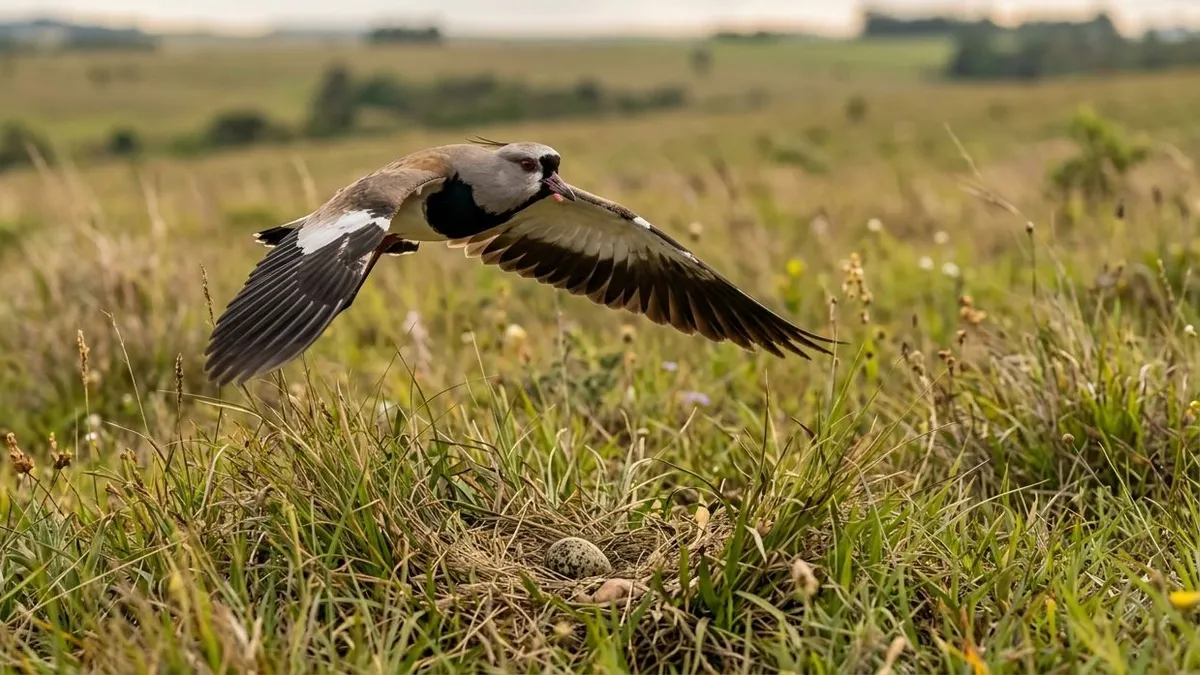
The southern lapwing (Vanellus chilensis), known in Brazil as quero-quero, uses a spur on the bend of its wing during low, swooping flights to drive off animals that come near its nest. The bird does not have to be bigger than the intruder to start the defense. It climbs, calls and dives toward the target, exposing the pointed structure on its wing in a charge that can make a mammal or a larger bird back away.
This strategy works together with a shallow nest placed directly on the ground, where the eggs blend into their surroundings. When danger appears, the pair also gives repeated calls that act as an alarm for other lapwings and can alert other species sharing the field. The defense therefore combines physical attack, camouflage and collective vigilance.
How the spur takes part in the low dive
The spur sits at the bend of the wing. When the lapwing opens its wings during a charge, that structure can be presented to the animal approaching. The move is more than a low flight over the intruder. The bird picks a directed path, passes close to the target and uses the wing as an instrument of threat and contact. The fast approach raises the pressure on the intruder, which has to deal at once with a loud call, an abrupt change of direction and the chance of being hit.
During the defense the lapwing may repeat the low dive several times. The larger animal does not have to be injured to leave the area. The combination of a close pass and a pointed structure makes approaching costlier than any benefit of pressing on. This behavior is especially useful on open ground, where the bird can spot an intruder from far away and gain room to maneuver before passing over the nest.
Wing and body work together
The spur is only one part of the defensive mechanism. The lapwing has long legs, a body suited to life on the ground and wings capable of quick changes of direction. These traits let the bird alternate between staying close to the nest and flying at the intruder. Body posture adds to the threat. With open wings and continuous calls, the lapwing looks bigger and makes it clear that the approach has been detected.
The defense does not depend on the strength to pin down a predator. It depends on precision, repetition and controlled exposure. The bird chooses when to leave the ground, at what height to fly and how close to pass the target. If the intruder keeps advancing, the pair can keep up the pressure with new dives. A structure on the wing becomes part of a set of movements that protects the area without a long fight on the ground.
A shallow nest hides the eggs in the open field
The nest is a shallow depression in the ground, with little material around it. This choice keeps the structure low and helps the eggs merge with the colors and shapes of the terrain. In grassland, the ground can hold dry leaves, plant fragments and small irregularities. Camouflaged eggs benefit from that visual background, especially when an adult moves away to draw the intruder’s attention and lead it off from the breeding area.
Camouflage, however, does not make the nest invisible in every situation. An animal walking straight over the spot can find the eggs by smell, movement or contact. That is why the aerial defense complements the disguise. While the eggs stay still, the adult reveals its presence in the sky and directs the risk toward itself. The system divides the roles: hide what cannot flee, and drive away whoever comes too close.
When the bird attacks a bigger animal
The lapwing triggers its defense when it identifies a threat near the nest or the chicks. The reaction can occur in the face of mammals, birds and other animals that cross the breeding area. The intruder’s size does not prevent a response. If anything, a large animal can be seen as a greater risk, because its steps and movements could reach the eggs quickly. The call starts to organize the reaction even before any physical contact.
The low dive creates an exclusion zone around the nest. The bird passes over the intruder, comes back and repeats the approach, keeping the target under pressure. More than one adult can take part, which increases the number of flights and calls. For an animal that is simply crossing the field, pressing on stops being a neutral act. The insistent presence of the lapwings signals a vulnerable breeding spot that is being actively protected.
The call that makes the field’s sentinel
The lapwing’s calls are a central part of the defense. By calling in the face of risk, the bird announces an intruder to members of its own species nearby. The warning also reaches other species in the field, which may stop what they are doing, look for cover or pay closer attention to their surroundings. The behavior of one pair is therefore not limited to protecting its own eggs.
This sentinel effect depends on visibility and sound in open terrain. In a field with few obstacles, the low dive can be seen from a distance while the alarm spreads across the area. Other animals do not need to understand the exact reason for the call to react to the change. The link between intense calling, unusual movement and the presence of a predator creates useful information for the community. The lapwing turns territorial defense into a signal that can benefit its neighbors.
The mix of spur, low dive, camouflage and alarm suits environments where the nest is exposed. With no trees or shrubs nearby, the adults cannot fully hide the breeding site or move the eggs somewhere else. The alternative is to detect the threat early and control the distance between the intruder and the nest. A clear view of the field favors this vigilance, while the wings let the bird reach any point of the protected area quickly.
The ecological result goes beyond the survival of a single brood. By keeping larger animals at a distance and signaling danger, the lapwing takes part in the dynamics of a space used by many species. Its behavior shows that defending a nest can depend as much on a body structure as on shared information. In a field where the ground seems to offer little protection, the bird uses its own body, its voice and its behavior to build a moving barrier around lives that cannot yet defend themselves.
The southern lapwing shows that protecting a nest does not mean staying hidden. In an open landscape, the strategy can be exactly the opposite: an adult that is visible, noisy and insistent, while the eggs stay discreet on the ground. The spur reinforces that message, but it is the combination of anatomy, timing and communication that gives the defense its reach. Every low dive also changes the behavior of whoever crosses the field, a reminder that shared landscapes have their own signs of vigilance, which we often notice before we understand them.
Reporting: Natália Santos / Amazonia Mag

Editor · Amazonia Mag
Anne Silva is the editor of Amazonia Mag, the English-language edition of Revista Amazônia. She curates, translates and adapts the outlet's science and environment coverage for an international audience, reporting on Amazon wildlife, flora, rivers, climate and research. Every story she edits is grounded in peer-reviewed studies, official data and on-the-ground reporting from the Revista Amazônia newsroom in Belém, Pará, Brazil. More by Anne Silva →