
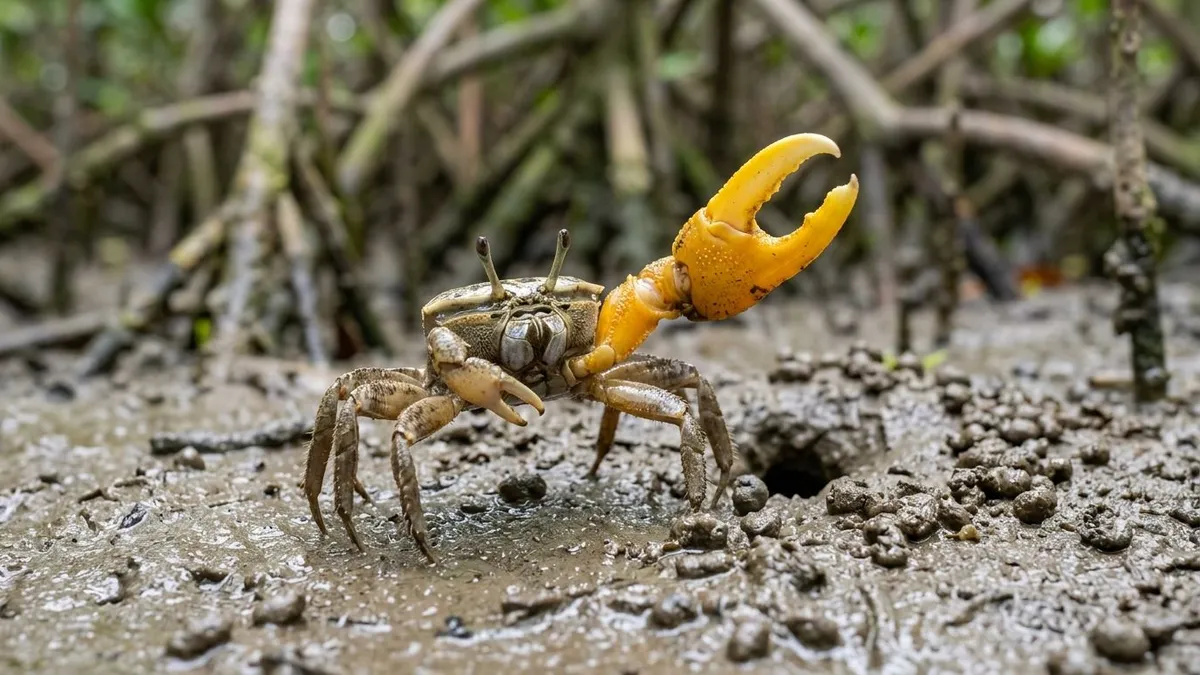
The male fiddler crab shows an extreme body asymmetry: one claw, or chela, many times larger than the other. This oversized structure plays no part in feeding. It is used only as a visual signal in courtship rituals and in the defense of territory at low tide in mangrove ecosystems.
While the small claw works nonstop gathering sediment and filtering organic matter, the large claw carries out calculated sequences of waves in the air. These rhythmic movements work as a precise visual language, able to attract females for mating and to push back rival males that try to invade the underground gallery built by the owner.
The mechanics of the wave and visual signaling
The movement of the larger claw follows a repeated vertical and circular path that changes in frequency and amplitude depending on which other crabs are around. By lifting the heavy limb above the carapace, the male stretches the structure toward the sunlight and creates a clear visual contrast against the dark background of the mangrove mud. The rhythmic repetition turns the claw into a kinetic beacon that can be seen from far away.
The pace of the wave speeds up as a female approaches the burrow. This faster rhythm demands a large amount of energy and shows the physical ability of the individual. If another male comes close with territorial intentions, the pattern of movement changes to threat postures, with the claw held open and raised to project an even bigger body size.
Adaptive anatomy and functional asymmetry
The asymmetry of the fiddler crab develops during the growth of the animal, when one of the claws goes through a marked enlargement. This larger pincer loses the ability to align its tips to pick up small particles, and becomes useless for taking in food. In return, the muscles inside the base of the limb grow stronger to support and move a mass that is huge in proportion to the body.
The small claw keeps its original working form, with specialized bristles and slender tips that move quickly. While the large claw stays raised or at rest in a defensive pose, the small pincer makes hundreds of movements per minute, carrying wet substrate straight to the mouth. There the mouthparts filter out the organic matter before the inert sediment is rejected in the form of tiny balls.
The tidal cycle and the timing of displays
The display activity of the fiddler crab is tightly governed by the tidal cycle. As soon as the water pulls back and exposes the mud banks, the males come out of their burrows and begin their visual rituals. The window of time on exposed ground is limited, which demands maximum efficiency both in feeding and in the search for reproductive partners before the tide rises again and floods the area.
The peak of wave intensity comes at times of high crab density on the surface, when hundreds of individuals compete at once for the attention of females. The strong sun that brings out the colors of the claw, together with the dry surface of the sediment, creates ideal conditions for the visual signal to be seen without the interruptions caused by moving water.
Energy cost and evolutionary advantage
Carrying a structure that makes up a significant share of the total body weight imposes a high evolutionary cost on the fiddler crab. The giant claw lowers the escape speed of the animal in front of predators and limits its ability to look for food with both claws. Even so, sexual selection makes up for this disadvantage, since males with larger claws and more vigorous waves have greater reproductive success.
The large pincer is also an efficient tool for avoiding tiring physical fights. In most territorial disputes, simply showing the size of the claw and performing threat waves is enough to make the rival back off. In this way the animal avoids serious injuries to its shell or the loss of limbs in direct fights for control of the ground.
Building and defending the burrows
Each fiddler crab builds and maintains its own burrow, dug into the sediment of the mangrove. The burrow serves as a refuge from predators, a shelter during low tide and a place for mating. The owner defends the entrance strictly, standing in the opening while it shakes its enlarged claw to signal ownership to neighbors and passersby.
When the visual signal does not stop an intruder from advancing, the males engage in contests of strength and use the giant claws as levers. They lock their claws together in a pushing match at the entrance of the gallery. The loser is driven off and must look for a new space in the sediment or compete for an empty burrow, which means that only the strongest individuals hold the best shelters.
Ecological engineering and mangrove dynamics
The constant digging of burrows and the movement of sediment by fiddler crabs aerate the muddy substrate of the mangrove. By turning over mud that is saturated with water and poor in oxygen, these crustaceans help air reach the deeper layers of the soil, which directly benefits the root systems of mangrove trees and encourages the breakdown of organic matter.
Filtering sediment for food removes microalgae, bacteria and debris, and helps recycle nutrients in the coastal ecosystem. The intense biological activity of these crabs turns stagnant mud into a dynamic environment, supporting the productivity of the mangrove and serving as a base for the food chain of many fish and sea birds.
The complex visual signaling of the fiddler crab shows how evolution shapes extravagant anatomical structures to secure the continuity of a species. The balance between the cost of keeping a tool used only for ritual and the ecological benefits of constant digging shows how connected the mangrove is. Each wave over the mud not only decides the reproductive fate of the individual, but also drives the biogeochemical processes that keep the whole estuarine ecosystem alive.
Reporting: Natália Santos / Amazonia Mag

Editor · Amazonia Mag
Anne Silva is the editor of Amazonia Mag, the English-language edition of Revista Amazônia. She curates, translates and adapts the outlet's science and environment coverage for an international audience, reporting on Amazon wildlife, flora, rivers, climate and research. Every story she edits is grounded in peer-reviewed studies, official data and on-the-ground reporting from the Revista Amazônia newsroom in Belém, Pará, Brazil. More by Anne Silva →