
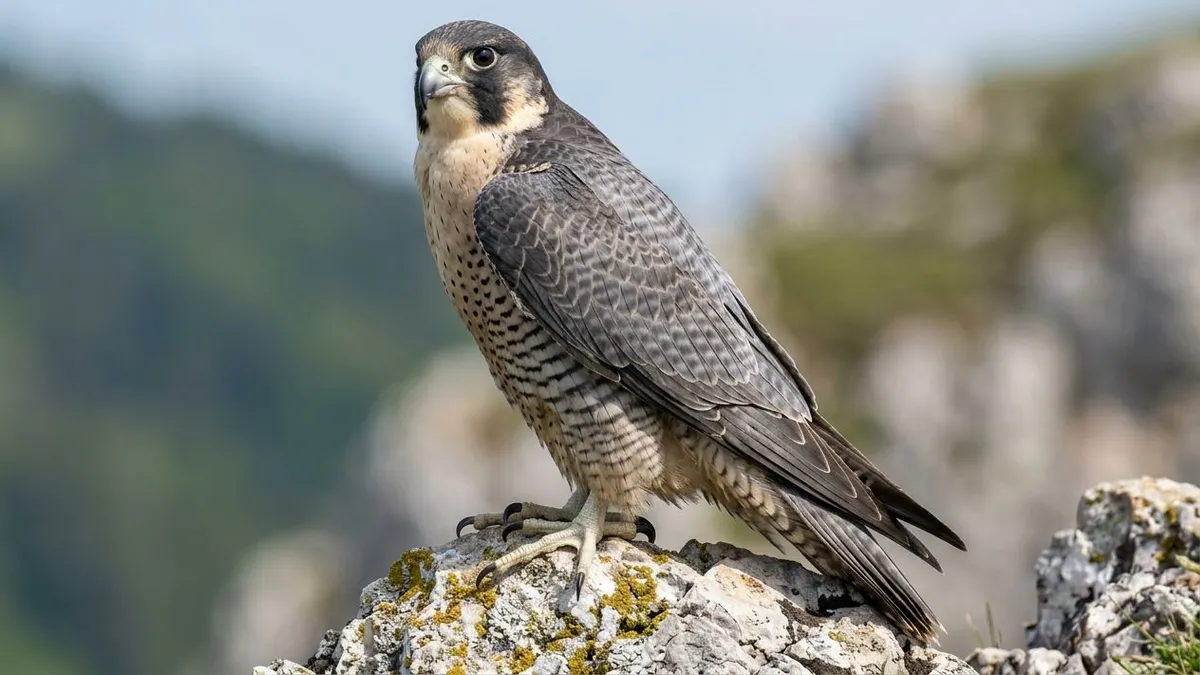
The peregrine falcon performs the fastest hunting maneuver recorded in the animal kingdom, known as the stoop, or vertical dive. During this controlled descent, the bird of prey passes 186 mph (300 km/h), turning the acceleration of gravity into raw mechanical force to reach other birds flying in open air.
The efficiency of the attack does not depend on grabbing the prey at once. The falcon folds its toes and keeps its talons locked in the shape of a rigid fist, colliding head-on with the target at hundreds of kilometers per hour. In many attacks the impact carries enough kinetic energy to injure the skeleton of the victim on the spot.
Extreme aerodynamics and the mechanics of the dive
Reaching such speeds without losing control of the trajectory requires the body of the peregrine to change shape in flight. On spotting prey hundreds of yards below, the bird pulls its wings in close to the trunk and adjusts the angle of the primary feathers to cut air resistance. This configuration turns the outline of the animal into something close to a teardrop, which brings aerodynamic drag down to the lowest value it can reach.
Stability during a high-speed descent comes from small adjustments of the tail and shoulders. This tight alignment keeps turbulence from pushing the bird off its line, so the falcon can hold a precise path toward a moving target even when the air is unstable. The dive is not a simple fall. It is a steered approach in which the hunter keeps correcting its course until the moment of contact.
Nasal tubercles and breathing at high speed
Breathing at speeds above 186 mph (300 km/h) is a serious physical challenge, because the pressure of the air entering the nostrils could damage delicate lung tissue. The skeleton of the peregrine offers a possible answer: small cone-shaped projections inside each nostril, known as nasal tubercles. They are thought to work as flow deflectors, slowing the incoming air before it reaches the internal airways.
According to this explanation, the deflection channels the air in a spiral, lowers its dynamic pressure and lets the respiratory system keep working steadily throughout the dive. The exact role of the tubercles is still discussed among specialists, so it is best described as a widely accepted hypothesis and not as a closed question. What is clear is that a bird that dives at this speed must solve the problem of taking in air, and its anatomy shows a specialized structure exactly where the airflow arrives.
Eye protection and the third eyelid
The eyes of the bird must stay fixed on the prey during the whole length of the fall, facing the instant drying caused by the strong wind. Visibility is kept by the nictitating membrane, a transparent third eyelid that slides horizontally across the cornea. This structure cleans the surface of the eye and spreads a thin film of tear fluid without blocking the light or the perception of depth.
The eye of the falcon also carries a very high density of foveae, the retinal regions with concentrated photoreceptors. This anatomy allows the predator to process images much faster than a human can. With that quick visual processing, the bird can recalculate the distance to the target and correct its route in fractions of a second while it is still accelerating.
The physics of a closed-foot strike
The killing technique of the species differs from the capture behavior of most raptors. Instead of slowing down to hold the prey with open toes, the peregrine closes its feet into a rigid fist at the exact moment of contact. The mass of the bird, multiplied by its speed, concentrates a large force on a small contact area.
The collision reaches the spine or the head of birds such as pigeons and ducks, causing sudden trauma to the bone structure of the target. In many attacks the prey dies at the instant of the shock and falls toward the ground. The falcon then collects it in the air or right after the fall, which reduces the risk of a struggle that could damage the plumage of the hunter.
Hunting on the move and in open ecosystems
Although the peregrine is a species with a global distribution, individuals of the migratory subspecies travel from the Northern Hemisphere to South America during the northern winter. In Brazil these birds use open ecosystems, such as the seashore, the banks of calm rivers and savanna formations, where the lack of dense vegetation makes it easier to watch the sky and carry out vertical dives.
In these stopover habitats the falcon takes part in the control of waterbird and shorebird populations, selecting individuals that fly in the open. The habit of hunting from great height demands large, unobstructed stretches of land, which makes flat and open areas the key points for successful attacks along its continental routes.
Life in the city and the role of a top predator
Conservation and reintroduction programs over recent decades have shown how flexible the peregrine is in environments changed by people. Large cities offer skyscrapers and communication towers that work as substitutes for the rock walls and cliffs where the bird originally nests and watches its territory.
The steady supply of urban prey, such as domestic pigeons, gives the predator a constant food source. The presence of these raptors in city centers restores a regulating dynamic at the top of the food chain, reducing the concentration of urban pests without chemical intervention or artificial control by human populations.
The flight of the peregrine falcon shows how extreme anatomical adaptations and refined behavior work together to secure the survival of a top predator. Understanding the mechanics of the dive and the precision of the hunt reveals the degree of specialization that evolution shaped in an animal that depends on mastering the air to thrive.
Reporting: Natália Santos / Amazonia Mag

Editor · Amazonia Mag
Anne Silva is the editor of Amazonia Mag, the English-language edition of Revista Amazônia. She curates, translates and adapts the outlet's science and environment coverage for an international audience, reporting on Amazon wildlife, flora, rivers, climate and research. Every story she edits is grounded in peer-reviewed studies, official data and on-the-ground reporting from the Revista Amazônia newsroom in Belém, Pará, Brazil. More by Anne Silva →