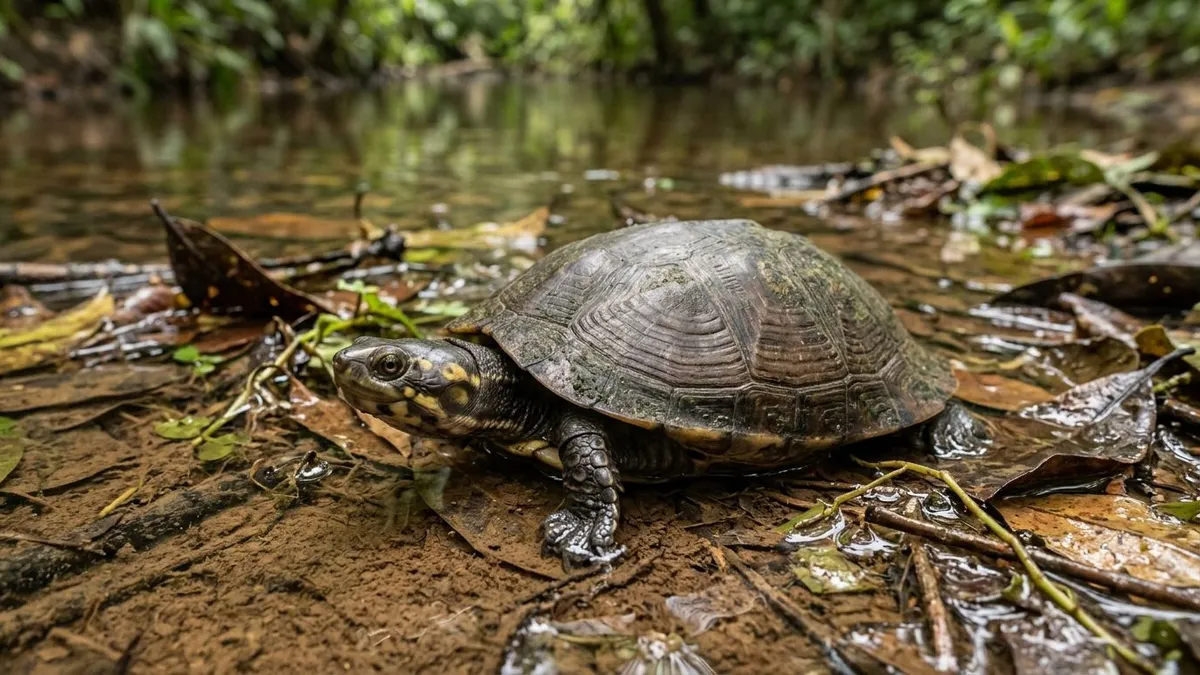
On the bank of a shallow stream, between still water and a muddy bed, a dark stone resting on the bottom may turn out to be a scorpion mud turtle, known in Brazil as the muçuã (Kinosternon scorpioides). It is one of the smallest turtles in the Amazon region, a low-profile animal that spends much of its life in the shallow water of streams, swamps and floodplains.
What sets it apart is how it protects itself: it shuts its shell with a hinge on its underside, buries itself in mud when the water disappears, and releases a strong-smelling substance when disturbed.
A small turtle that closes its shell
In a study published in 2024 in the Brazilian Journal of Biology, researchers captured 206 individuals in the transition zone between the Amazon and the Cerrado in northeastern Brazil. Adults had a shell length of 3.9 to 7 inches (98 to 178 millimeters), most of them between 4.7 and 6.3 inches (12 to 16 centimeters). The largest males can exceed that: the guide Turtles of the World cites up to 10.6 inches (27 centimeters) for the nominate subspecies, and the PPBio turtle catalog, linked to the National Institute for Amazonian Research (INPA), records a weight of up to 1.1 pounds (500 grams).
What defines the animal’s protection is its shell. The muçuã belongs to the family Kinosternidae and the suborder Cryptodira. According to Turtles of the World, the plastron, the lower part of the shell, has a movable joint between the pectoral and abdominal plates. That hinge lets the turtle raise the front and rear sections against the upper shell and close the shell opening after the head and legs have been tucked in.
How completely the shell closes depends on the source. The guide notes that the plastron does not always cover the whole opening, while the PPBio/INPA catalog describes it as hinged and long enough to close the shell completely. Either way, the hinge turns the animal’s body into a nearly sealed box.
When handled or threatened, the muçuã also turns to chemistry. The Brasília Zoo reports that the species releases a strong-smelling substance, musk, produced by glands near the hind legs.
Neck pulled straight back, not sideways
Turtles fall into two large groups according to how they hide the head. In a study published in 2017 in Scientific Reports, researchers linked to the Jurassica Museum and the University of Fribourg in Switzerland describe how cryptodires retract the neck in the vertical plane, between the shoulder girdles, while pleurodires bend the neck sideways and protect the head under the front edge of the shell.
The muçuã is a cryptodire, like the other members of its family: the head is pulled directly back into the shell. This is the picture most people have in mind when they imagine a turtle hiding.
South America’s pleurodires belong to the families Chelidae and Podocnemididae, the latter including the river turtles and yellow-spotted side-neck turtles of the genus Podocnemis. These are the ones that tuck their necks sideways in Amazonian rivers. The muçuã takes a different route: it pulls in head and legs and relies on its hinged plastron to seal the opening.
Shallow water, vegetation and mud in the dry season
According to PPBio/INPA, the muçuã occurs from Mexico to Argentina and is one of the most widely distributed turtles in the Neotropics. In the 2024 study, the authors describe a preference for shallow, still aquatic environments with vegetation and water between 81 and 86 degrees Fahrenheit (27 to 30 degrees Celsius). The species uses flooded plains, streams and drier land, and the animals move according to the water available: the study recorded movements of up to 4.6 miles (7.41 kilometers) between nesting areas and feeding areas.
When drought shrinks the stream or the pond, the animal buries itself. Turtles of the World records that if the watercourse dries up, the muçuã sinks into the muddy bottom until the next rains. Researchers from the Baixada Maranhense, in a 2025 article in the Brazilian Journal of Biology, describe this behavior as estivation by self-burial, a dry-season rest that lowers metabolic demand and helps the animal cope with the heat.
That ability helps explain how the species can persist in places where water does not last all year. The animal does not have to travel to another body of water: it waits under the mud for the rain to return.
An omnivore that leans toward meat
PPBio/INPA classifies the muçuã as an omnivore with a carnivorous tendency, eating fruit, seeds, algae, fish, amphibians and carrion. Turtles of the World adds insects and snails to the list. That flexibility lets it use whatever the bottom and the banks offer in each season.
A varied diet makes sense in environments that change with the water level. When a stream is high, a different kind of food is available than when it shrinks to pools, and an animal that eats almost anything does not depend on a single source.
Eggs on the ground and pressure on populations
The muçuã builds shallow nests on land. PPBio/INPA reports that the female lays 2 to 6 eggs and that the sex of the hatchlings depends on incubation temperature. In the northeast, the 2024 study found eight nests buried next to grass of the genus Andropogon, about 4 inches (10 centimeters) deep, with 3 to 4 eggs each, all in the dry season, between August and December.
The species is assessed as Least Concern (LC) by ICMBio, Brazil’s federal conservation agency, meaning no extinction risk across the territory as a whole. That does not remove local pressures. PPBio/INPA points to local declines caused by the consumption of adults and eggs and by habitat loss. In the area studied in 2024, the researchers reported that introduced buffalo and pigs threaten egg survival and recruitment of young, that is, the entry of new individuals into the population.
Shallow streams and vegetated banks therefore concentrate both the feeding and the nesting of the species. Protecting those small environments also means protecting an animal that goes almost unnoticed.
Reporting: Natália Santos / Amazonia Mag

Editor · Amazonia Mag
Anne Silva is the editor of Amazonia Mag, the English-language edition of Revista Amazônia. She curates, translates and adapts the outlet's science and environment coverage for an international audience, reporting on Amazon wildlife, flora, rivers, climate and research. Every story she edits is grounded in peer-reviewed studies, official data and on-the-ground reporting from the Revista Amazônia newsroom in Belém, Pará, Brazil. More by Anne Silva →