
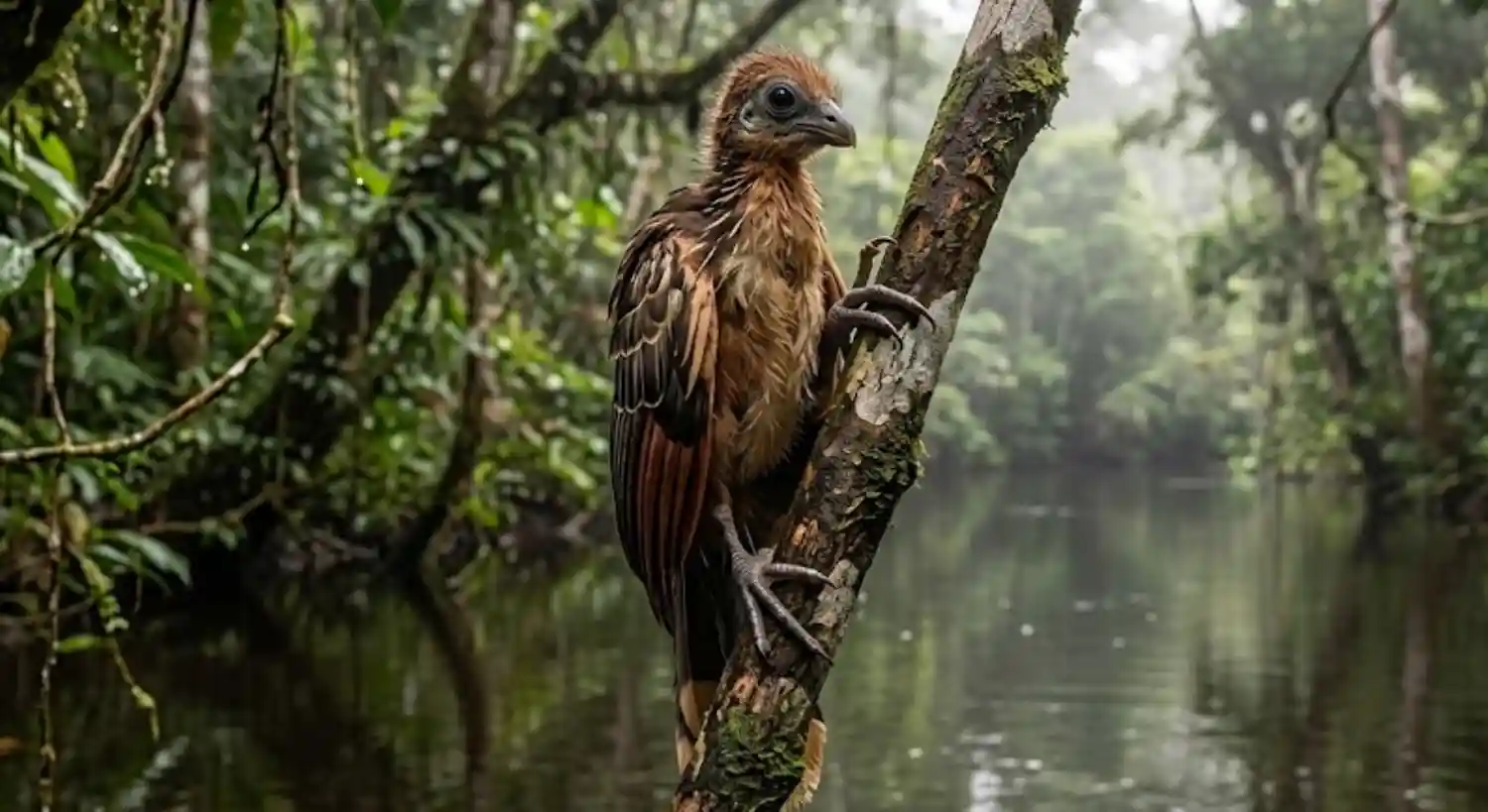
The hoatzin, known in Brazil as cigana, displays one of the most singular evolutionary traits in the whole of world birdlife: it is the only bird in the country whose chicks are born with functional claws on the tips of their wings. This temporary anatomical structure serves a critical survival function during the first weeks of life, inside flooded forests and blackwater igapo areas. Established ornithological facts indicate that these sharp bony appendages allow young birds to climb the marginal vegetation with agility, offering an efficient escape route from aquatic and terrestrial predators well before their flight feathers are fully developed.
Nests are built strategically on branches that project directly over the surface of rivers and calm lakes. When a potential danger is detected, such as an approaching monkey or a bird of prey, the chick of Opisthocomus hoazin throws itself straight into the water, submerging to escape the attack. Once the threat has passed, the animal uses the claws on the digits of its wings, working in coordination with its robust feet, to climb the vertical trunk of the tree and return to the original nest. It is a form of four limbed locomotion that vanishes completely in the adult phase.
How the juvenile claws work
The presence of these claws on the forelimbs points back to anatomical specializations that disappeared in almost every lineage of modern birds over the long course of natural selection. In the first days after hatching, the chick shows two well developed hooks on each wing, positioned on the first and second digit of the skeletal structure of the forelimb. The claws carry a high density of keratin and a precise curvature that guarantees immediate mechanical grip on the rough bark of tropical trees, supporting the full weight of the animal during a vertical climb.
As the young bird develops and reaches roughly three to four weeks of age, the flight feathers begin to grow and cover the tip of the wing, shifting the motor function of the limb toward gliding flight. As a result, the claws undergo a natural process of biological reabsorption and atrophy, losing their practical usefulness and disappearing entirely before the bird reaches sexual maturity. This morphological transition is an exact answer to the vulnerability of the nestling stage, protecting the physical integrity of the individual precisely in the window when it is most exposed to environmental predation pressure.
Digestion by leaf fermentation
Beyond the unusual locomotion of its chicks, the hoatzin shows a physiological specialization that is unique among birds, based on a bacterial fermentation system that mimics the stomach of ruminant mammals. Its diet consists almost exclusively of green leaves from aquatic plants and floodplain trees, a food source that is abundant in the Amazon yet extremely rich in cellulose and chemically hard to break down. To process this fibrous plant matter, the bird has a hypertrophied crop and esophagus that operate as active fermentation chambers, where symbiotic microorganisms decompose the cell walls of the plants.
This internal digestive arrangement is so voluminous that it alters the skeletal and muscular distribution of the animal itself, occupying the space that in most birds is reserved for the pectoral flight muscles. Because the crop packed with fermented leaf mass accounts for a significant share of body weight, the keel of the sternum is reduced and the active flight capacity of the hoatzin becomes limited and heavy, restricting its movement to short glides between neighboring canopies. The metabolic priority of the organism is directed toward the slow extraction of nutrients from cellulose, securing its caloric needs from a food base that almost every other bird ignores.
A distinctive odor and a social life
The continuous bacterial fermentation inside the digestive tract produces a secondary chemical consequence: it gives the bird a strong and distinctive body odor, frequently compared to the manure of large herbivores. That penetrating smell works as an indirect chemical defense against medium sized predators and, historically, discouraged human populations in the region from eating its meat, shielding the species from systematic hunting pressure. The slow metabolism also requires the animal to spend long hours of the day resting on sunlit perches along riverbanks, waiting out a digestive cycle that can last more than a full day for each portion of leaves.
Social groups of hoatzins are territorial and maintain a cooperative breeding structure, in which young individuals from earlier broods stay with the reproductive pair to help defend the territory and feed the new chicks. This social cooperation raises survival rates for the offspring in seasonal floodplain environments, where fluctuations in water level change both the availability of tender young leaves and the density of predators in the area. Communication between members of the flock happens through hoarse calls and rough hissing sounds that echo along the riverbanks at dawn, coordinating collective foraging movements.
Conserving river habitats
The survival of populations of this improbable bird is directly tied to the ecological integrity of riparian forests and the connected water networks of the Amazon basin. Replacing native vegetation along riverbanks with pasture or agricultural monoculture eliminates the fruit trees and the specific botanical species that supply the soft leaves the digestive system of the bird depends on. On top of that, the removal of low branches that touch the water surface makes the escape and climbing mechanism of the chicks unworkable, interrupting the natural reproductive cycle that keeps colonies renewed across the seasons.
Preserving these floodable microhabitats acts as a safeguard for the entire community of vertebrates that share the transition zones between land and water in the Amazon. Understanding the biological needs of the hoatzin reinforces the value of establishing permanently protected areas along watercourses, ensuring that evolutionary and adaptive processes keep operating autonomously in the wild. The persistence of species carrying such extreme specializations is a reliable indicator of the structural health of Brazilian tropical forests under external pressures of landscape modification.
The claws on the wing digits of the chicks function as temporary mechanical anchors in the bark of floodplain trees. That fixation system is what allows a juvenile to return to the nest after throwing itself into the water to escape a predator, a positional adaptation of remarkable precision for survival in the flooded environments of the forest. Nothing about it is decorative: every element, from the curvature of the hook to the timing of its reabsorption, is calibrated to a narrow and dangerous window of early life.
Studying the biology of the hoatzin is an invitation to reflect on the immense plasticity of the life forms that inhabit Brazilian territory, and on how evolution develops unexpected paths to solve the challenges of survival. The temporary claws on the wings of the chicks and the fermentative digestion of leaves are proof that biodiversity conceals complex mechanisms binding anatomy, physiology and behavior together in ways that cannot be separated. Protecting the natural flow of the waters and the density of igapo forests means guaranteeing that these singular biological solutions continue to exist and to enrich the natural heritage of the planet.
Reporting: Anne Silva / Amazonia Mag. Source: Revista Amazônia.

Editor · Amazonia Mag
Anne Silva is the editor of Amazonia Mag, the English-language edition of Revista Amazônia. She curates, translates and adapts the outlet's science and environment coverage for an international audience, reporting on Amazon wildlife, flora, rivers, climate and research. Every story she edits is grounded in peer-reviewed studies, official data and on-the-ground reporting from the Revista Amazônia newsroom in Belém, Pará, Brazil. More by Anne Silva →