
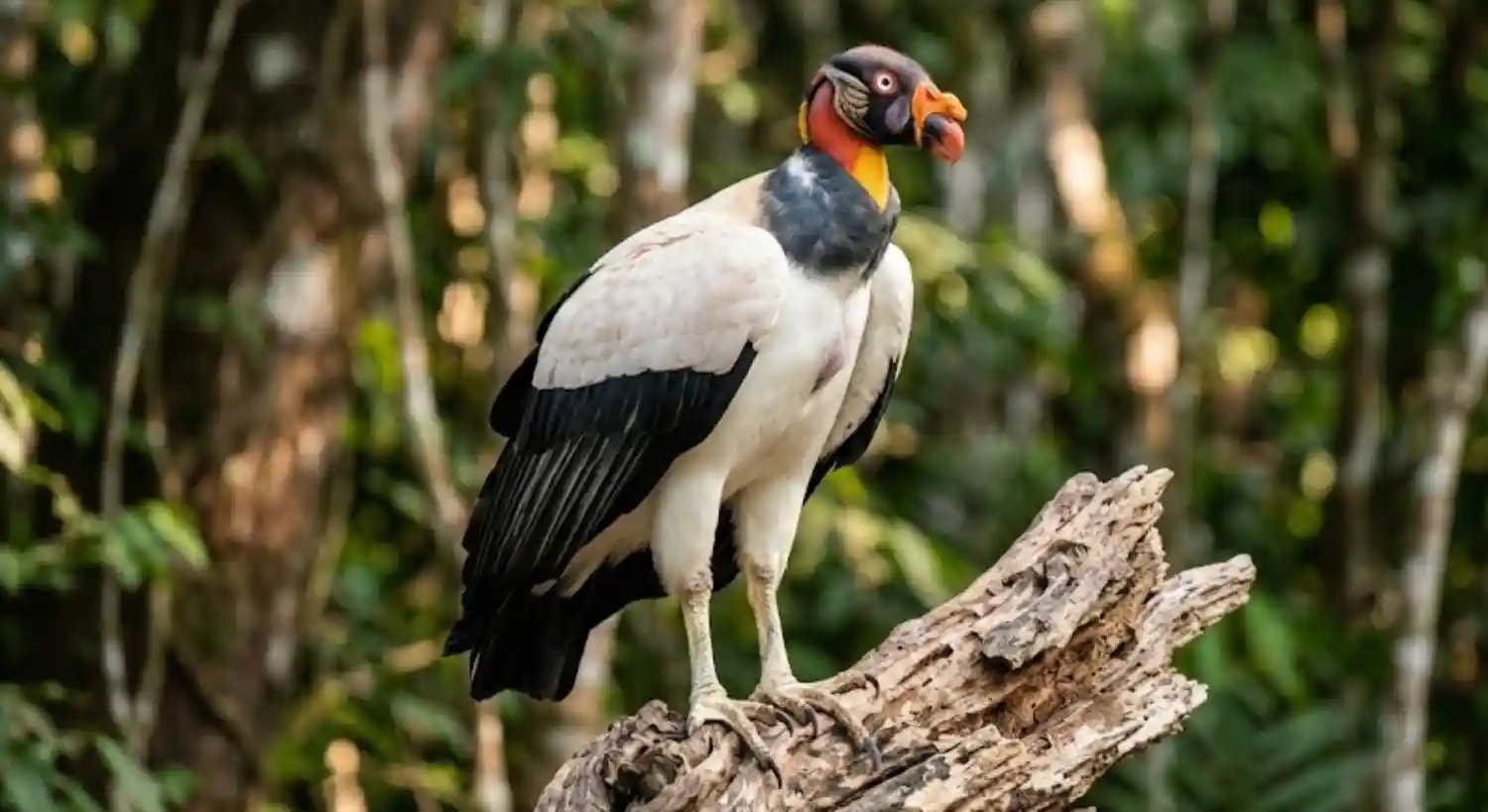
The king vulture, Sarcoramphus papa, sits at the very top of the hierarchy among Brazil’s carrion feeding birds, and it has developed a foraging strategy that combines complementary sensory abilities to optimise the way it finds food. Unlike other species in the group, which rely exclusively on a finely tuned sense of smell to detect the gases of organic decomposition rising through the tree canopy, this large scavenger uses vision of extremely high spatial definition from great altitudes. Consolidated ornithological knowledge indicates that the bird monitors the flight behaviour of smaller species and descends with surgical precision the moment those competitors locate a carcass on the forest floor.
This social dynamic establishes a mutual and orderly dependence between the different bird species that consume decomposing organic matter in tropical ecosystems. The smaller vultures, equipped with enlarged olfactory bulbs, pick up the first chemical signals of carcasses hidden beneath the dense canopy, yet they frequently lack the muscular power needed to break through the thick hide of large mammals. The arrival of the forest giant changes the scene entirely, because its physical presence and mechanical capability guarantee that the food is opened for the whole associated group.
Anatomy and the mechanical power of the beak
The king vulture’s efficiency in exploiting resources lies in the robustness of its cranial skeletal structure and in the anatomical design of its upper mandible. The beak is laterally compressed, with a pronounced hooked curvature and cutting edges that work like high pressure biological blades. That morphological configuration gives the animal the ability to apply superior mechanical leverage, allowing it to tear through dense fibrous tissue, tendons and thick skin that would resist the frailer beaks of other carrion birds.
This biomechanical specialisation turns the animal into the principal opener of carcasses across Brazilian forests and savannas, giving it a central logistical role in the decomposition chain. By breaching the outer musculature of large dead animals such as tapirs and capybaras, the king vulture makes subsequent access possible for black headed and red headed vultures. The process accelerates the rate at which organic matter is consumed, before an excessive proliferation of pathogenic bacteria can contaminate the soil and the adjacent water bodies.
Facial colours and social signalling
The morphology of the king vulture’s head displays striking visual features that serve rigorous adaptive functions tied both to hygiene and to communication within the species. The skin of the head and neck is entirely free of long feathers and shows vivid colouring that ranges across shades of red, orange, yellow and blue, complemented by an unstable caruncle above the beak. That absence of cephalic plumage prevents organic residues and body fluids from accumulating while the bird feeds inside a carcass, and it allows rapid cleaning through direct exposure to sunlight and ultraviolet radiation.
Beyond its sanitary usefulness, the intensity of those colours works as a precise social signalling system that establishes dominance status between individuals without the need for costly physical confrontation. Adult birds with more saturated colouring take immediate feeding priority at a carcass and push away juvenile competitors, which still carry dark plumage and dull skin on the neck. This visual ordering stabilises interactions inside forest clearings, ensures that feeding happens quickly and efficiently, and minimises the time the birds spend exposed to large ground predators.
Flight dynamics and metabolic economy
The king vulture’s movement through Brazilian airspace depends on making maximum use of rising thermal currents, masses of warm air that lift off the ground through the course of the day. With a wingspan reaching two metres and a high body weight, the bird avoids active flapping flight, which would demand an energy expenditure its metabolism could not sustain. Instead it glides in concentric circles, climbing to great altitudes to gain a panoramic line of sight covering tens of square kilometres of continuous vegetation cover.
This extended soaring strategy lets the bird remain airborne for several hours with minimal muscular effort while it monitors the clearings and watercourses where mammal mortality is most frequent. On sighting a group of smaller vultures making spiralling descents, the king vulture changes its gliding angle and begins a controlled descent towards the point of interest. Its imposing arrival on the ground causes the smaller species to fall back immediately, waiting patiently for the toughest parts of the carcass to be removed so that they can take the remaining fragments.
A regulating role in environmental health
The biological activity of this large scavenger performs an indispensable environmental service for the health of the biomes where it occurs, functioning as a natural system of biological sanitation. The king vulture’s digestive system has extreme stomach acidity, with a pH close to zero, capable of neutralising bacterial toxins and the spores of highly resistant pathogenic microorganisms. By consuming decomposing flesh and digesting those infectious agents, the bird removes potential outbreak points for wildlife epidemics that could otherwise decimate healthy mammal populations in the forest.
Efficient carcass removal also prevents the excessive build up of insect populations that act as disease vectors, keeping sanitary balance in the transition zones between preserved areas and rural environments. As the terminal consumer of the detritus chain, the king vulture ensures that the flow of energy and nutrients locked in animal biomass is returned to the soil quickly and safely through its mineral rich droppings. The long term ecological stability of Brazil’s forests and cerrado depends directly on the continuity of these discreet processes of territorial cleaning.
Why continuous territory decides its future
The survival of this large bodied species is tied to the existence of extensive, continuous stretches of native vegetation able to sustain healthy populations of large ground mammals. Habitat fragmentation, and the reduction in available prey biomass that follows it, limits foraging opportunities and forces individuals either to expand their flight ranges dangerously or to fall back on resources of lower energy quality. Protecting tropical forests and safeguarding the integrity of large herbivore populations is the same thing as ensuring that this aerial monitoring keeps performing its essential regulating function in Brazilian nature.
Seen together, these traits describe an animal whose ecological weight is far greater than its numbers suggest. A single bird patrolling from altitude can survey a landscape that no ground based scavenger could cover, and its arrival at a carcass sets in motion a sequence that involves several other species at once. Remove that link, and the decomposition network does not simply lose one participant: it loses the specialist that makes the resource available to everyone else, and the material that should have returned quickly to the soil instead lingers.
Understanding the complex interactions surrounding the king vulture and the wider network of decomposers reveals the sophistication of the self regulating mechanisms that hold life in balance across the country’s ecosystems. The combination of precise aerial vision with the mechanical strength of a specialised beak shows that every anatomical detail was refined by evolution to answer an exact functional demand of the environment. The social structure around a carcass sets a feeding order based on the physical capacity of each bird: the king vulture uses its visual dominance and mechanical power to make the first cut into dense tissue, and only afterwards do the smaller species join the feast. Ensuring that those wings keep crossing the skies and patrolling the forest means preserving the invisible machinery that clears away the residues of the past and fertilises the soil for the future of biodiversity.
Reporting: Anne Silva / Amazonia Mag. Source: Revista Amazônia.

Editor · Amazonia Mag
Anne Silva is the editor of Amazonia Mag, the English-language edition of Revista Amazônia. She curates, translates and adapts the outlet's science and environment coverage for an international audience, reporting on Amazon wildlife, flora, rivers, climate and research. Every story she edits is grounded in peer-reviewed studies, official data and on-the-ground reporting from the Revista Amazônia newsroom in Belém, Pará, Brazil. More by Anne Silva →