
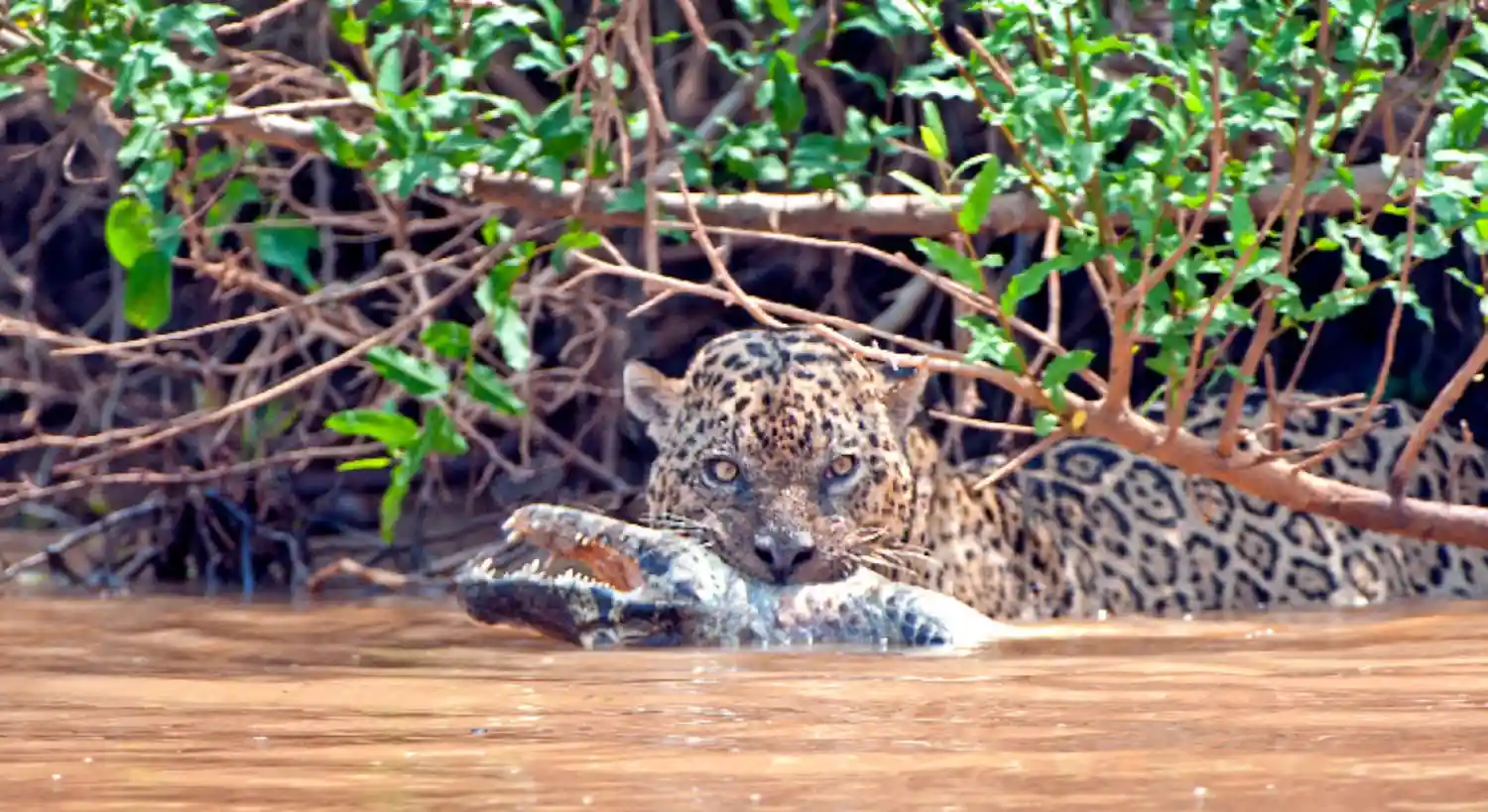
The jaguar, Panthera onca, is the only big cat in the Americas that hunts actively and regularly inside the water, and that habit sets it apart from every other large carnivore on the continent. Most felids avoid deep water and use riverbanks only to drink. South America’s largest carnivore did the opposite: it turned rivers, lakes and flooded igapó forests into essential extensions of its foraging territory. Established biological knowledge shows that this apex predator submerges completely to capture robust prey such as caimans and turtles, an evolutionary specialisation with no equivalent among the world’s big cats.
That capacity for swimming and underwater hunting requires structural physical adaptations that separate the species from lions and tigers. The jaguar’s body is compact, with short fore and hind limbs carrying an unusually high muscle density, which delivers the mechanical traction needed to move efficiently against the current. The bone structure of its paws works like a natural propeller as well, spreading the animal’s weight and allowing it to hold body stability while chasing targets across muddy or already submerged ground.
The biomechanics of a river ambush
Predation inside the water rests on a camouflaged approach and on concentrated brute force used to neutralise reptiles that carry rigid natural defences. The cat locates caimans resting on river beaches or floating close to the surface, using bankside vegetation as a visual shield. When the attack begins, the jaguar launches itself towards the river channel and subdues the reptile with a direct bite to the rear of the skull, breaking through the osteoderm armour that protects the hunted animal’s central nervous system.
This mechanical approach cuts the duration of the confrontation dramatically and denies the caiman its main defensive advantage, which is dragging an attacker into deeper water to drown it. The jaguar’s neck musculature is hypertrophied, letting it lift and haul prey of roughly its own weight out of the riverbed. The carcass is then moved against gravity, up steep and heavily vegetated banks, until the cat reaches safe ground inside the forest where the meat can be consumed without interference.
Jaws built to break shells and hides
The animal’s diet across the ecosystems of the Amazon and the Pantanal reflects an evolutionary answer to the abundance of aquatic vertebrates wrapped in dense protective coverings. Freshwater turtles make up a regular share of the prey taken, which demands a dental arcade capable of cracking compact bony plates. The short jaw and the robust canines act as mechanical wedges that puncture the chelonian and open access to the internal tissues without fracturing the structure of the cat’s own tooth in the process.
Being able to exploit a food base that is inaccessible to other land carnivores reduces competition for biological resources and gives the species greater population stability through the seasonal flood cycle. When várzea floodplain forests stay inundated for long stretches, terrestrial mammals migrate to higher ground, leaving the cat with a steady supply of fish, reptiles and amphibians spread along the river channels. That ecological flexibility underpins reproductive success and keeps adult individuals in good condition throughout the whole year.
A territory measured in rivers
The jaguar’s daily movement involves continuously mapping the drainage networks that cut across its home range, an area that can cover dozens of square kilometres. Individuals use rivers as natural roads, monitoring fluctuations in prey populations and marking the limits of their domain through visual and scent signals left on fallen trees. The ability to swim across channels more than a kilometre wide connects populations that would otherwise be isolated by large watercourses, sustaining the genetic exchange the species depends on.
Swimming also works as an efficient thermoregulation strategy during the hottest seasons, when temperatures in the understorey climb to high levels. The animal spends long stretches resting on river beaches or under the shade of branches that touch the water, keeping its metabolism stable and lowering thermal stress on the body. This close relationship with water has shaped the social behaviour and the activity patterns of the species, whose movement peaks coincide with the hours when river reptiles are most active.
A regulator of aquatic ecosystems
As the largest predator in tropical river basins, the influence of this cat reaches directly into the structure of aquatic biological communities. By applying hunting pressure on medium sized caimans and on large semi aquatic rodents such as the capybara, the jaguar prevents those species from overpopulating riparian ecosystems. That population control stops excessive consumption of bankside vegetation and keeps fish stocks stable, the same stocks that feed the reptiles themselves, which preserves the complexity of the food web.
Removing this apex carnivore would trigger structural disorganisation along river channels, with uncontrolled increases in mid level predators and consequent degradation of riparian flora. The physical integrity of riverbanks and the quality of the water both depend on maintaining that balanced chain of consumption, in which every species performs a function of pressure and control. The jaguar therefore acts as a guardian of biological integrity across terrestrial and aquatic ecosystems at the same time, rather than in one habitat alone.
The survival of the species depends on preserving continuous ecological corridors that link terra firme forests to várzea and igapó zones. Human driven changes to hydrological regimes and the contamination of watercourses directly compromise prey density and make the underwater hunting strategies developed by the animal unworkable. Protecting river basins and the forests along their margins in the Amazon is the way to ensure that this predatory behaviour keeps performing its regulating role and sustaining the functional richness of Brazilian biomes for coming generations.
Observing this behaviour reveals the precision with which evolution shapes organisms to occupy the functional gaps available in nature. The transformation of a land based cat into an effective swimmer shows that the borders between ecosystems are fluid, and that life expands through rigorous anatomical adaptation rather than by chance. Ensuring that these animals keep crossing the currents and patrolling the water is a way of safeguarding the biological essence that makes South American biodiversity a global reference for ecological complexity.
Seen from the water, then, the jaguar is not simply a forest predator that happens to swim. It is a fully amphibious hunter whose anatomy, territory and daily rhythm are organised around river systems, and whose presence quietly holds together the ecological accounts of an entire basin.
Reporting: Anne Silva / Amazonia Mag. Source: Revista Amazônia.

Editor · Amazonia Mag
Anne Silva is the editor of Amazonia Mag, the English-language edition of Revista Amazônia. She curates, translates and adapts the outlet's science and environment coverage for an international audience, reporting on Amazon wildlife, flora, rivers, climate and research. Every story she edits is grounded in peer-reviewed studies, official data and on-the-ground reporting from the Revista Amazônia newsroom in Belém, Pará, Brazil. More by Anne Silva →