
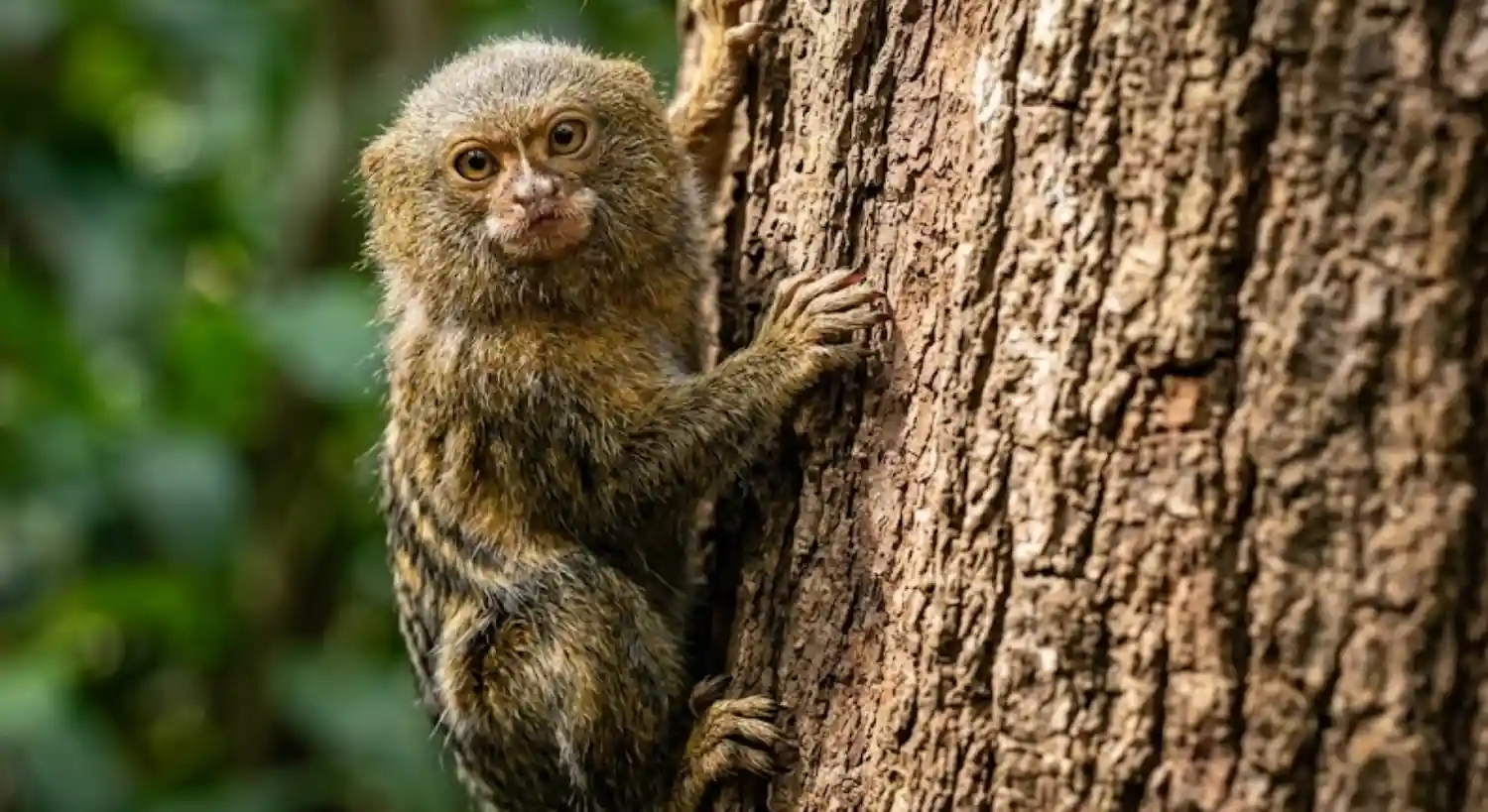
The pygmy marmoset (Cebuella pygmaea), recognized as the smallest primate on the planet, displays a set of biological traits that seem to push against the physical limits of forest mammal development. Its adult body weight frequently falls below one hundred and thirty grams, which means the animal weighs less than a common chicken egg, an extraordinary anatomical benchmark for a creature that belongs to the same evolutionary order as the great chimpanzees and human beings. An exclusive inhabitant of the canopy and the understory of the tropical forests of the Amazon Basin, the pygmy marmoset has developed highly refined morphological and behavioral adaptations that allow it to exploit ecological niches inaccessible to larger primates, securing its survival in one of the most competitive environments on Earth.
Claws instead of nails for a vertical life
In the dynamic vertical ecosystem of flooded and upland forests, life in the heights demands precise biomechanical solutions to avoid fatal falls and to guarantee access to hidden food. While most New World monkeys rely on flattened nails and prehensile tails to grip horizontal branches, the reduced size of the pygmy marmoset forced a different evolutionary route. This tiny primate carries sharp claws on almost every digit, with the exception of the big toe, which keeps a flat nail. Those claws work much like mountaineering crampons, allowing the animal to anchor itself vertically and safely on the rough bark of wide tree trunks.
It is in that vertical posture, clinging to the coarse surface of the trees, that the pygmy marmoset carries out most of its daily feeding and resting activity. The strategy opens up a three dimensional territory that other primates of the same forest simply cannot occupy: the surface of the trunks, a space most monkeys only cross in passing. By specializing in that vertical plane, the species reduces direct competition for resources and finds shelter in a place where its minuscule body blends into the textures of the bark.
A diet built on tree sap
The biological physics of its diet rests on a highly specialized feeding habit known as exudativory, which consists of the active consumption of sap, gum and latex produced by certain species of forest trees and vines. To reach those nutritious fluids that circulate beneath the thick bark of plants, the pygmy marmoset uses a modified dentition in an almost surgical way. The animal has long, sharp lower incisors that match the length of its canine teeth. With that adapted oral tool it gnaws repeatedly at the bark, opening small circular channels that stimulate the plant to release its liquid defenses in the form of resin, providing a steady source of carbohydrates and minerals throughout the year.
Running that sap extraction system demands rigid territorial behavior from the small monkey and constant monitoring of the wounds opened in the plants. A single family group of pygmy marmosets holds ownership of several producing trees within its territory, patrolling the holes daily to collect the accumulated gum and to clean the entrances of the channels so that the natural healing of the plant does not block the flow of food. Studies indicate that this continuous drilling activity does not compromise the long term health of large trees, establishing a low impact relationship of exploitation in which the primate obtains energy without destroying the physical structure of its forest shelter.
A family that shares the weight of the young
The social structure of pygmy marmosets is based on small cooperative family groups ranging from two to nine individuals, led by a dominant breeding pair. The reproductive dynamics of the smallest primate in the world carry important particularities: females usually give birth to twins after a gestation period lasting about four and a half months. Because the combined weight of the twins represents a significant share of the mother’s body weight, the group has structured a system of shared care in which the father and the older siblings take on most of the physical effort of carrying the infants on their backs, handing them over to the female only at the moments required for nursing.
That intense social cooperation extends to the collective safety of the group against attacks by aerial and terrestrial predators. Because they are extremely small animals, pygmy marmosets appear in the diet of a wide range of predators, including nocturnal and diurnal birds of prey, arboreal snakes and small wild cats. To mitigate that constant danger, the group uses a repertoire of high frequency vocalizations that sit close to the limit of human hearing. Those rapid whistles and trills work as danger alerts, allowing the animals to camouflage themselves instantly against tree trunks or to flee into dense vegetation before a predator manages to locate them visually.
The combination of shared parenting and acoustic alarms shows how tightly survival at this body size depends on the group rather than on the individual. A single pygmy marmoset, weighing less than a chicken egg, has almost no physical defense against a bird of prey. What protects it is the vigilance of relatives spread across the same stand of trees, the speed of a warning call and the familiarity with every crevice of bark that can serve as an escape route. Break the family unit and the individual loses far more than company: it loses the entire system that keeps it alive.
A thermometer for forest health
The integrity of pygmy marmoset populations works as an important indicator of the ecological quality of transition forests and riparian vegetation areas. Because the species prefers to inhabit young secondary forest zones or river margins, where the density of vines and sap producing trees is higher, monitoring its presence helps scientists assess the stages of natural regeneration of the forest after physical disturbances. Conserving those habitats also ensures that the flow of biological energy generated by sap extraction continues to feed other smaller species of insects and birds that take advantage of the channels opened by the marmosets to feed on plant resins.
Fragmentation and trafficking threaten the balance
At present, the subtle balance that guarantees the survival of the smallest primate in the world faces growing threats stemming from the accelerated environmental transformations caused by disorderly human action. The fragmentation of riparian forests and the advance of residential subdivisions destroy the corridors of continuous vegetation that marmosets need in order to disperse and find new feeding territories. On top of that, the illegal capture of wild animals driven by the exotic pet trade removes individuals from complex family structures, compromising reproductive stability and the survival of entire groups.
Securing the future of the pygmy marmoset and safeguarding the richness of its evolutionary adaptations demands the consolidation of public enforcement policies against wildlife trafficking and the preservation of the river basins that shelter its native forests. It is essential to support national scientific research focused on the behavioral ecology and genetics of small mammals, and to promote environmental education programs in local communities that stress the importance of keeping wildlife in its original habitat.
Protecting the skies of foliage and the ancient trunks that serve as home to the pygmy marmoset is an act of preservation of an immense evolutionary heritage and of the environmental sovereignty of Brazil. By choosing development models that value keeping forests standing, and by rigorously fighting aggressions against the environment, we become active defenders of an extraordinary biological patrimony. May the agile presence of this smallest of primates keep pulsing at the top of the canopy, proving that conserving biodiversity requires attention and care through all the future ages of the Earth.
Reporting: Anne Silva / Amazonia Mag. Source: Revista Amazônia.

Editor · Amazonia Mag
Anne Silva is the editor of Amazonia Mag, the English-language edition of Revista Amazônia. She curates, translates and adapts the outlet's science and environment coverage for an international audience, reporting on Amazon wildlife, flora, rivers, climate and research. Every story she edits is grounded in peer-reviewed studies, official data and on-the-ground reporting from the Revista Amazônia newsroom in Belém, Pará, Brazil. More by Anne Silva →