
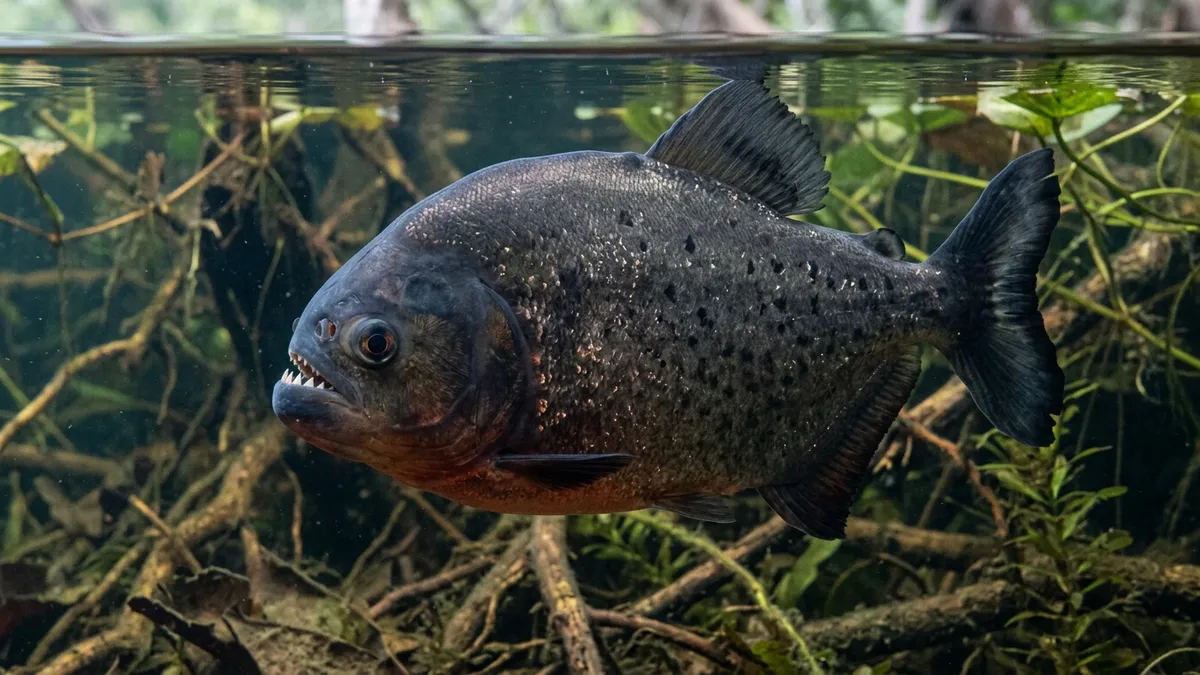
The black piranha, known scientifically as Serrasalmus rhombeus, has a bite force that does not match the size of its body. In a specimen of about 2.2 pounds (1 kilogram), the recorded force reached roughly 320 newtons (about 72 pounds-force), a value that placed the species among the fish with the strongest relative bite force.
A bite concentrated in a small body
The number does not mean every individual produces exactly the same force. The result varies with the animal’s size, the position of the tooth, the point of contact and the way the bite is measured. Even so, the proportion is the central fact. The black piranha concentrates muscle, bone and teeth in a structure able to cut tissue quickly. Rather than relying on a large mouth alone, it uses a compact jaw, with a vigorous closing stroke and tooth edges that work together.
The shape of the mouth helps explain the effect. The teeth are triangular, set very close together and interlocked so as to form a cutting margin. When the jaw closes, upper and lower teeth meet like blades that channel the force into a small area. This combination lets the fish remove pieces from prey, break through scales and cut parts of animals that would be hard for a fish of similar size to handle. The bite can also serve to grip slippery food, especially when turbid water reduces visibility. The performance should not be described as unlimited. The force depends on anatomy and context, and it does not turn the species into an animal that attacks everything around it. It is a tool for feeding and defense shaped by the environment of Amazonian rivers.
The tooth is not a permanent part
A second feature makes the mouth of the black piranha especially efficient over time. The triangular teeth do not necessarily stay in the same place throughout life. The species replaces them in blocks, in a process that allows whole sets of the tooth row to be renewed. Instead of losing a single piece and interrupting its ability to cut, the fish can replace a functional unit of the jaw. The swap happens in a coordinated way, with new teeth forming and taking the place of the old ones.
This mechanism matters for an animal that uses its mouth on hard food, scales, fins, shells and tough tissue. Wear stops being a permanent problem because the dental structure is continuously restored. The renewal does not mean the black piranha has endless teeth available at once, but that its replacement system keeps up with the needs of a lifetime.
Replacement in blocks also helps to avoid a common interpretation of the fish. The piranha does not depend on an isolated bite, as if all feeding were decided by a single attack. The mouth works as a mechanical set, in which the jaw, the muscles and several tooth rows take part in cutting. When one part wears down, organized renewal keeps the ability to grasp and process food. The detail is relevant because popular fame tends to reduce the species to sharp teeth and aggressive behavior. Biologically, what exists is an adaptation for exploiting varied resources in waters where the supply of food changes with the season, the flood and the ebb.
A diet that goes beyond the image of a predator
The black piranha is carnivorous, but its diet is not limited to large attacks on fish. It can eat smaller fish, parts of other animals, crustaceans and insects, and it can take advantage of different items available in the environment. The variety depends on the place, the age of the individual, the time of year and the supply of food. In Amazonian rivers, the rise and fall of the water changes access to banks, roots, leaves, fruit and shelter areas. A fish able to cut and remove small portions copes with this variation better than a species limited to a single prey. The strong bite, therefore, should not be read only as a hunting weapon. It is also a solution for handling foods of different sizes and textures.
This opportunistic feeding does not remove the need for caution in describing the species. The black piranha does not show the same behavior in every situation, and the presence of food, water temperature, season and the concentration of fish influence how the group responds. Young and adult individuals can also exploit different resources. The animal uses its mouth to capture, cut and carry, but there is no basis for turning every encounter with a person into an attack scenario. Under natural conditions, most of its interactions are with other organisms of the aquatic ecosystem. Fish, invertebrates, animal remains and resources tied to the flooded forest all enter this network of use.
The shoal acts as a layer of protection
Shoaling adds another dimension to the story. The black piranha can stay close to other piranhas, forming groups that should not automatically be read as an attack team. For these fish, concentration is also linked to defense. Many individuals together increase the chance of detecting threats, reduce the probability that a single fish will be chosen as a target and allow quick responses when a predator approaches. The shoal turns perception of the environment into a shared task. Each animal still makes its own movements, but the presence of the others changes the individual risk. This kind of organization is especially useful in waters with vegetation, logs, flooded banks and limited visibility.
The pairing of a strong bite with defensive grouping shows that the survival of the species does not depend only on attacking. It also involves avoiding capture and keeping away from animals that pose danger. The best-known scene, with many piranhas gathered around prey, can occur under certain conditions, but it does not explain how a shoal works on its own. Grouping has ecological value even when the fish are not feeding.
An adaptation shaped by Amazonian rivers
The black piranha occurs in freshwater systems of South America, including parts of the Amazon basin, and its biology has to be read in that setting. The alternation between flood and ebb changes depth, current speed, connection with lakes and access to the flooded forest. In each phase the fish meet different opportunities and risks. The mouth with triangular teeth allows the use of varied foods; replacement in blocks preserves the cutting function; and the shoal helps reduce individual exposure. These three elements are not isolated traits. They take part in the same relationship with the environment, in which finding food and avoiding predators call for complementary responses.
The force of 320 newtons measured in a specimen of about 1 kilogram is, for that reason, only part of the explanation. The performance of the species arises from the combination of anatomy, tooth renewal, social behavior and the ability to exploit available resources. It is also worth separating what is established from what would be a generalization. The black piranha has a bite that is very strong for its size, triangular teeth replaced in blocks throughout life, a diet wider than the popular image suggests and shoaling behavior tied to defense. These facts do not allow us to claim it is the strongest fish by every measure, or that it attacks people indiscriminately. Comparisons depend on the method, the size of the specimens and the definition of relative force. In the river, strength is not only power. It is also knowing when to cut, when to renew and when to stay with the group.
Reporting: Natália Santos / Amazonia Mag

Editor · Amazonia Mag
Anne Silva is the editor of Amazonia Mag, the English-language edition of Revista Amazônia. She curates, translates and adapts the outlet's science and environment coverage for an international audience, reporting on Amazon wildlife, flora, rivers, climate and research. Every story she edits is grounded in peer-reviewed studies, official data and on-the-ground reporting from the Revista Amazônia newsroom in Belém, Pará, Brazil. More by Anne Silva →