
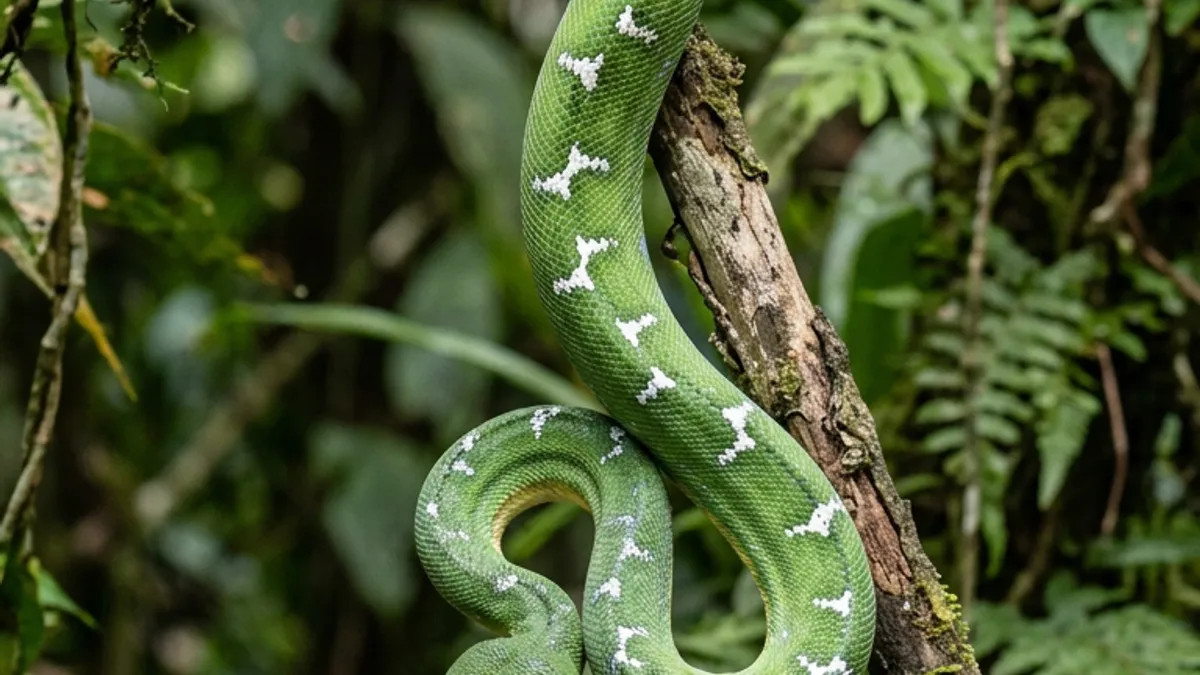
High in the forest, the emerald tree boa can stay motionless while part of its body is held out in open air. The tail coils around a branch and supports the animal, leaving the rest of the body free of the tree. In this position the snake waits for prey to pass without having to rest its belly on a broad surface. The behavior is tied to the species’ life in the trees, where it uses the canopy as shelter, lookout and hunting ground. Its green body helps it blend into the vegetation, but the mechanism that matters most to its routine is the combination of a prehensile tail and heat sensors near the mouth. The emerald tree boa does not rely on sight alone to read its surroundings. It brings together support, camouflage and heat detection in a strategy that works high above the forest floor.
Life among the branches
The common name periquitamboia is associated in Brazil with arboreal snakes of the genus Corallus, especially Corallus caninus, known in English as the emerald tree boa. The species lives in the Amazon region and in forested areas of northern South America. Its anatomy is suited to branches, with a muscular body, a tail able to grip supports and a head that concentrates sensory structures. The animal does not need to build a nest or occupy a burrow on the ground to complete its life cycle. The tree offers resting and ambush positions, while the vegetation supplies routes between branches. When the body hangs, the tail acts as a living anchor point.
The prehensile tail holds the body while the head stays ready to strike
The prehensile tail is the feature that allows the snake to keep one part of its body supported and another part free. It coils around the branch with enough force to work as an anchor, while the muscles of the trunk control the position of the rest of the body. This arrangement does not mean the tail is a structure independent of the rest of the body. Control comes from muscular coordination and from the ability to adjust pressure on the support. The grip leaves the head and the front of the body in a position suited to reaching prey that passes within striking range. Instead of chasing animals over long stretches, the snake can wait along a route used by birds or bats. The attack is fast, and the bite holds the prey while the body readjusts on the branch. The tail, therefore, does not serve only for climbing. It helps turn the space between branches into a capture zone.
The suspended posture also reduces the need for constant movement. The emerald tree boa can stay coiled for long periods, alternating rest, watchfulness and short moves between branches. This economy of movement suits an ambush predator, which depends on the approach of prey and not on a ground chase. Catching bats in the air demands synchronization between body position, the moment of the strike and the strength of the bite. In the case of birds, the snake can reach individuals that pass close to the vegetation or land on accessible branches. Taking prey from the air does not mean the snake flies or leaps long distances. The body still depends on a support, and the tail provides that support before the attack.
Lip pits detect the heat of nearby prey
On the scales around the mouth there are labial pits, small cavities sensitive to the infrared radiation given off by warm bodies. These sensors help the emerald tree boa notice differences in temperature in its surroundings, especially when light is low or when prey approaches among leaves and branches. Heat information does not replace the other senses. Sight, smell, vibration and touch also take part in orientation and attack. The pits work as an additional source of information, letting the snake detect a warm animal against a relatively cooler background. In a species that stays coiled and waits, sensing heat can be decisive in choosing the moment to strike. The principle is similar to that of other arboreal constrictor snakes that have infrared-sensitive organs. It is not the same as seeing a colored image of heat, but rather registering temperature differences that help locate prey.
The use of these structures needs to be described without exaggeration. The labial pits do not guarantee that the snake will find any bat or bird at great distances, nor do they work as a radar able to map the whole forest. Efficiency depends on distance, temperature contrast, the position of the prey, the vegetation and environmental conditions. When a bat passes close, the heat of its body can offer an additional signal to guide the attack. In a bird, the same system can complement visual and chemical perception. The snake combines the signals and decides whether the opportunity is within reach. The practical consequence is an advantage for a predator that occupies the treetops and is active in low light.
Bats and birds on the menu without bringing the snake to the ground
The capture of bats and birds shows how the emerald tree boa exploits an environment that terrestrial snakes cannot use in the same way. A bat may pass through the foliage on its nighttime travels, while birds may approach branches to rest or move through the canopy. The emerald tree boa waits in an ambush position, fixes its tail on the support and extends the front of its body when prey comes within range. After the bite, it uses constriction to immobilize the animal before swallowing it. The behavior does not make the species an exclusive specialist on bats or birds. The makeup of its diet may vary with local availability and with the age of the individual. Nor is it right to credit every capture to a single sensory cue. The attack brings together posture, sight, heat perception, smell and muscular coordination.
The snake’s way of life is arboreal, and it does not depend on regular trips down to the ground in order to hunt. In Brazil, this trait connects the species to the vertical structure of the Amazon, where trunks, vines and branches form different layers of shelter and food. Looking at the emerald tree boa, the forest stops being just ground covered by trees and reveals suspended corridors, where a tail can serve as support, sensor and survival strategy.
Reporting: Natália Santos / Amazonia Mag

Editor · Amazonia Mag
Anne Silva is the editor of Amazonia Mag, the English-language edition of Revista Amazônia. She curates, translates and adapts the outlet's science and environment coverage for an international audience, reporting on Amazon wildlife, flora, rivers, climate and research. Every story she edits is grounded in peer-reviewed studies, official data and on-the-ground reporting from the Revista Amazônia newsroom in Belém, Pará, Brazil. More by Anne Silva →