
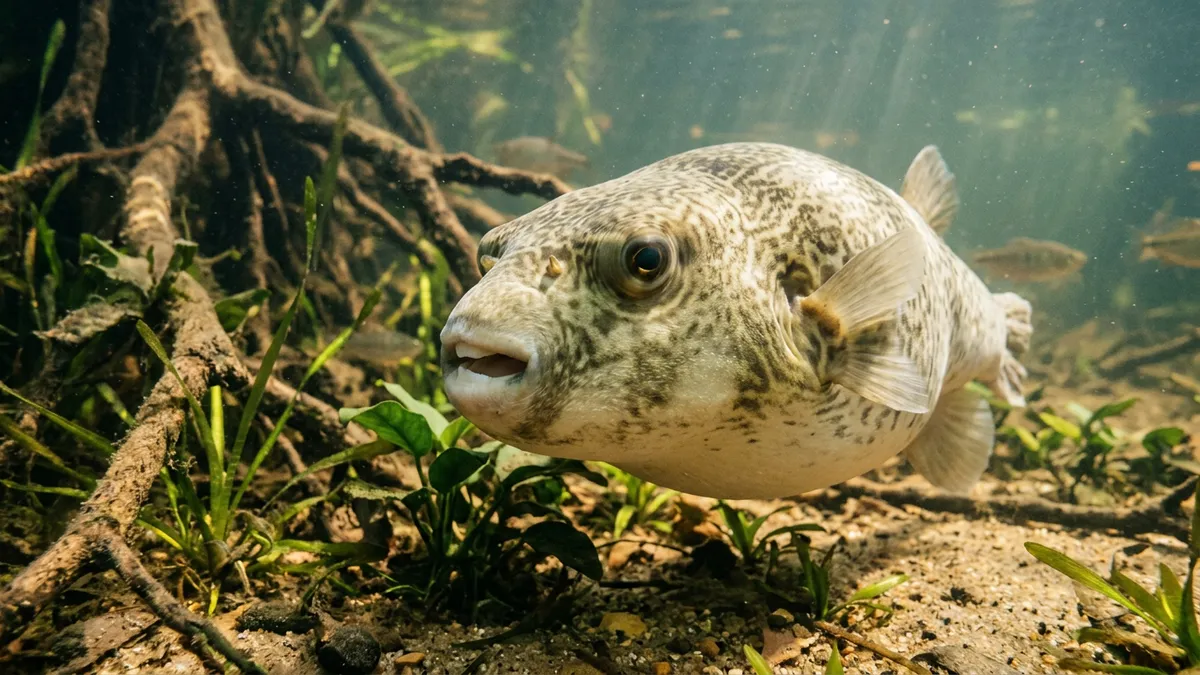
The body of a freshwater pufferfish can grow to almost twice its size when the fish swallows water and expands its stomach. The scene looks like inflation with air, but the mechanism is different. Water fills the digestive system and stretches the elastic tissues of the body, changing the animal’s shape in moments. The expansion also alters the look of the fins and makes it harder for a predator to swallow the fish whole. The pufferfish needs no external pouches or rigid structures to produce this volume. It turns part of its own body into temporary storage space.
The same animal combines another trait that is uncommon among fish. Its mouth holds dental plates that grow continuously and must be worn down during feeding. Instead of having isolated teeth that are simply replaced, the pufferfish uses strong structures to crush the shell and hard parts of mollusks. The combination of an expandable stomach, scaleless skin and a crushing mouth defines a fish prepared for physical risks and tough food. Some tissues also contain toxin, which means the animal should not be treated as fit to eat without specialized knowledge.
Water fills the stomach and changes the fish’s outline
When it senses a threat, the freshwater pufferfish can stop its normal activity and start to expand. Water enters through the mouth and passes into the stomach, which works as a reservoir able to increase in volume. The belly bulges, the skin tightens and the fish takes on a rounded shape. Because the filling is done with liquid, there is none of the sound or appearance of a balloon inflated with air. The difference matters because excess air could stay trapped in the digestive tract in a dangerous way, whereas water can be released afterward through the mouth.
Scaleless skin lets the outline stretch without the resistance of a covering made of overlapping plates. The pufferfish, however, does not stay in this state indefinitely. Keeping the body enlarged takes energy and limits mobility, so the expansion is a temporary response. Once the threat eases, the contents of the stomach are expelled and the fish returns to its usual shape. The change in volume can make capture harder for predators, but it does not make the animal invulnerable. It still needs suitable water, room to swim and the ability to recover normal function after the defense.
Dental plates turn shells into food
The popular word “teeth” simplifies a more specific anatomy. The structures in the mouth form robust dental plates, arranged to apply pressure to hard food. When it catches a mollusk, the pufferfish places the prey between these plates and makes biting movements able to break or crush the shell. This mechanical work reduces the food to smaller pieces before digestion and keeps a rigid layer from blocking the passage through the mouth. The diet can vary with the species and the habitat, but the consumption of mollusks explains why the mouthparts must withstand frequent wear.
The continuous growth creates a permanent requirement. If the plates kept growing without being worn, they could become too long and get in the way of feeding. Crushing shells therefore works as a natural form of wear. This is not an exceptional growth that happens only in old animals, but a process maintained throughout life. The mouth has to balance the formation of dental tissue with its removal by friction. This mechanism also explains why a supply of very soft foods may be unsuitable for some species kept in aquariums, although any care depends on correctly identifying the pufferfish and on specialized guidance.
The body combines defense, feeding and chemical risk
Expansion should not be confused with the production of poison. These are different mechanisms, even though they can occur in the same animal. Water in the stomach changes the size and shape of the body; the toxin, present in some tissues of certain pufferfish, is a chemical barrier. The occurrence and concentration of the compound should not be generalized to every individual just because it belongs to the pufferfish group. This distinction is essential to avoid two opposite mistakes: imagining that any contact causes poisoning, or concluding that the fish is safe because it is a freshwater species.
In the environment, the pufferfish takes part in the movement of matter between small animals and predators. By crushing mollusks, it acts on shelled organisms and uses a food source that demands concentrated strength in the mouth. It can also be prey at different stages of life, although body expansion and chemical protection reduce the chances of being eaten by some predators. Scaleless skin does not mean an absence of protection. It is part of a set of traits in which behavior, shape, mouth and tissue composition work at different moments. The result is a strategy distributed across the body, not a single isolated defense.
The pufferfish also helps explain the diversity of Brazilian rivers
In Brazil, the term freshwater pufferfish can refer to different species, and that variety calls for care with photographs, common names and husbandry information. Rivers, creeks, floodplains and other inland environments shelter fish that differ in size, diet and tolerance of water conditions. For that reason it is not correct to automatically transfer to every pufferfish a fact observed in a single species. Identification should consider body shape, skin pattern, geographic distribution and the features of the mouth. Even when a mechanism is shared, the species needs to be confirmed before any recommendation.
What is described here is a set of well-established biological traits of freshwater pufferfish: water entering the stomach during defensive expansion, a body size increase that can reach double, scaleless skin, dental plates that grow continuously, and the presence of toxin in some tissues. Observing the pufferfish accurately means recognizing that its body does not rely on a single trick, but on adjustments that connect defense, feeding and survival in each encounter with its environment.
Reporting: Natália Santos / Amazonia Mag

Editor · Amazonia Mag
Anne Silva is the editor of Amazonia Mag, the English-language edition of Revista Amazônia. She curates, translates and adapts the outlet's science and environment coverage for an international audience, reporting on Amazon wildlife, flora, rivers, climate and research. Every story she edits is grounded in peer-reviewed studies, official data and on-the-ground reporting from the Revista Amazônia newsroom in Belém, Pará, Brazil. More by Anne Silva →