
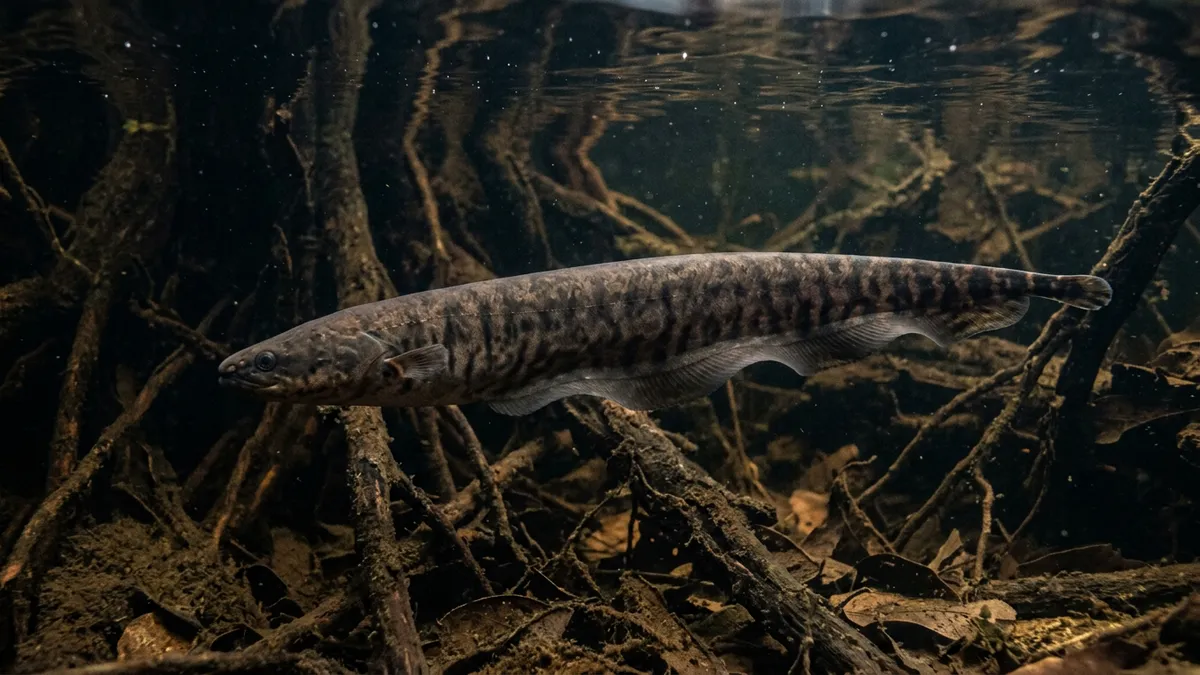
In a stretch of dark water, the tuvira does not have to wait for light to reveal the way. This electric knifefish produces a weak, continuous electric field around its own body and keeps track of the changes caused by everything that comes near. The principle is active: first the fish emits pulses, then it reads the distortion caused by an obstacle, the bottom or another animal. The sequence turns the space around it into an area that can be recognized even when the water holds little light.
This is not a discharge used to injure. The electricity the tuvira produces serves orientation and the perception of its surroundings, like a sensory system that works at short range.
A biological radar where sight runs out of range
The mechanism depends on an integrated set of structures. The part responsible for the emission is linked to the electric organ, made of specialized cells that produce small variations in electrical potential. Receptors spread across the skin pick up changes in the field around the body. The information reaches the nervous system and helps the fish adjust its direction, its distance and its movement.
The result is not a visual image of the water but a reading of electrical changes in the nearby space. In environments with roots, leaves, sediment and low transparency, this ability complements the conventional senses. The tuvira does not need to light the way or touch every obstacle to notice that it is there.
An elongated body that keeps the fish moving
The shape of the body takes part directly in this way of life. Long and slender, the tuvira moves with successive undulations and can swim forward and backward with equal ease. That movement is especially useful when the fish explores crevices, vegetated banks or narrow spaces where a wide turn would be difficult. Reverse motion also lets it back away from an obstacle without turning its whole body around.
While it swims, the tuvira keeps the electric field around its surface, and the reading of changes takes place in a zone close to the animal. The system therefore combines locomotion and perception, and the fish does not have to stop moving to investigate the path ahead.
The shape also sets the tuvira apart from fish that rely mainly on a tail fin to change direction. In long-bodied electric fish, the undulation of the fins and of the body itself gives fine control at low speed. That favors approaching, retreating and staying in areas with irregular structure.
Active electroreception adds a sensory layer to this behavior, because every change in the field can signal that the geometry of the space has shifted. A neighbor, a nearby surface or a submerged object does not appear as a detailed image, but it modifies the pattern the fish receives. This combination explains how the tuvira can explore dark water without depending on electric attacks or on permanent physical contact.
The pulses also help recognize who is nearby
The tuvira’s electricity does not serve only to avoid collisions. The field the fish produces is also altered when another individual enters its area of perception. Because each animal interferes with the other’s field, the reading can give information about presence, approach and relative position.
The recognition of a neighbor takes place within this sensory exchange and not through an offensive discharge. Electrical communication, in this context, is tied to identification and to organizing the distance between individuals. The pattern emitted and the way it is received are part of a sensory environment that keeps working even when vision is limited. Dark water stops being a completely hidden space, because the fish can follow electrical changes that sight alone would not detect.
This system should not be confused with the ability of electric fish that produce strong discharges to immobilize prey or drive off threats. In the tuvira, the field is weak and continuous, and its role is that of a biological radar and a means of recognition. The distinction matters because the word electricity tends to suggest attack, shock or capture. The mechanism here is different: the emission creates a reference around the body, and the distortion of that reference supplies data about the environment. The tuvira can adjust its route, keep space between itself and another fish and explore its surroundings without turning the field into a weapon. The benefit lies in perception, not aggression.
A discreet mechanism with weight in aquatic life
In an aquatic ecosystem, perceiving space is part of the decisions that keep an animal alive. The tuvira has to move among submerged structures, find suitable areas and avoid unnecessary contact. The weak electric field offers a solution for situations in which light, water transparency or closeness to the bottom reduce the efficiency of vision.
The ability to swim in both directions adds to that advantage, because it lets the fish investigate a space and leave it without slow maneuvers. Reading neighbors also reduces its dependence on visual signals for organizing the distance between individuals. The electric system thus acts as a sensory extension of the body, integrated with its elongated anatomy and its wave-like movement.
One caution applies. The popular name tuvira can be used for electric fish from closely related groups, so it would be wrong to assume that every tuvira shows exactly the same pattern. The central function stays clear all the same: emission of weak pulses, reading of the distortion of the field, navigation and recognition of neighbors, with no use for attack.
In Brazil, where dark waters and vegetated banks are part of many inland environments, this mechanism is a reminder that perceiving does not necessarily mean seeing. Sometimes the way is built from signals that only the fish itself can sense.
Reporting: Natália Santos / Amazonia Mag

Editor · Amazonia Mag
Anne Silva is the editor of Amazonia Mag, the English-language edition of Revista Amazônia. She curates, translates and adapts the outlet's science and environment coverage for an international audience, reporting on Amazon wildlife, flora, rivers, climate and research. Every story she edits is grounded in peer-reviewed studies, official data and on-the-ground reporting from the Revista Amazônia newsroom in Belém, Pará, Brazil. More by Anne Silva →