
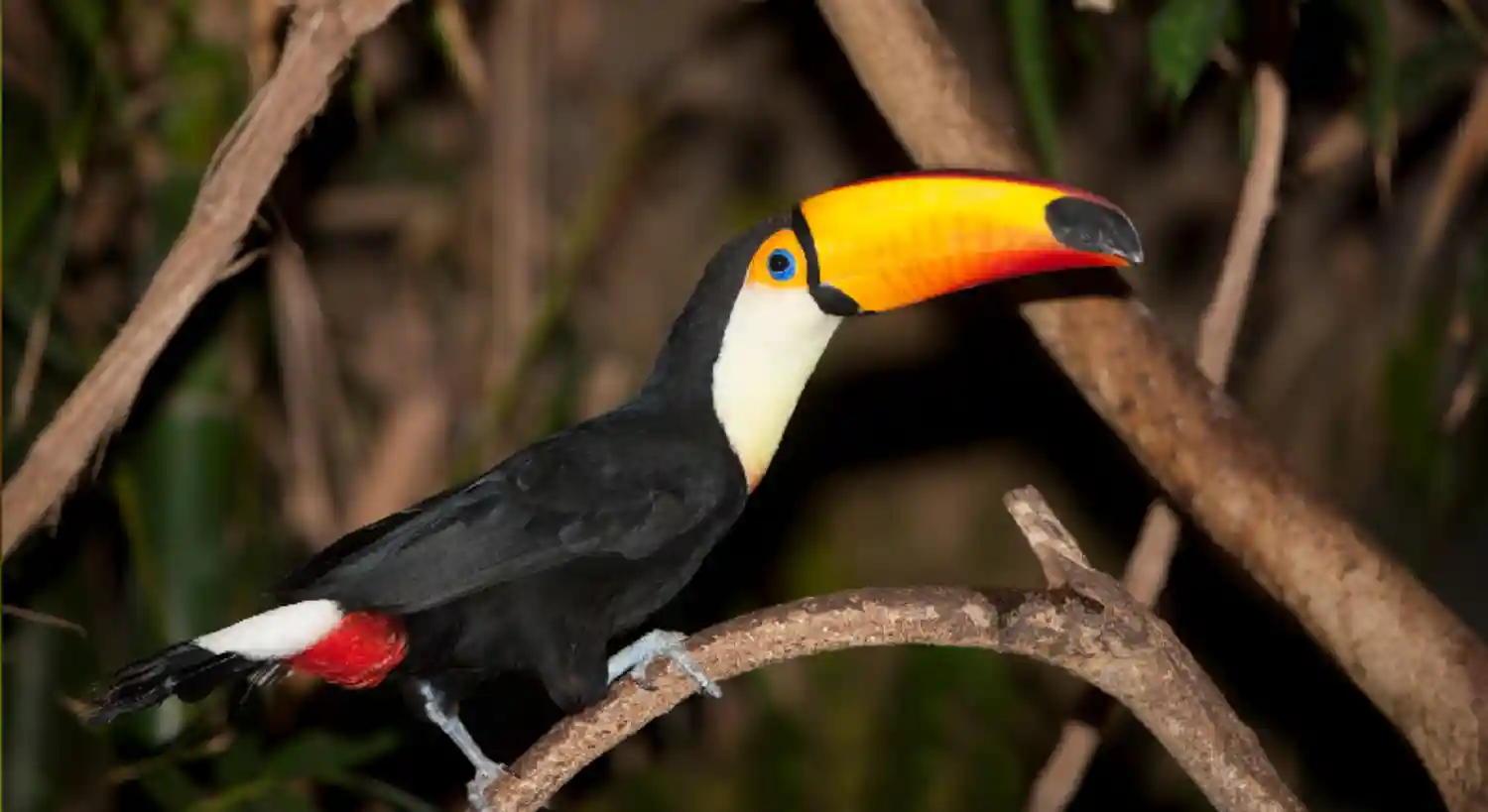
The toco toucan (Ramphastos toco), known worldwide for its contrasting black plumage and for a monumental bill that can account for more than a third of the bird’s total body length, hides one of the most spectacular adaptive solutions in animal biophysics beneath that colorful keratin. Far from being merely a tool for picking fruit or an ornament for courtship, the bill of this bird works as an active thermal radiator of remarkably fine mechanical precision. Studies indicate that the toucan regulates its internal body temperature by altering the blood flow that runs through a microscopic network of surface vessels installed in the bill, dissipating excess metabolic heat into the surrounding air without losing a single drop of water to evaporation.
In the dynamic, hot ecosystems of tropical forest and of the Cerrado savanna, keeping body temperature constant imposes severe metabolic constraints on medium and large birds. Because they are endothermic animals that produce heat internally, and because they have no sweat glands in the skin, birds usually depend on evaporative methods, such as accelerated panting, to avoid overheating during the hottest hours of the day. That respiratory process, however, causes a constant loss of water through evaporation that can compromise hydration and the electrolyte balance of the organism. The toco toucan overcame that physiological restriction by transferring the effort of body cooling to the dry structure of its enormous vascularized bill.
An architecture of bone, keratin and blood
The anatomical physics that makes this thermoregulation possible rests on the internal structure of the bill, which is built from a three dimensional network of thin bony trabeculae wrapped in a rigid keratin sheath. Between those light skeletal struts runs a dense mesh of blood capillaries that reaches the outermost layers of the structure, just beneath the horny wall. By controlling the diameter of those vessels through impulses from the autonomic nervous system, the bird can open or close the biological floodgates of blood flow. In hot environments the vessels undergo vasodilation, increasing the volume of warm blood circulating near the surface of the bill and promoting rapid heat loss by radiation and by convection into the wind.
In the opposite situation, when ambient temperatures fall during cold winter nights or at the high altitudes reached in flight, the toucan performs a contrary maneuver of energy economy. The nervous system sends commands for a rigorous vasoconstriction in the capillaries of the bill, cutting blood circulation through the structure almost to zero. By keeping heat concentrated exclusively in the vital organs of the chest and abdomen, the bird minimizes the loss of thermal energy to the outside. That insulation is complemented by a classic behavioral shift: at bedtime, the toucan turns its head backwards and tucks the bill under the feathers of its back, using the plumage as a natural blanket.
What the infrared cameras revealed
Use of thermal technology: the workings of this mechanism were clearly documented through research using high resolution infrared cameras. Thermography images showed that, when exposed to high temperatures, the toucan’s bill lights up in tones of red and white on computer screens, indicating that the structure reaches temperatures very close to that of the body core and works as a genuine window for thermal release. That visual reading turned an invisible phenomenon into measurable data, comparable between individuals and between different environmental conditions, and it gave researchers a way to watch physiology happen in real time.
The efficiency of this biological radiator is considered one of the highest ever recorded in vertebrate zoology. Biophysics studies show that the bill of the toco toucan can dissipate up to sixty percent of the total heat produced by the bird’s resting metabolism, a thermal capacity proportionally greater than the one observed in the famous ears of African elephants or of wild rabbits from arid climates. That flexibility allows the species to move in thermal comfort across a temperature range that runs from ten to more than thirty five degrees Celsius, keeping metabolism stable and preserving the cognitive functions needed to escape predators and to search for food.
The contrast between the two operating modes sums up the system well. In heat, vessel diameter reaches maximum vasodilation, bill temperature approaches core body temperature, the physiological effect is rapid loss of metabolic heat, and the associated behavior is the active exposure of the structure to moving air. In cold, severe vasoconstriction sets in, bill temperature drops toward ambient temperature, the physiological effect becomes conservation of energy in the core, and the bird hides the bill under its feathers. It is a single organ operating either as a heat sink or as an insulator, depending on what the environment demands at each moment of the day.
Seen from an evolutionary angle, this dual function helps explain why such an oversized structure was not selected against despite the obvious mechanical costs of carrying it. A bill that large has to be light enough not to unbalance flight, strong enough to handle fruit and to defend a nest, and useful enough to justify the material invested in it. The trabecular architecture answers the weight problem, the keratin sheath answers the strength problem, and the vascular mesh adds a third payoff that has nothing to do with feeding: a thermal exchange surface that works without spending water. Several selective pressures converge on the same anatomy, which is exactly the kind of layered solution that makes the toco toucan such a frequently studied model.
From the forest to the engineering lab
This remarkable thermal management solution has inspired important advances in the field of biomimetics and modern engineering. Designers and mechanical engineers use the geometric and vascular model of the toucan bill to develop more efficient and more sustainable industrial cooling systems. The hollow structure reinforced by trabeculae serves as a basis for developing ultralight and resistant materials for the aerospace industry, while the pattern of fluid distribution through peripheral channels inspires the design of heat exchangers for computers and smart buildings, reducing dependence on electricity for cooling artificial environments.
Today, the subtle and extraordinary balance that guarantees the survival of the toco toucan faces risks arising from the accelerated environmental transformations driven by human activity. The disorderly advance of illegal deforestation, the conversion of native forest into vast pastureland and criminal burning destroy the giant trees with natural hollows that the species uses to build its nests and protect its eggs. Without those safe shelters, reproduction rates collapse, while chronic forest fragmentation isolates populations on small islands of vegetation where the supply of wild fruit and small animals is insufficient to sustain the energy demand of these large birds.
Securing the future of the toco toucan and safeguarding the richness of its evolutionary solutions requires the urgent consolidation of strict public environmental protection policies and the rigorous enforcement of the Brazilian Forest Code. It is essential to support national scientific research devoted to the ecology and the physiology of wildlife, ensuring that federal laboratories and universities receive the funding needed to monitor how global climate change and severe droughts affect the thermoregulation capacity and the geographic distribution of birds across Brazilian biomes.
Protecting the forests and savannas that serve as territory for the colorful flight of the toco toucan is a direct act of preserving biological intelligence and ecological stability. By choosing development models that value the integrity of standing natural landscapes, and by firmly confronting environmental crime, we become allies of planetary conservation. May the image of this national symbol keep adorning the skies, reminding us that harmony between the technology of life and our own development demands deep respect, constant protection and continuous preservation of all biodiversity for the generations to come.
Reporting: Anne Silva / Amazonia Mag. Source: Revista Amazônia.
This article is the English edition of reporting originally published by Revista Amazônia. Images: Revista Amazônia archive.

Editor · Amazonia Mag
Anne Silva is the editor of Amazonia Mag, the English-language edition of Revista Amazônia. She curates, translates and adapts the outlet's science and environment coverage for an international audience, reporting on Amazon wildlife, flora, rivers, climate and research. Every story she edits is grounded in peer-reviewed studies, official data and on-the-ground reporting from the Revista Amazônia newsroom in Belém, Pará, Brazil. More by Anne Silva →