
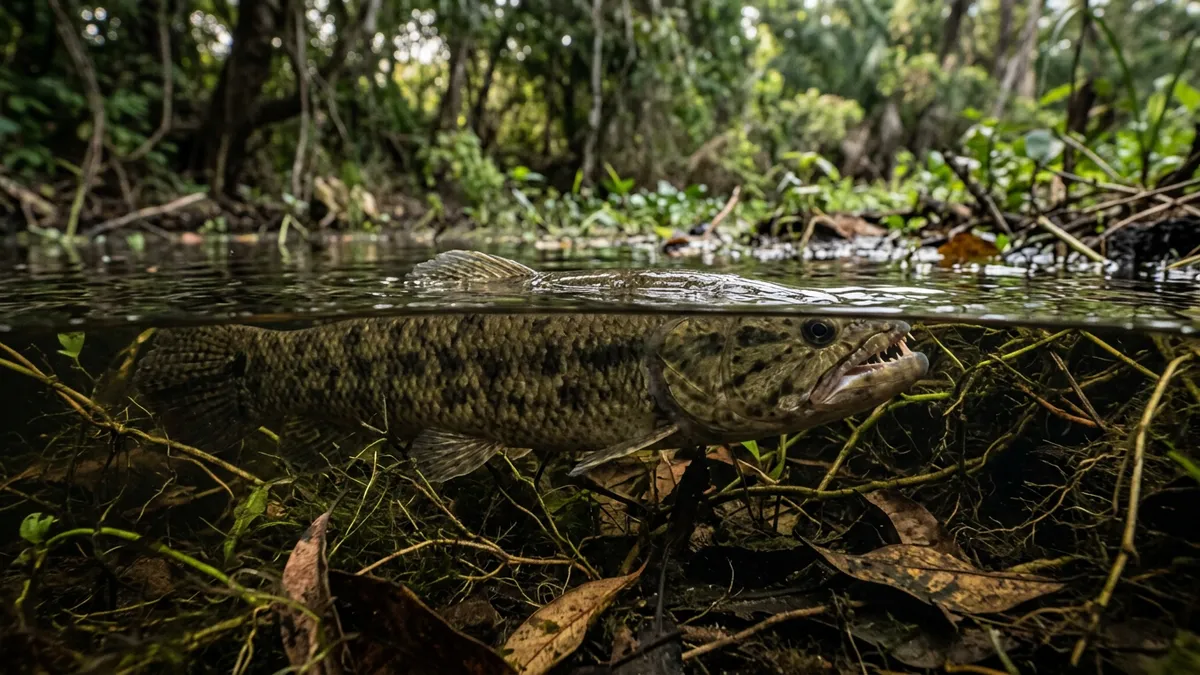
The trahira can supplement the breathing it does with its gills by using the swim bladder as a chamber in contact with air. When the water turns warm, still and poor in oxygen, the fish rises to the surface, gulps air and takes advantage of the swim bladder’s vascularized wall to exchange gases. This mechanism does not turn the trahira into a land animal, but it raises its tolerance for aquatic environments that would be hard for many other fish.
In shallow pools, the same adaptation pairs with an economical way of hunting. The trahira stays motionless among plants, branches or the dark bottom and strikes over a short distance when a fish, a tadpole or another animal passes within reach. A quick bite, backed by conical teeth, cuts the time spent chasing and helps the predator catch food in confined waters, where the lack of oxygen also limits the activity of its prey.
How the trahira makes use of air at the surface
Normal fish breathing takes place in the gills, structures with a large contact area between water and blood. Dissolved oxygen crosses the gill filaments and reaches the circulation, while carbon dioxide travels the opposite way. In a warmed pool, however, the water holds less oxygen. The decay of leaves, algae and other organic material also uses up that gas, especially at night.
Under these conditions the trahira can rise to the surface and take in air through the mouth. The swallowed air reaches the swim bladder, an internal organ normally associated with buoyancy control. Because its wall contains blood vessels, part of the oxygen can cross it and enter the circulation. Air passing through the mouth and being used by the swim bladder together form an accessory form of air breathing, brought into play as needed. The animal still depends on water to live and keeps its gills as an important part of its breathing.
The swim bladder is more than a float
In many bony fish, the swim bladder works as a density regulator. By controlling the amount of gas inside, the fish can stay at a given depth while spending less energy. In the trahira, this organ also takes part in a physiological solution that is useful in environments prone to swings in oxygen. The vascularized wall lets air taken in at the surface come into contact with the blood without the fish having to leave the water.
The benefit depends on conditions in the environment and on the animal’s ability to reach the surface. The trahira has to coordinate swimming, mouth opening and the movement of air, while keeping its body ready to react to a threat or a chance to feed. The adaptation is most useful in still or slow-moving water, where oxygen concentration can fall. It is not full lung breathing, and it is not a physiological license to live out of the water for an indefinite time.
Why shallow water favors an ambush
The trahira tends to use margins, lagoons, marshes, backwaters and other shallow stretches. These places offer cover in submerged vegetation, piled-up leaves, roots and branches. The fish can stay still with its body partly hidden and cut the movements that would give its presence away. Instead of spending energy chasing prey nonstop, it waits for the prey to come within striking range.
Shallow water also makes it easier to reach the surface when dissolved oxygen drops. The trahira alternates between periods of stillness, short moves and trips up to take in air. This mix matters because an ambush demands a brief burst of effort, while staying in a hot, oxygen-poor spot puts limits on activity. By saving movement between one attack and the next, the fish preserves energy without giving up a habitat that may be avoided by competitors that depend more on gill breathing.
Conical teeth and a fast bite finish the attack
The trahira has an elongated body, a robust head and a mouth armed with pointed, cone-shaped teeth. This dentition suits holding slippery prey, such as small fish, and can also be used against other aquatic animals of a compatible size. A conical tooth does not work like a blade for cutting off large pieces. It penetrates and helps keep the prey in place while the mouth closes.
The attack relies more on a short distance and a sudden burst of speed than on a long chase. The trahira detects movement nearby and drives its body forward in a quick lunge, opening and closing the mouth in a very short time. Turbid water, the shade of vegetation and the irregular coloring of its body can make it harder to spot. Once the capture is made, the bite reduces the chance of escape and lets the fish return to cover or eat the prey in a more protected position.
Surviving drought, and caring for the next generation
Temporary pools and flooded areas change quickly. Temperature climbs during the day, the water level drops and the accumulated organic matter can stimulate microorganisms that consume oxygen. In such periods, fish that depend only on dissolved oxygen can suffer before the water disappears. Accessory air breathing gives the trahira a physiological margin to withstand the stress while there is still enough water to protect its body and allow it to feed.
This advantage does not remove the risks of drought. If a pool loses all its water, the trahira does not begin breathing normally on land, because its gills need to stay moist and the body remains adapted to the aquatic environment. The ability to use air should be understood as a response to hypoxic water, meaning water with little dissolved oxygen. It can prolong the stay in an aquatic refuge and raise the chance of reaching another stretch with better conditions, but it does not prevent death when the habitat dries up completely.
The trahira’s relationship with shallow environments is not limited to breathing and hunting. During reproduction, an area is prepared for spawning, usually in a protected spot with relatively calm water. After the eggs are released and fertilized, the adults may stay close and defend the area against intruders, a behavior that reduces predator pressure on the mass of eggs.
Parental protection is especially relevant in shallow water, where the nest can be reachable by other fish and animals that forage on the bottom. The defense does not guarantee the survival of the whole clutch, but it changes the chances of development for embryos and larvae. When the young leave the nest, they join the food web of small predators and, as they grow, become hunters of other aquatic organisms. The same habitat that shelters the adults thus supports different stages of the life cycle.
By combining gills, a vascularized swim bladder, ambush hunting and care for the spawn, the trahira shows that survival depends on several coordinated responses, not on a single trait. It does not beat drought by ignoring it, but by using the interval in which water and air are still available. In each pool, the presence of this fish reveals a quiet negotiation among temperature, oxygen, shelter and food. Watching that balance is a reminder that conserving small bodies of water also means protecting life mechanisms that rarely show up when we look only at large rivers.
Reporting: Natália Santos / Amazonia Mag

Editor · Amazonia Mag
Anne Silva is the editor of Amazonia Mag, the English-language edition of Revista Amazônia. She curates, translates and adapts the outlet's science and environment coverage for an international audience, reporting on Amazon wildlife, flora, rivers, climate and research. Every story she edits is grounded in peer-reviewed studies, official data and on-the-ground reporting from the Revista Amazônia newsroom in Belém, Pará, Brazil. More by Anne Silva →