
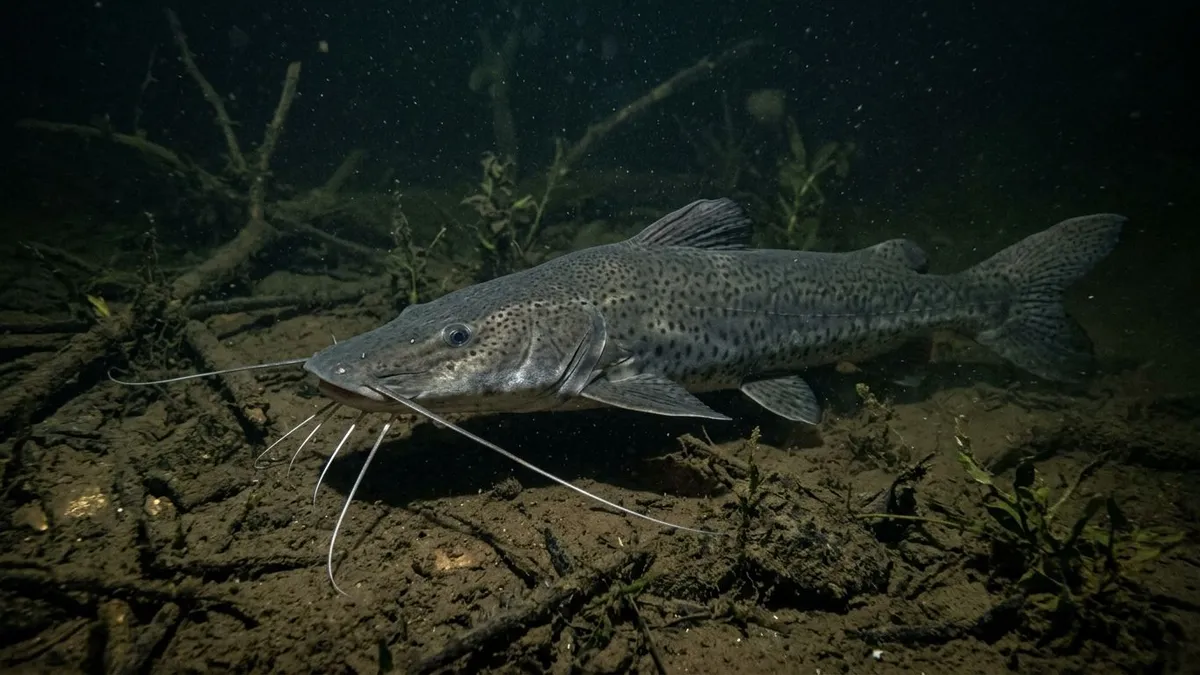
The surubim, known in English as the tiger shovelnose catfish, finds food on river bottoms by using its barbels as taste and touch sensors. These structures, set around the mouth, make contact with the water, the sediment and any possible prey. They help the fish pick up chemical and physical signals when vision loses its edge.
This mechanism fits the species’ nocturnal, bottom-dwelling habits. In dark, murky or turbulent water, the surubim does not need a clear view to explore its surroundings. The sensitivity of the barbels guides the search, while the mouth reaches food close to the riverbed. The same fish also makes a reproductive migration upstream, tying its life on the bottom to the changing course of the river system.
How the barbels pick up signals on the bottom
The surubim’s barbels carry both gustatory and tactile receptors. The taste receptors identify substances dissolved in the water or present on the surface of particles and organisms. Touch sensitivity, in turn, registers contact with sediment, obstacles and possible prey. Together, these senses give the fish a close-range reading of its surroundings, taken while it moves along the bottom.
The barbels do not produce light, and they do not replace every other sense the animal has. They work at short range, near the mouth, where information is most useful for confirming that food is present. A surubim can touch the substrate, notice a change in texture and respond to chemical signals before it captures anything. The search therefore proceeds by approach and contact, not by exclusive reliance on sight.
What the anatomy says about the way it hunts
The surubim’s anatomy is tied to life along the riverbed. Its barbels are positioned to reach the area directly in front of the mouth, exactly where the fish looks for food. Scaleless skin is also a hallmark of this group of fish, setting their body surface apart from species that wear scales as a covering.
That does not mean the skin is left unprotected. It forms the direct interface between the body and the water, while the barbels extend the fish’s ability to sense the space around it. Swimming low, the surubim can keep its sensors in contact with particles and surfaces on the bottom. This anatomy favors continuous exploration, especially when there is too little light to guide a visual hunt.
Why night favors the search for food
The nocturnal habit puts the surubim into action just as natural light fades. At that hour visual cues become less reliable, especially on river bottoms, where sediment can hang in suspension and make the water even less transparent. The taste and touch receptors on the barbels remain useful in these conditions because they depend on contact and on the presence of substances, not on a sharp image.
Bottom-dwelling behavior also narrows the hunt to a specific band of the environment. The fish covers the area close to the bed and uses its barbels to examine whatever lies within reach of the mouth. If a chemical signal points to food, contact helps confirm where it is. The process reduces the need to chase something from a distance and makes the search workable in low-visibility water.
The advantage of combining taste and touch
Placing two kinds of receptor on the same set of structures provides complementary information. Taste helps recognize chemical signals associated with food. Touch reports whether there is prey, a particle or an obstacle in the area being examined. Neither sense has to work alone. The combination lets the surubim move ahead, touch the bottom and adjust its direction according to what it perceives.
This strategy suits a predator that lives in a changeable environment. The water can shift in transparency, the current can displace particles and the sediment can hide organisms. Instead of depending on stable visual conditions, the surubim uses signals available close to its body. The advantage lies in being able to keep exploring the bottom when vision offers little information for locating food right away.
From the riverbed to the headwaters
By searching for food on the bottom, the surubim takes part in the relationships among the organisms that live in or pass through the riverbed zone. Its barbels are the sensory bridge between the fish and that environment. Each contact with the sediment can provide information about the presence of food or about the structure of the place, without the animal having to leave the band where it usually moves.
Night hunting also spreads the fish’s activity across the river’s daily cycle. After dark, the surubim explores a low-light scene with senses that operate close to the body. This behavior places it in interaction with prey and with other animals that occupy the bottom at that time. The result is a direct part in the river’s food dynamics, built on chemical signals, contact and movement along the substrate.
The surubim is not confined to the spot where it hunts day to day. In the breeding season it migrates upstream. This movement adds a second dimension to its way of life, since the fish alternates between exploring the bottom and traveling along the river channel toward areas associated with reproduction.
The migration shows that the surubim’s environment has to be understood as a connected system. The animal depends on the features of the bottom to feed, but also on the continuous flow of the river to complete its reproductive cycle. Barbels, scaleless skin, nocturnal activity and upstream travel form a set of adaptations and behaviors linked to the same environment. Looking at any one of them helps show how the fish uses different parts of the river system over its life.
The surubim makes visible a rule of aquatic life that often goes unnoticed. When the water darkens and the bottom no longer offers clear images, life does not stop. It only changes the language used to find food. For this fish, dissolved substances, textures and close contacts replace the security of a wide view. Its barbels are a reminder that knowing a river also depends on perceiving what happens next to the sediment, where many ecological processes begin before they ever show at the surface.
Reporting: Natália Santos / Amazonia Mag

Editor · Amazonia Mag
Anne Silva is the editor of Amazonia Mag, the English-language edition of Revista Amazônia. She curates, translates and adapts the outlet's science and environment coverage for an international audience, reporting on Amazon wildlife, flora, rivers, climate and research. Every story she edits is grounded in peer-reviewed studies, official data and on-the-ground reporting from the Revista Amazônia newsroom in Belém, Pará, Brazil. More by Anne Silva →