
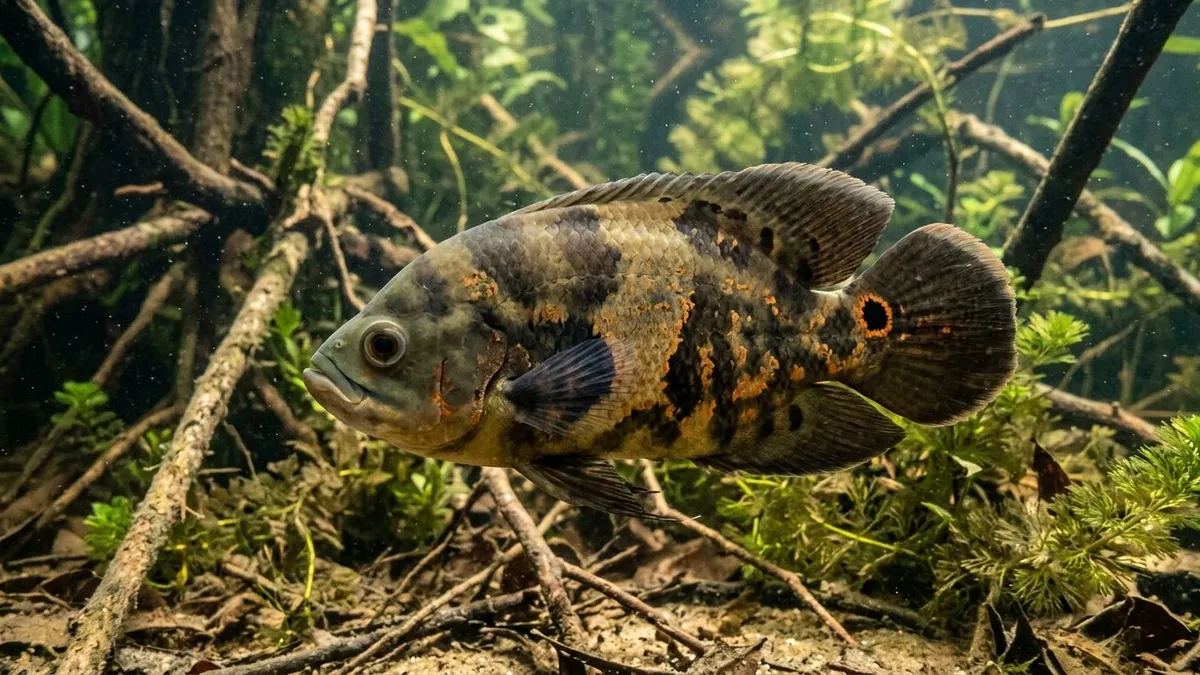
When a predator closes in from behind, the oscar (Astronotus ocellatus), known in Brazil as apaiari, shows a rounded mark on its tail that looks like a second eye. The pattern is called a caudal ocellus, and it sits where it can change the point an attacker aims at. Instead of striking the head, a lunge may be drawn toward the rear of the body, where the fish has a better chance of getting away.
The mark is not a real eye. It does not form images and it does not replace the true eyes on the head. It works as a visual signal inside a defensive strategy that also depends on movement, distance and the behavior of the predator.
A false eye on the tail of a South American cichlid
The oscar is a freshwater cichlid tied to the Amazon basin and to other South American waters. Its robust body, wide mouth and fins let it maneuver in water full of vegetation, branches and submerged structures. The ocellus can be more or less obvious depending on the light, the position of the fish and the state of its coloration, so it is not a fixed painting with the same contrast in every situation.
That variability matters. The combination of a tail spot and the ability to change the pattern of the whole body makes the visual communication of this fish more complex than the simple image of a false eye suggests. The tail mark is one signal among several that the animal can show, and what it displays depends on the moment.
A pair that stays with the school of fry
After reproduction, the oscar does not abandon its offspring right away. The pair stays close to the eggs and the young, follows their movements and reacts to fish that approach and may pose a risk. When the young begin to move around together, the group forms a compact school, normally kept under the watch of the adults.
This behavior reduces the dispersal of the fry and lets the parents concentrate their defense on a smaller area. The school also creates a group effect: many individuals move at the same time, which makes it harder for a predator to single out one young fish.
Parental care includes defending the site, leading the young and keeping the juveniles close to one another. The adults can charge at intruders, change their position in relation to the brood and use visual signals from their bodies during a confrontation. Protection does not mean that every young fish survives. The environment still offers predators, changes in current, a lack of shelter and competition for food. What the behavior shows is a division of reproductive tasks that lasts longer than in many other fish. In the oscar, the presence of the pair adds a layer of protection at exactly the stage when the young are least able to escape on their own.
Color that changes when the fish is on alert
The coloration of the oscar can change quickly when the fish moves from rest to a state of alert. The body may gain contrast, darken or bring out bands and regions that looked less marked before. These changes are tied to the control of pigment cells in the skin, the chromatophores, which redistribute pigments and alter the outward appearance.
The process is not an instant switch to any color, and it does not happen in exactly the same way in every individual. Age, lighting, background, physical condition and social context also influence the pattern that is seen.
In a territorial dispute, the body contrast can go together with threat postures, side-on approaches, spread fins and display movements. The fish uses this set of actions to signal that it is alert and intends to keep a rival at a distance. Even so, color should not be read as a human feeling translated into pigment. When people say that the oscar changes color with its mood, the popular phrase sums up physiological and behavioral states such as alertness, social stress and defense of territory. What is known is the rapid change of the visual pattern in response to context, not a precise reading of emotions such as joy or irritation.
What the false eye can and cannot do
The false eye on the tail does not guarantee that every attack will be turned aside. The effectiveness of the mark depends on the angle of approach, the distance, the clarity of the water and the predator’s ability to recognize the signal. The most widely accepted functional hypothesis is that the ocellus confuses an attacker or redirects the strike toward the rear of the body, but different predators may respond in different ways. In some cases the spot may also make the head harder to identify or offer an advantage during an escape. The presence of the pattern alone does not allow anyone to say that the oscar always fools its attacker, or that the trait evolved for a single reason.
The pair’s care has limits as well. Adults defend their young, but they cannot control every threat. The school protects through concentration and vigilance, yet it does not prevent losses. In the same way, a change of color can signal alert or conflict without proving any specific emotional experience. These cautions matter because the oscar combines traits that sound like stories but belong to observable biological mechanisms. The account comes from the accumulated zoological knowledge about Astronotus ocellatus, a species scientifically described in 1831.
The oscar in the Amazon and beyond
In the Amazon, understanding these mechanisms helps people look at fish beyond their role as food or as animals kept in aquariums. The oscar takes part in relationships among predators, competitors and young, and its marks and color changes turn its own body into a signal. Its Brazilian connection lies in its South American origin and in the populations associated with Amazonian waters, where shelter, visibility and the makeup of the fish community shape each response of the animal.
The species has also been introduced to regions outside its natural range, where its presence may call for a local ecological assessment. That does not justify generalizations about every environment, and it does not mean that every introduced population has the same effect.
The result is a sequence of solutions that work together. The caudal ocellus can draw a predator’s attention away from the head, the pair keeps the young gathered, and the color change makes a state of alert more visible to rivals and to other fish. None of these resources acts alone or offers absolute protection. They gain value because they answer different moments in the animal’s life, from individual defense to reproduction and the contest for space. Watching the oscar is a reminder that, in an environment of rapid signals, survival also depends on controlling what the body communicates.
Reporting: Natália Santos / Amazonia Mag

Editor · Amazonia Mag
Anne Silva is the editor of Amazonia Mag, the English-language edition of Revista Amazônia. She curates, translates and adapts the outlet's science and environment coverage for an international audience, reporting on Amazon wildlife, flora, rivers, climate and research. Every story she edits is grounded in peer-reviewed studies, official data and on-the-ground reporting from the Revista Amazônia newsroom in Belém, Pará, Brazil. More by Anne Silva →